
磁粒子成像中的信号编码:系统函数的特性
Signal encoding in magnetic particle imaging: properties of the system function.
作者信息
Rahmer Jürgen, Weizenecker Jürgen, Gleich Bernhard, Borgert Jörn
机构信息
Philips Research Europe - Hamburg, Röntgenstrasse 24-26, 22335 Hamburg, Germany.
出版信息
BMC Med Imaging. 2009 Apr 1;9:4. doi: 10.1186/1471-2342-9-4.
BACKGROUND
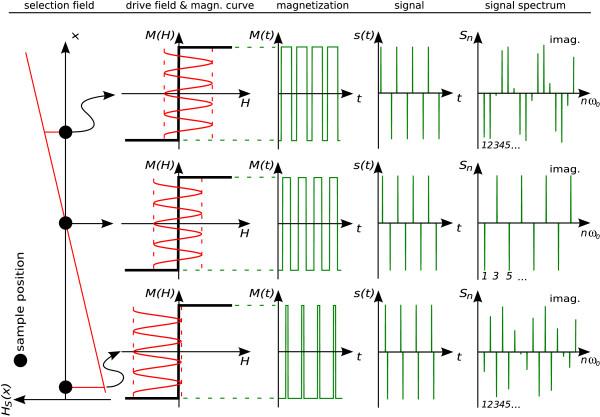
Magnetic particle imaging (MPI) is a new tomographic imaging technique capable of imaging magnetic tracer material at high temporal and spatial resolution. Image reconstruction requires solving a system of linear equations, which is characterized by a "system function" that establishes the relation between spatial tracer position and frequency response. This paper for the first time reports on the structure and properties of the MPI system function.
METHODS
An analytical derivation of the 1D MPI system function exhibits its explicit dependence on encoding field parameters and tracer properties. Simulations are used to derive properties of the 2D and 3D system function.
RESULTS
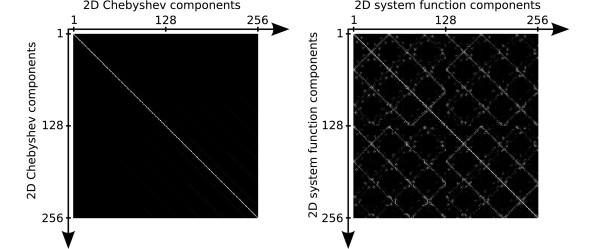
It is found that for ideal tracer particles in a harmonic excitation field and constant selection field gradient, the 1D system function can be represented by Chebyshev polynomials of the second kind. Exact 1D image reconstruction can thus be performed using the Chebyshev transform. More realistic particle magnetization curves can be treated as a convolution of the derivative of the magnetization curve with the Chebyshev functions. For 2D and 3D imaging, it is found that Lissajous excitation trajectories lead to system functions that are closely related to tensor products of Chebyshev functions.
CONCLUSION
Since to date, the MPI system function has to be measured in time-consuming calibration scans, the additional information derived here can be used to reduce the amount of information to be acquired experimentally and can hence speed up system function acquisition. Furthermore, redundancies found in the system function can be removed to arrive at sparser representations that reduce memory load and allow faster image reconstruction.
背景
磁粒子成像(MPI)是一种新的断层成像技术,能够以高时间和空间分辨率对磁示踪材料进行成像。图像重建需要求解一个线性方程组,该方程组的特征是一个“系统函数”,它建立了空间示踪剂位置与频率响应之间的关系。本文首次报道了MPI系统函数的结构和特性。
方法
对一维MPI系统函数进行解析推导,揭示了其对编码场参数和示踪剂特性的明确依赖性。利用模拟来推导二维和三维系统函数的特性。
结果
发现在谐波激励场和恒定选择场梯度下,对于理想的示踪粒子,一维系统函数可以用第二类切比雪夫多项式表示。因此,可以使用切比雪夫变换进行精确的一维图像重建。更实际的粒子磁化曲线可以看作是磁化曲线导数与切比雪夫函数的卷积。对于二维和三维成像,发现李萨如激励轨迹导致的系统函数与切比雪夫函数的张量积密切相关。
结论
由于迄今为止,MPI系统函数必须通过耗时的校准扫描来测量,这里导出的额外信息可用于减少实验中需要获取的信息量,从而加快系统函数的获取。此外,可以消除系统函数中发现的冗余,以得到更稀疏的表示,从而减少内存负载并加快图像重建。





 Zotero 插件