Moore Fabrice, Colli Maikel L, Cnop Miriam, Esteve Mariana Igoillo, Cardozo Alessandra K, Cunha Daniel A, Bugliani Marco, Marchetti Piero, Eizirik Décio L
Laboratory of Experimental Medicine, Université Libre de Bruxelles, Brussels, Belgium.
Diabetes. 2009 Jun;58(6):1283-91. doi: 10.2337/db08-1510. Epub 2009 Mar 31.
The pathogenesis of type 1 diabetes has a strong genetic component. Genome-wide association scans recently identified novel susceptibility genes including the phosphatases PTPN22 and PTPN2. We hypothesized that PTPN2 plays a direct role in beta-cell demise and assessed PTPN2 expression in human islets and rat primary and clonal beta-cells, besides evaluating its role in cytokine-induced signaling and beta-cell apoptosis.
PTPN2 mRNA and protein expression was evaluated by real-time PCR and Western blot. Small interfering (si)RNAs were used to inhibit the expression of PTPN2 and downstream STAT1 in beta-cells, allowing the assessment of cell death after cytokine treatment.
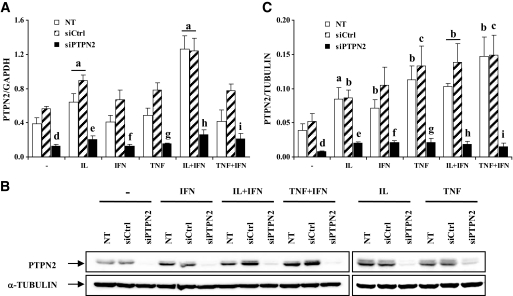
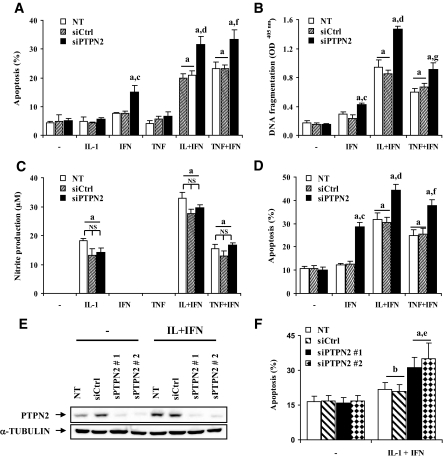
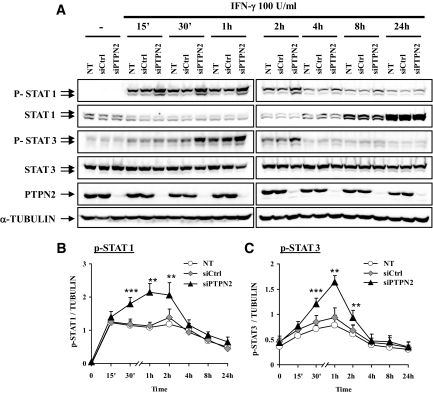
PTPN2 mRNA and protein are expressed in human islets and rat beta-cells and upregulated by cytokines. Transfection with PTPN2 siRNAs inhibited basal- and cytokine-induced PTPN2 expression in rat beta-cells and dispersed human islets cells. Decreased PTPN2 expression exacerbated interleukin (IL)-1beta + interferon (IFN)-gamma-induced beta-cell apoptosis and turned IFN-gamma alone into a proapoptotic signal. Inhibition of PTPN2 amplified IFN-gamma-induced STAT1 phosphorylation, whereas double knockdown of both PTPN2 and STAT1 protected beta-cells against cytokine-induced apoptosis, suggesting that STAT1 hyperactivation is responsible for the aggravation of cytokine-induced beta-cell death in PTPN2-deficient cells.
We identified a functional role for the type 1 diabetes candidate gene PTPN2 in modulating IFN-gamma signal transduction at the beta-cell level. PTPN2 regulates cytokine-induced apoptosis and may thereby contribute to the pathogenesis of type 1 diabetes.
1型糖尿病的发病机制有很强的遗传因素。全基因组关联扫描最近发现了包括蛋白酪氨酸磷酸酶N22(PTPN22)和蛋白酪氨酸磷酸酶N2(PTPN2)在内的新的易感基因。我们推测PTPN2在β细胞死亡中起直接作用,并评估了PTPN2在人胰岛、大鼠原代和克隆β细胞中的表达,此外还评估了其在细胞因子诱导的信号传导和β细胞凋亡中的作用。
通过实时PCR和蛋白质印迹法评估PTPN2 mRNA和蛋白的表达。使用小干扰(si)RNA抑制β细胞中PTPN2和下游信号转导子和转录激活子1(STAT1)的表达,从而评估细胞因子处理后的细胞死亡情况。
PTPN2 mRNA和蛋白在人胰岛和大鼠β细胞中表达,并被细胞因子上调。用PTPN2 siRNA转染可抑制大鼠β细胞和分散的人胰岛细胞中基础和细胞因子诱导的PTPN2表达。PTPN2表达降低加剧了白细胞介素(IL)-1β+干扰素(IFN)-γ诱导的β细胞凋亡,并使单独的IFN-γ变成促凋亡信号。抑制PTPN2可增强IFN-γ诱导的STAT1磷酸化,而同时敲低PTPN2和STAT1可保护β细胞免受细胞因子诱导的凋亡,这表明STAT1过度激活是PTPN2缺陷细胞中细胞因子诱导的β细胞死亡加剧的原因。
我们确定了1型糖尿病候选基因PTPN2在β细胞水平调节IFN-γ信号转导中的功能作用。PTPN2调节细胞因子诱导的凋亡,可能因此参与1型糖尿病的发病机制。