Department of Experimental Psychology, University of Oxford, Oxford, UK.
Int J Lang Commun Disord. 2009 Jul-Aug;44(4):489-510. doi: 10.1080/13682820802708080.
Developmental language disorder is a heterogeneous diagnostic category. Little research has compared the long-term outcomes of children with different subtypes of language impairment.
To determine whether the pattern of language impairment in childhood related to language and literacy outcomes in adulthood.
METHODS & PROCEDURES: Adults who took part in previous studies as children were traced. There were four groups of participants, each with a different childhood diagnosis: specific language impairment (SLI; n = 19, mean age at follow-up = 24;8), pragmatic language impairment (PLI; n = 7, mean age at follow-up = 22;3), autism spectrum disorder (ASD; n = 11; mean age at follow-up = 21;9), and no childhood diagnosis (typical; n = 12; mean age at follow-up = 21;6). Participants were administered a battery of language and literacy tests.
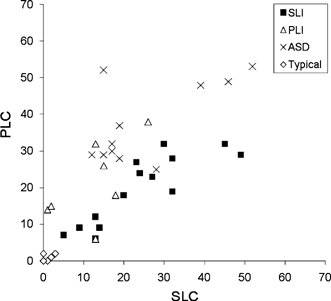
OUTCOMES & RESULTS: Adults with a history of SLI had persisting language impairment as well as considerable literacy difficulties. Pragmatic deficits also appeared to develop over time in these individuals. The PLI group had enduring difficulties with language use, but presented with relatively intact language and literacy skills. Although there were some similarities in the language profile of the PLI and ASD groups, the ASD group was found to have more severe pragmatic deficits and parent-reported linguistic difficulties in conversational speech.
CONCLUSIONS & IMPLICATIONS: The pattern of deficits observed in different subtypes of developmental language disorder persists into adulthood. The findings highlight the importance of a wide-ranging clinical assessment in childhood, which may provide an indication of outcome in adulthood.
发育性语言障碍是一个异质的诊断类别。很少有研究比较过具有不同语言损伤亚型的儿童的长期预后。
确定儿童时期的语言损伤模式与成年后的语言和读写能力结果之间的关系。
追踪了以前作为儿童参加过研究的成年人。有四组参与者,每组都有不同的儿童诊断:特定语言损伤(SLI;n=19,随访时的平均年龄=24;8)、语用语言损伤(PLI;n=7,随访时的平均年龄=22;3)、自闭症谱系障碍(ASD;n=11,随访时的平均年龄=21;9)和无儿童诊断(典型;n=12,随访时的平均年龄=21;6)。参与者接受了一系列语言和读写测试。
有 SLI 病史的成年人仍然存在语言障碍,并且存在相当大的读写困难。在这些个体中,语用缺陷似乎也随着时间的推移而发展。PLI 组的语言使用持续存在困难,但语言和读写能力相对完整。尽管 PLI 和 ASD 组的语言模式存在一些相似之处,但 ASD 组在会话言语中表现出更严重的语用缺陷和父母报告的语言困难。
研究发现强调了在儿童时期进行广泛的临床评估的重要性,这可能为成年后的结果提供指示。