Harun-Or-Rashid M, Khatun Uh Farida, Yoshida Yoshitoku, Morita Satoshi, Chowdhury Nuruddin, Sakamoto Junichi
Department of Healthcare Administration, Nagoya University Graduate School of Medicine, Nagoya 466-8550, Japan.
Nagoya J Med Sci. 2009 Feb;71(1-2):39-49.
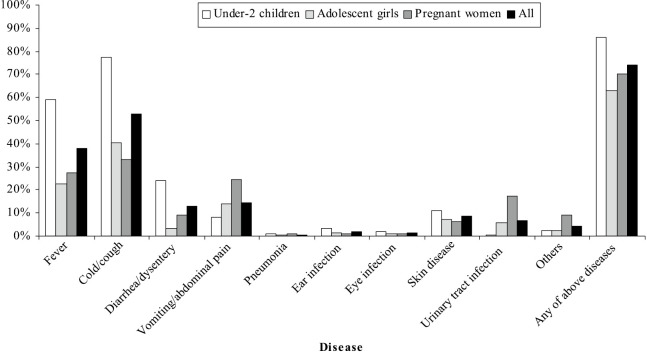
We examined the frequency of iron and iodine deficiencies and associations of iron and iodine deficiencies with common diseases among under-2 children, adolescent girls, and pregnant women of Bangladesh. We assayed the blood hemoglobin concentration in 395 under-2 children, 355 adolescent girls, and 263 pregnant women, the urinary iodine concentration of those adolescent girls and pregnant women, and the iodine level of all household salt specimens. The history of common diseases within their previous 2 weeks were also obtained from recall to explore the associations of iron and iodine deficiencies with common diseases. Anemia was found in 49.1% of children, 24.8% of adolescent girls, and 44.4% of pregnant women using defined cut-off values (Hb < 11.0 g/dL for under-2 children and pregnant women; <12.0 g/dL for adolescent girls). Prevalence of iodine deficiencies (urinary iodine <100 microg/L) was 38.4% in adolescent girls and 39.4% in pregnant women, and 39.4% of salt specimens had inadequate iodine (<15 ppm). The relative risk (RR) and 95% confidence intervals (CI) were estimated and adjusted for age, sex, and gestational age to explore the associations of iron and iodine deficiencies with common diseases. The RR of anemia was increased for fever (RR = 1.7, 95% CI = 1.3-2.3), ear infection (RR = 3.4, 95% CI = 1.3-8.5), skin disease (RR = 1.4, 95% CI = 0.9-2.2), and pneumonia (RR = 3.7, 95% CI = 0.7-19.5). The RR of iodine deficiency was elevated for diarrhea/dysentery (RR = 2.2, 95% CI = 1.1l-4.4) and eye infection (RR = 2.1, 95% CI = 0.5-9.4). We concluded that iron and iodine deficiencies are quite high among the Bangladeshi population. Observed associations of iron and iodine deficiencies with common diseases indicated the necessity of eliminating iron and iodine deficiencies from this vulnerable population through strengthening of iron and iodine supplementation, in order to prevent diseases and promote health conditions.
我们调查了孟加拉国2岁以下儿童、青春期女孩和孕妇中铁缺乏和碘缺乏的发生率,以及铁缺乏和碘缺乏与常见疾病之间的关联。我们检测了395名2岁以下儿童、355名青春期女孩和263名孕妇的血血红蛋白浓度,这些青春期女孩和孕妇的尿碘浓度,以及所有家庭盐样本的碘含量。还通过回忆获取了他们过去2周内常见疾病的病史,以探究铁缺乏和碘缺乏与常见疾病之间的关联。按照既定的临界值(2岁以下儿童和孕妇血红蛋白<11.0 g/dL;青春期女孩<12.0 g/dL),发现49.1%的儿童、24.8%的青春期女孩和44.4%的孕妇患有贫血。青春期女孩碘缺乏(尿碘<100μg/L)的患病率为38.4%,孕妇为39.4%,39.4%的盐样本碘含量不足(<15 ppm)。估计了相对风险(RR)和95%置信区间(CI),并对年龄、性别和孕周进行了调整,以探究铁缺乏和碘缺乏与常见疾病之间的关联。发热(RR = 1.7,95% CI = 1.3 - 2.3)、耳部感染(RR = 3.4,95% CI = 1.3 - 8.5)、皮肤病(RR = 1.4,95% CI = 0.9 - 2.2)和肺炎(RR = 3.7,95% CI = 0.7 - 19.5)时贫血的RR增加。腹泻/痢疾(RR = 2.2,95% CI = 1.1 - 4.4)和眼部感染(RR = 2.1,95% CI = 0.5 - 9.4)时碘缺乏的RR升高。我们得出结论,孟加拉国人群中铁缺乏和碘缺乏的情况相当严重。观察到的铁缺乏和碘缺乏与常见疾病之间的关联表明,有必要通过加强铁和碘的补充,从这个弱势群体中消除铁缺乏和碘缺乏,以预防疾病并改善健康状况。