Munro S
MRC Laboratory of Molecular Biology, Cambridge, UK.
EMBO J. 1991 Dec;10(12):3577-88. doi: 10.1002/j.1460-2075.1991.tb04924.x.
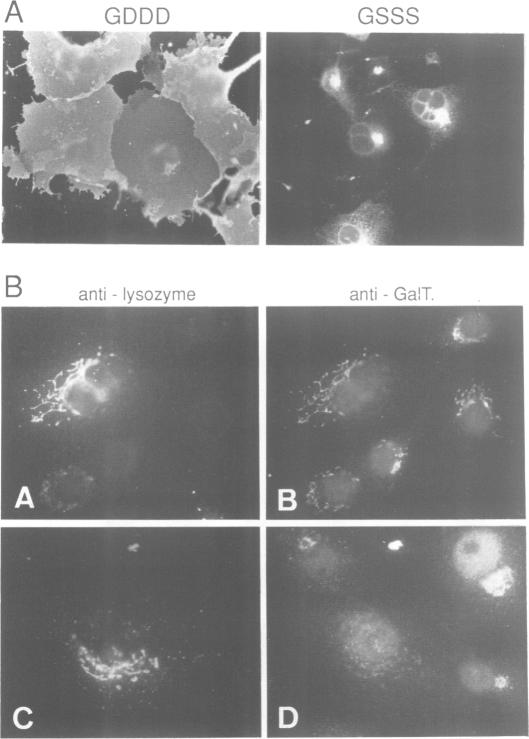
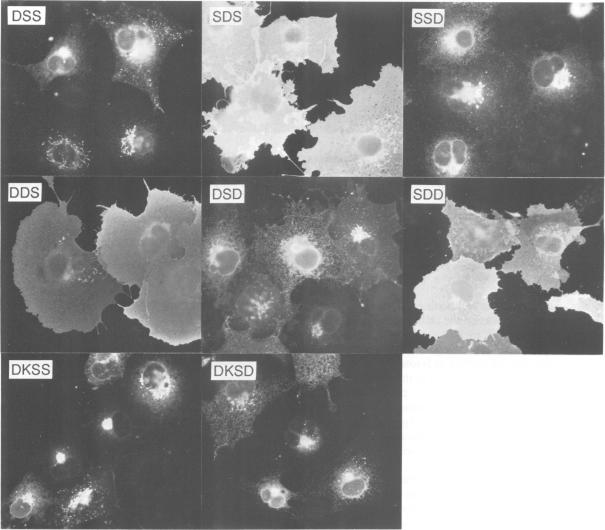
The glycosyltransferase alpha-2,6-sialyltransferase (ST) is a Type II membrane protein localized to the Golgi apparatus. The first 44 amino acids of this protein were able to specify Golgi retention of a fused marker protein, lysozyme. This section of ST contains a transmembrane segment which serves as a non-cleaved signal anchor. When lysozyme was fused to an equivalent region of a cell surface protein it now appeared on the cell surface. Analysis of chimeras between the two proteins revealed that the transmembrane segment of ST specifies Golgi retention. Furthermore, altering this segment in full-length ST results in the protein accumulating on the cell surface. However, the retaining effect of the transmembrane domain of ST is augmented by the presence of adjacent lumenal and cytoplasmic sequences from ST. If these sequences are spaced apart by a transmembrane domain of the same length as that of ST they too can specify Golgi retention. Thus retention in the Golgi of ST appears to involve recognition of an extended region of the protein within and on both sides of the bilayer.
糖基转移酶α-2,6-唾液酸转移酶(ST)是一种定位于高尔基体的II型膜蛋白。该蛋白的前44个氨基酸能够确定融合标记蛋白溶菌酶在高尔基体中的保留。ST的这一部分包含一个跨膜片段,其作为一个不被切割的信号锚定序列。当溶菌酶与细胞表面蛋白的等效区域融合时,它现在出现在细胞表面。对这两种蛋白之间的嵌合体分析表明,ST的跨膜片段决定了高尔基体中的保留。此外,改变全长ST中的这一片段会导致该蛋白在细胞表面积累。然而,ST跨膜结构域的保留作用会因ST相邻的腔内和细胞质序列的存在而增强。如果这些序列被与ST相同长度的跨膜结构域隔开,它们也能决定高尔基体中的保留。因此,ST在高尔基体中的保留似乎涉及对双层膜内及两侧蛋白延伸区域的识别。