Eriksson Margareta K, Franks Paul W, Eliasson Mats
Björknäs Primary Health Care Centre, Boden, Sweden.
PLoS One. 2009;4(4):e5195. doi: 10.1371/journal.pone.0005195. Epub 2009 Apr 14.
Successfully transferring the findings of expensive and tightly controlled programmes of intensive lifestyle modification to the primary care setting is necessary if such knowledge is to be of clinical utility. The objective of this study was to test whether intensive lifestyle modification, shown previously in tightly-controlled clinical trials to be efficacious for diabetes risk-reduction among high-risk individuals, can reduce cardiovascular risk factor levels in the primary care setting.
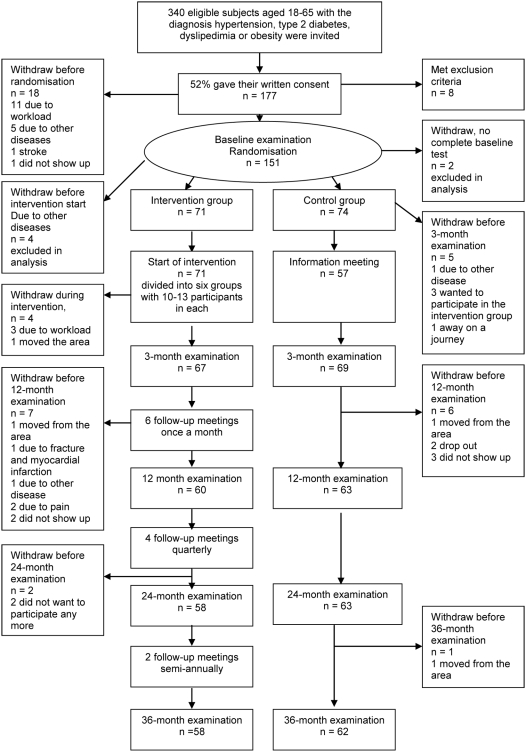
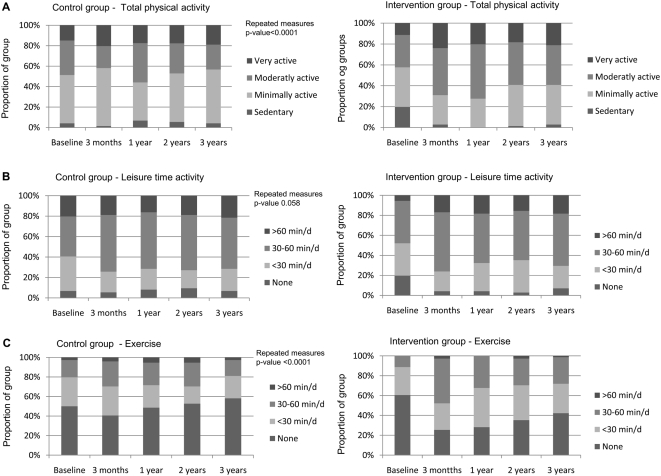
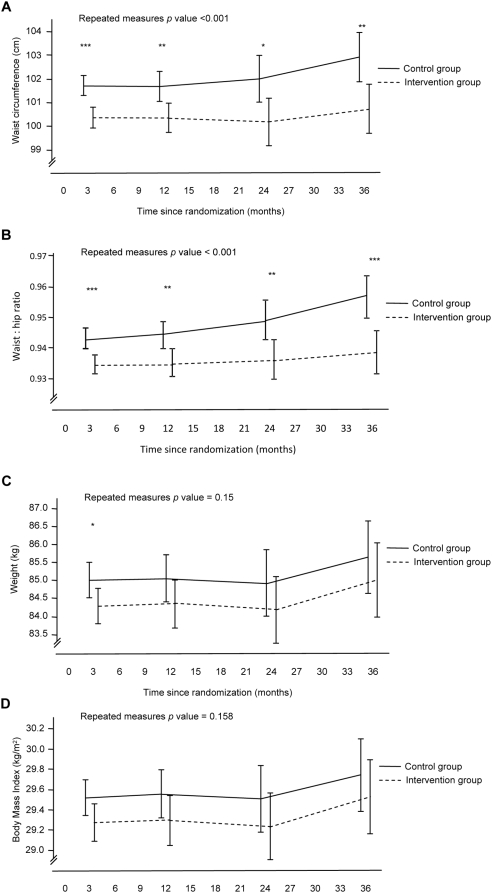
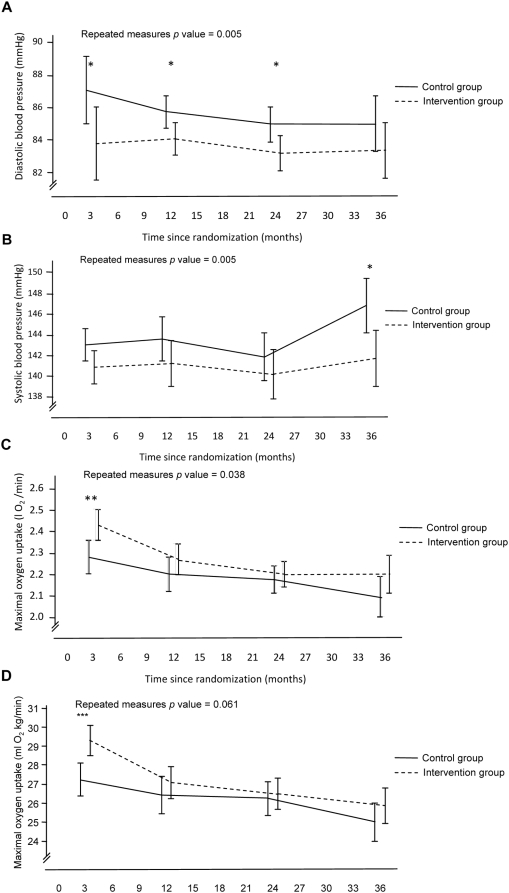
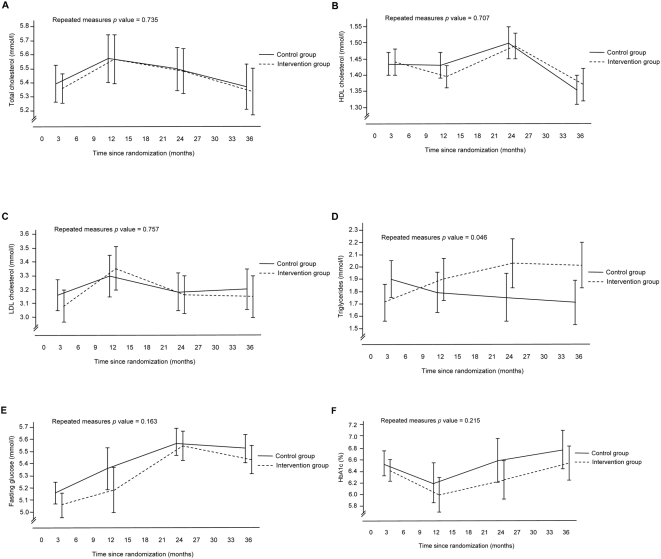
METHODOLOGY / PRINCIPAL FINDINGS: The Swedish Björknäs study was a randomized controlled trial conducted from 2003 to 2006 with follow-up on cardiovascular risk factors at 3, 12, 24 and 36 months. A total of 151 middle-aged men and women at moderate- to high-risk of cardiovascular disease from northern Sweden were randomly assigned to either an intensive lifestyle intervention (n = 75) or control (n = 76) group. The intervention was based broadly on the protocol of the Diabetes Prevention Program. The three-month intervention period was administered in the primary care setting and consisted of supervised exercise sessions and diet counselling, followed by regular group meetings during three years. The control group was given general advice about diet and exercise and received standard clinical care. Outcomes were changes in anthropometrics, aerobic fitness, self-reported physical activity, blood pressure, and metabolic traits. At 36 months post-randomisation, intensive lifestyle modification reduced waist circumference (-2.2 cm: p = 0.001), waist-hip ratio (-0.02: p<0.0001), systolic blood pressure (-4.9 mmHg: p = 0.036), and diastolic blood pressure (-1.6 mmHg: p = 0.005), and improved aerobic fitness (5%; p = 0.038). Changes in lipid or glucose values did not differ statistically between groups. At 36 months, self-reported time spent exercising and total physical activity had increased more in the intervention group than in the control group (p<0.001).
CONCLUSION / SIGNIFICANCE: A program of intensive lifestyle modification undertaken in the primary health care setting can favourably influence cardiovascular risk-factor profiles in high-risk individuals.
ClinicalTrials.gov NCT00486941.
如果要使此类知识具有临床实用性,那么将昂贵且严格控制的强化生活方式改变计划的研究结果成功转化到初级保健环境中是很有必要的。本研究的目的是测试先前在严格控制的临床试验中显示对高危个体降低糖尿病风险有效的强化生活方式改变,是否能在初级保健环境中降低心血管危险因素水平。
方法/主要发现:瑞典比约克内斯研究是一项于2003年至2006年进行的随机对照试验,在3个月、12个月、24个月和36个月时对心血管危险因素进行随访。共有151名来自瑞典北部、心血管疾病中度至高度风险的中年男性和女性被随机分配到强化生活方式干预组(n = 75)或对照组(n = 76)。干预大致基于糖尿病预防计划的方案。为期三个月的干预期在初级保健环境中进行,包括监督下的锻炼课程和饮食咨询,随后在三年期间定期举行小组会议。对照组接受关于饮食和锻炼的一般建议并接受标准临床护理。结果指标包括人体测量学、有氧适能、自我报告的身体活动、血压和代谢特征的变化。随机分组后36个月时,强化生活方式改变使腰围减少(-2.2厘米:p = 0.001)、腰臀比降低(-0.02:p<0.0001)、收缩压降低(-4.9毫米汞柱:p = 0.036)、舒张压降低(-1.6毫米汞柱:p = 0.005),并改善了有氧适能(5%;p = 0.038)。两组间血脂或血糖值的变化无统计学差异。36个月时,干预组自我报告的锻炼时间和总身体活动增加幅度大于对照组(p<0.001)。
结论/意义:在初级卫生保健环境中开展的强化生活方式改变计划可对高危个体的心血管危险因素状况产生有利影响。
ClinicalTrials.gov NCT00486941 。