Center for Clinical Research, County of Västmanland, Uppsala University, Västerås, Sweden.
Department of Public Health and Caring Sciences, Family Medicine and Preventive Medicine, Uppsala University, Uppsala, Sweden.
Ups J Med Sci. 2020 Aug;125(3):250-256. doi: 10.1080/03009734.2020.1726533. Epub 2020 Feb 20.
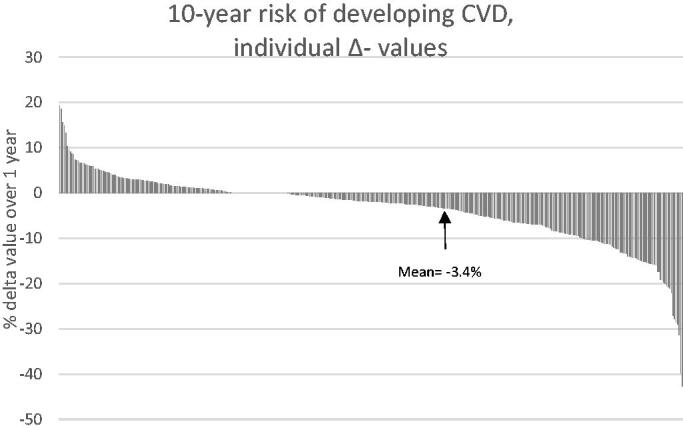
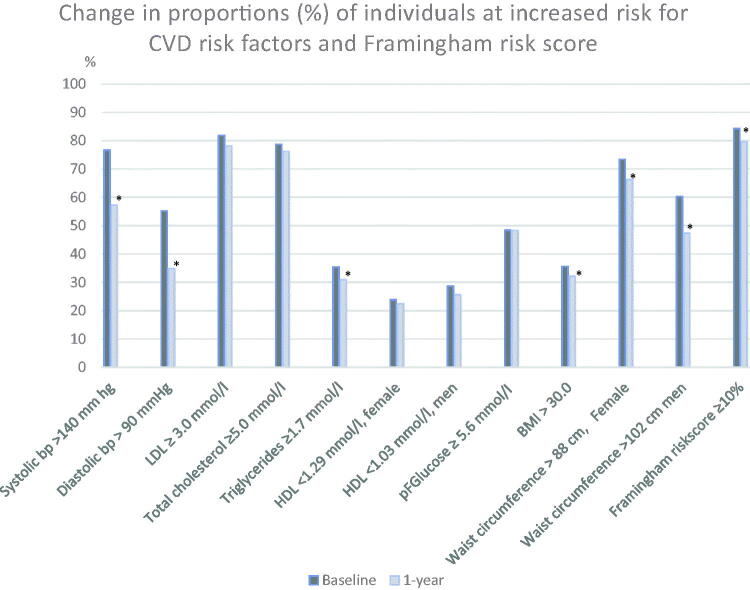
Despite well-known preventive effects for future cardiovascular disease (CVD) risk through lifestyle changes, scientific evaluations of lifestyle programmes in primary care are scarce. Moreover, structured lifestyle counselling is still not integrated in everyday clinical practice. We aimed to evaluate change in cardiovascular risk factors and Framingham 10-year risk score of developing CVD in men and women at high cardiovascular risk after participation in a structured lifestyle programme over 1 year. A single-group study was carried out with a 1-year follow-up including before and after measurements. The lifestyle programme comprised five appointments to a district nurse over 1 year, focussing on lifestyle habits based on motivational interviewing. Fasting blood samples and anthropometric measurements were obtained at baseline and 1-year follow-up. The 10-year risk of CVD was calculated according to Framingham general CVD risk score. A total of 404 patients were included in the study. There was a positive change over 1 year in the total study population for all risk factors evaluated. This included improvements in weight, waist circumference, blood pressure, blood lipids, and fasting glucose. The 10-year risk of developing CVD decreased for the total population from 24.8% to 21.4% at 1 year, equivalent to a 14% decrease. A structured lifestyle programme in primary care contributes to significant improvements of cardiovascular risk factors and the reduction of 10-year risk for CVD for both men and women at high cardiovascular risk.
尽管通过生活方式改变可以显著降低未来心血管疾病(CVD)的风险,但针对初级保健中生活方式计划的科学评估却很少。此外,结构化的生活方式咨询仍然没有融入日常临床实践中。我们旨在评估在高心血管风险的男性和女性参与结构化生活方式计划 1 年后,心血管风险因素和Framingham 10 年 CVD 发病风险评分的变化。这是一项单组研究,随访时间为 1 年,包括前后测量。生活方式计划包括 1 年内 5 次预约区护士,重点关注基于动机访谈的生活习惯。在基线和 1 年随访时采集空腹血样和人体测量学测量值。根据Framingham 一般 CVD 风险评分计算 10 年 CVD 风险。共有 404 名患者纳入研究。在 1 年内,所有评估的风险因素在整个研究人群中均有积极变化。这包括体重、腰围、血压、血脂和空腹血糖的改善。1 年内,总体人群的 CVD 发病 10 年风险从 24.8%降至 21.4%,相当于降低了 14%。初级保健中的结构化生活方式计划有助于显著改善心血管风险因素,并降低高心血管风险男性和女性的 CVD 发病 10 年风险。