Institut National de Santé Publique du Québec/Direction de Santé Publique de Montréal, Montréal, Québec H2L 1M3, Canada.
J Epidemiol Community Health. 2009 Aug;63(8):659-64. doi: 10.1136/jech.2008.078147. Epub 2009 Apr 14.
Little attention has been paid to how heat-related health effects vary with the micro-urban variation of outdoor temperatures. This study explored whether people located in micro-urban heat islands are at higher risk of mortality during hot summer days.
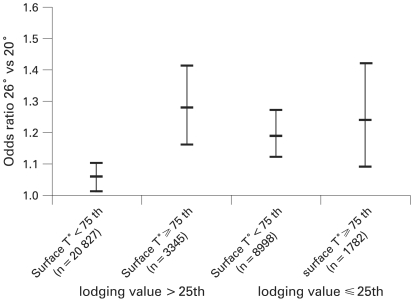
Data used included (1) daily mortality for Montreal (Canada) for June-August 1990-2003, (2) daily mean ambient outdoor temperatures at the local international airport and (3) two thermal surface images (Landsat satellites, infrared wavelengths). A city-wide temperature versus daily mortality function was established on the basis of a case-crossover design; this function was stratified according to the surface temperature at decedents' place of death.
The risk of death on warm summer days in areas with higher surface temperatures was greater than in areas with lower surface temperatures.
This study suggests that measures aimed at reducing the temperature in micro-urban heat islands (eg, urban greening activities) may reduce the health impact of hot temperatures. Further studies are needed to document the variation of heat-related risks within cities and to evaluate the health benefits of measures aimed at reducing the temperature in micro-urban heat islands.
人们很少关注与户外温度的微观城市变化相关的热相关健康影响。本研究探讨了在炎热的夏季,位于微观城市热岛中的人们是否面临更高的死亡风险。
使用的数据包括(1)1990 年至 2003 年 6 月至 8 月期间蒙特利尔(加拿大)的每日死亡率,(2)当地国际机场的每日平均环境室外温度,以及(3)两个热表面图像(陆地卫星,红外波长)。基于病例交叉设计建立了全市范围的温度与每日死亡率之间的函数关系;根据死者死亡地点的表面温度对该函数进行分层。
在表面温度较高的地区,温暖夏季日的死亡风险大于表面温度较低的地区。
本研究表明,旨在降低微观城市热岛温度的措施(例如城市绿化活动)可能会降低高温对健康的影响。需要进一步研究来记录城市内部与热相关风险的变化,并评估旨在降低微观城市热岛温度的措施的健康效益。