Division of Biostatistics, School of Public Health and Primary Care, Chinese University of Hong Kong, Shatin, Hong Kong.
PLoS One. 2012;7(6):e38551. doi: 10.1371/journal.pone.0038551. Epub 2012 Jun 22.
Prior studies from around the world have indicated that very high temperatures tend to increase summertime mortality. However possible effect modification by urban micro heat islands has only been examined by a few studies in North America and Europe. This study examined whether daily mortality in micro heat island areas of Hong Kong was more sensitive to short term changes in meteorological conditions than in other areas.
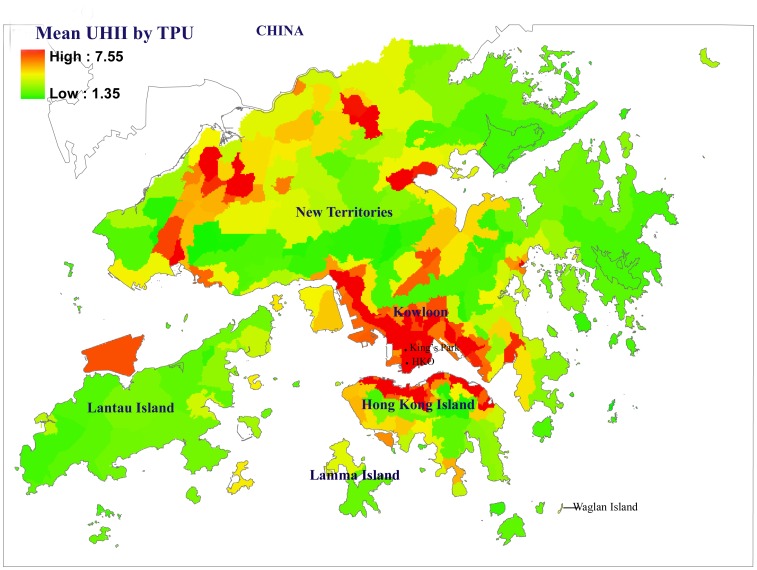
An urban heat island index (UHII) was calculated for each of Hong Kong's 248 geographical tertiary planning units (TPU). Daily counts of all natural deaths among Hong Kong residents were stratified according to whether the place of residence of the decedent was in a TPU with high (above the median) or low UHII. Poisson Generalized Additive Models (GAMs) were used to estimate the association between meteorological variables and mortality while adjusting for trend, seasonality, pollutants and flu epidemics. Analyses were restricted to the hot season (June-September).
Mean temperatures (lags 0-4) above 29 °C and low mean wind speeds (lags 0-4) were significantly associated with higher daily mortality and these associations were stronger in areas with high UHII. A 1 °C rise above 29 °C was associated with a 4.1% (95% confidence interval (CI): 0.7%, 7.6%) increase in natural mortality in areas with high UHII but only a 0.7% (95% CI: -2.4%, 3.9%) increase in low UHII areas. Lower mean wind speeds (5(th) percentile vs. 95(th) percentile) were associated with a 5.7% (95% CI: 2.7, 8.9) mortality increase in high UHII areas vs. a -0.3% (95% CI: -3.2%, 2.6%) change in low UHII areas.
The results suggest that urban micro heat islands exacerbate the negative health consequences of high temperatures and low wind speeds. Urban planning measures designed to mitigate heat island effects may lessen the health effects of unfavorable summertime meteorological conditions.
来自世界各地的先前研究表明,极高的温度往往会增加夏季的死亡率。然而,城市微观热岛的可能影响修饰作用仅在北美和欧洲的少数研究中进行了检查。本研究检查了香港微观热岛地区的每日死亡率是否比其他地区对短期气象条件变化更为敏感。
为香港的 248 个地理三级规划单元(TPU)中的每一个计算城市热岛指数(UHII)。根据死者居住地是否在 UHII 较高(高于中位数)或较低的 TPU,对香港居民所有自然死亡的每日计数进行分层。泊松广义加性模型(GAMs)用于估计气象变量与死亡率之间的关联,同时调整趋势、季节性、污染物和流感流行的影响。分析仅限于炎热季节(6 月至 9 月)。
高于 29°C 的平均温度(滞后 0-4)和较低的平均风速(滞后 0-4)与较高的每日死亡率显著相关,这些关联在 UHII 较高的地区更强。高于 29°C 升高 1°C 与 UHII 较高地区的自然死亡率增加 4.1%(95%置信区间(CI):0.7%,7.6%)相关,而 UHII 较低地区的死亡率仅增加 0.7%(95%CI:-2.4%,3.9%)。较低的平均风速(第 5 百分位与第 95 百分位)与 UHII 较高地区的死亡率增加 5.7%(95%CI:2.7%,8.9%)相关,而 UHII 较低地区的死亡率降低 0.3%(95%CI:-3.2%,2.6%)。
结果表明,城市微观热岛加剧了高温和低风速对健康的负面影响。旨在减轻热岛效应的城市规划措施可能会减轻不利夏季气象条件对健康的影响。