Riley R D, Sauerbrei W, Altman D G
Department of Public Health, Epidemiology and Biostatistics, Public Health Building, University of Birmingham, Edgbaston, Birmingham, UK.
Br J Cancer. 2009 Apr 21;100(8):1219-29. doi: 10.1038/sj.bjc.6604999.
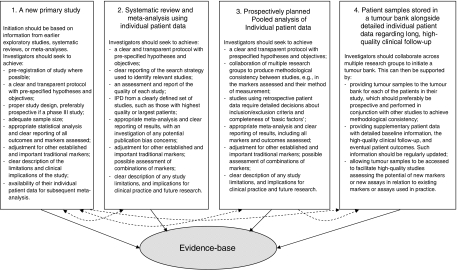
In oncology, prognostic markers are clinical measures used to help elicit an individual patient's risk of a future outcome, such as recurrence of disease after primary treatment. They thus facilitate individual treatment choice and aid in patient counselling. Evidence-based results regarding prognostic markers are therefore very important to both clinicians and their patients. However, there is increasing awareness that prognostic marker studies have been neglected in the drive to improve medical research. Large protocol-driven, prospective studies are the ideal, with appropriate statistical analysis and clear, unbiased reporting of the methods used and the results obtained. Unfortunately, published prognostic studies rarely meet such standards, and systematic reviews and meta-analyses are often only able to draw attention to the paucity of good-quality evidence. We discuss how better-quality prognostic marker evidence can evolve over time from initial exploratory studies, to large protocol-driven primary studies, and then to meta-analysis or even beyond, to large prospectively planned pooled analyses and to the initiation of tumour banks. We highlight articles that facilitate each stage of this process, and that promote current guidelines aimed at improving the design, analysis, and reporting of prognostic marker research. We also outline why collaborative, multi-centre, and multi-disciplinary teams should be an essential part of future studies.
在肿瘤学中,预后标志物是用于帮助评估个体患者未来发生某种结果风险的临床指标,例如初次治疗后疾病复发的风险。因此,它们有助于做出个体化的治疗选择,并为患者咨询提供帮助。所以,关于预后标志物的循证结果对临床医生及其患者都非常重要。然而,人们越来越意识到,在推动医学研究进步的过程中,预后标志物研究一直被忽视。大型的、遵循方案驱动的前瞻性研究是理想选择,要进行适当的统计分析,并清晰、无偏地报告所使用的方法和获得的结果。不幸的是,已发表的预后研究很少能达到这些标准,系统评价和荟萃分析往往只能让人注意到高质量证据的匮乏。我们讨论了随着时间推移,如何能从最初的探索性研究,发展到大型的、遵循方案驱动的初步研究,再到荟萃分析甚至更进一步,进行大型的前瞻性计划汇总分析以及启动肿瘤库,从而获得质量更高的预后标志物证据。我们重点介绍了有助于这一过程各阶段的文章,以及促进当前旨在改进预后标志物研究设计、分析和报告的指南的文章。我们还概述了为何协作性、多中心和多学科团队应成为未来研究的重要组成部分。