• 文献检索
  • 文档翻译
  • 深度研究
  • 学术资讯
  • Suppr Zotero 插件Zotero 插件
  • 邀请有礼
  • 套餐&价格
  • 历史记录
应用&插件
Suppr Zotero 插件Zotero 插件浏览器插件Mac 客户端Windows 客户端微信小程序
定价
高级版会员购买积分包购买API积分包
服务
文献检索文档翻译深度研究API 文档MCP 服务
关于我们
关于 Suppr公司介绍联系我们用户协议隐私条款
关注我们

Suppr 超能文献

核心技术专利:CN118964589B侵权必究
粤ICP备2023148730 号-1Suppr @ 2026

文献检索

告别复杂PubMed语法,用中文像聊天一样搜索,搜遍4000万医学文献。AI智能推荐,让科研检索更轻松。

立即免费搜索

文件翻译

保留排版,准确专业,支持PDF/Word/PPT等文件格式,支持 12+语言互译。

免费翻译文档

深度研究

AI帮你快速写综述,25分钟生成高质量综述,智能提取关键信息,辅助科研写作。

立即免费体验

近亲繁殖在一个欧洲王室王朝覆灭中所起的作用。

The role of inbreeding in the extinction of a European royal dynasty.

作者信息

Alvarez Gonzalo, Ceballos Francisco C, Quinteiro Celsa

机构信息

Departamento de Genética, Facultad de Biología, Universidad de Santiago de Compostela, Santiago de Compostela, La Coruña, Spain.

出版信息

PLoS One. 2009;4(4):e5174. doi: 10.1371/journal.pone.0005174. Epub 2009 Apr 15.

DOI:10.1371/journal.pone.0005174
PMID:19367331
原文链接:https://pmc.ncbi.nlm.nih.gov/articles/PMC2664480/
Abstract

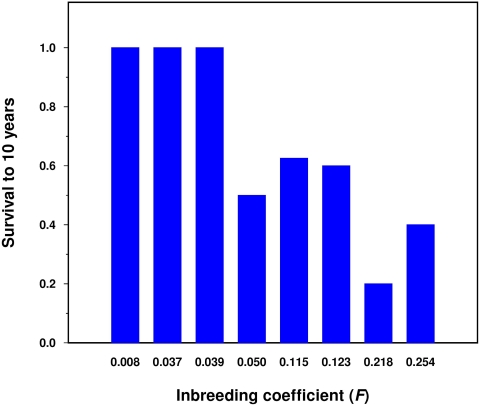
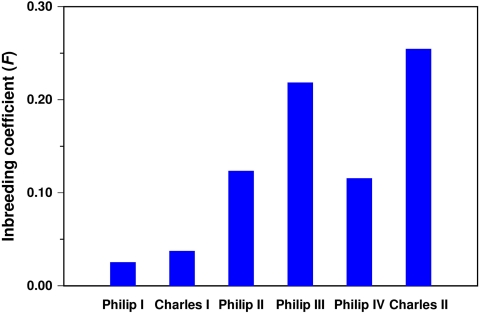
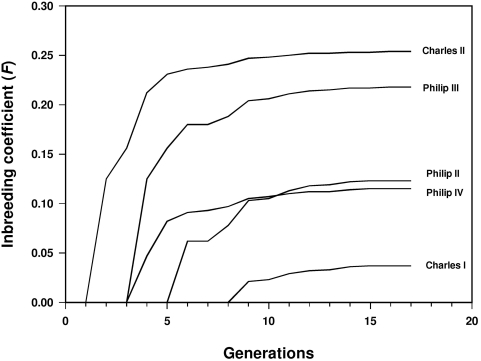
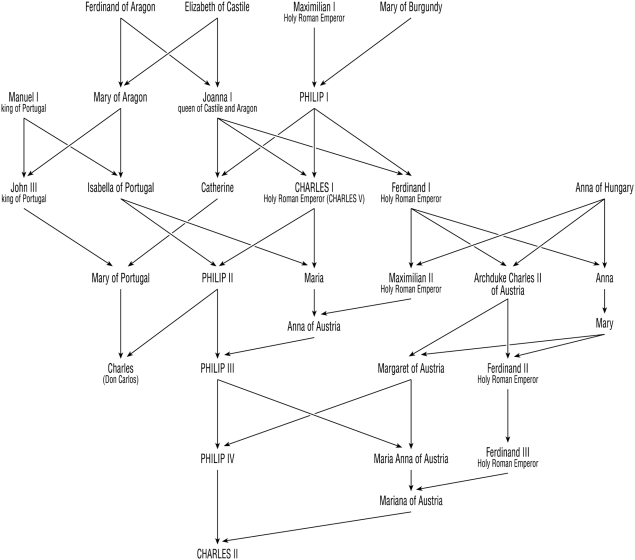
The kings of the Spanish Habsburg dynasty (1516-1700) frequently married close relatives in such a way that uncle-niece, first cousins and other consanguineous unions were prevalent in that dynasty. In the historical literature, it has been suggested that inbreeding was a major cause responsible for the extinction of the dynasty when the king Charles II, physically and mentally disabled, died in 1700 and no children were born from his two marriages, but this hypothesis has not been examined from a genetic perspective. In this article, this hypothesis is checked by computing the inbreeding coefficient (F) of the Spanish Habsburg kings from an extended pedigree up to 16 generations in depth and involving more than 3,000 individuals. The inbreeding coefficient of the Spanish Habsburg kings increased strongly along generations from 0.025 for king Philip I, the founder of the dynasty, to 0.254 for Charles II and several members of the dynasty had inbreeding coefficients higher than 0.20. In addition to inbreeding due to unions between close relatives, ancestral inbreeding from multiple remote ancestors makes a substantial contribution to the inbreeding coefficient of most kings. A statistically significant inbreeding depression for survival to 10 years is detected in the progenies of the Spanish Habsburg kings. The results indicate that inbreeding at the level of first cousin (F = 0.0625) exerted an adverse effect on survival of 17.8%+/-12.3. It is speculated that the simultaneous occurrence in Charles II (F = 0.254) of two different genetic disorders: combined pituitary hormone deficiency and distal renal tubular acidosis, determined by recessive alleles at two unlinked loci, could explain most of the complex clinical profile of this king, including his impotence/infertility which in last instance led to the extinction of the dynasty.

摘要

西班牙哈布斯堡王朝(1516 - 1700年)的国王们经常近亲结婚,叔侄、表亲及其他血亲结合在该王朝十分普遍。历史文献表明,近亲繁殖是导致该王朝覆灭的主要原因,因为国王查理二世身心残疾,于1700年去世,且他的两段婚姻均未留下子嗣,但这一假设尚未从遗传学角度进行检验。在本文中,通过计算西班牙哈布斯堡王朝国王们的近亲繁殖系数(F)来验证这一假设,所依据的扩展谱系深入至16代,涉及3000多人。西班牙哈布斯堡王朝国王们的近亲繁殖系数随世代显著增加,从王朝奠基人腓力一世的0.025增至查理二世的0.254,该王朝的几位成员近亲繁殖系数高于0.20。除了近亲结合导致的近亲繁殖外,来自多个远祖的祖先近亲繁殖对多数国王的近亲繁殖系数也有很大贡献。在西班牙哈布斯堡王朝国王们的后代中,检测到了对活到10岁具有统计学显著意义的近亲繁殖衰退现象。结果表明,表亲水平的近亲繁殖(F = 0.0625)对存活率产生了17.8%±12.3%的负面影响。据推测,查理二世(F = 0.254)同时患有两种不同的遗传疾病:联合垂体激素缺乏症和远端肾小管酸中毒,这两种疾病由两个不连锁基因座上的隐性等位基因决定,这可以解释这位国王复杂的临床症状,包括他的阳痿/不育,最终导致了王朝的覆灭。
https://cdn.ncbi.nlm.nih.gov/pmc/blobs/2ef6/2664480/4642a88ed778/pone.0005174.g004.jpg
https://cdn.ncbi.nlm.nih.gov/pmc/blobs/2ef6/2664480/c031289184ae/pone.0005174.g001.jpg
https://cdn.ncbi.nlm.nih.gov/pmc/blobs/2ef6/2664480/dd9450cdc881/pone.0005174.g002.jpg
https://cdn.ncbi.nlm.nih.gov/pmc/blobs/2ef6/2664480/0f2ecf66c7ac/pone.0005174.g003.jpg
https://cdn.ncbi.nlm.nih.gov/pmc/blobs/2ef6/2664480/4642a88ed778/pone.0005174.g004.jpg
https://cdn.ncbi.nlm.nih.gov/pmc/blobs/2ef6/2664480/c031289184ae/pone.0005174.g001.jpg
https://cdn.ncbi.nlm.nih.gov/pmc/blobs/2ef6/2664480/dd9450cdc881/pone.0005174.g002.jpg
https://cdn.ncbi.nlm.nih.gov/pmc/blobs/2ef6/2664480/0f2ecf66c7ac/pone.0005174.g003.jpg
https://cdn.ncbi.nlm.nih.gov/pmc/blobs/2ef6/2664480/4642a88ed778/pone.0005174.g004.jpg

相似文献

1
The role of inbreeding in the extinction of a European royal dynasty.近亲繁殖在一个欧洲王室王朝覆灭中所起的作用。
PLoS One. 2009;4(4):e5174. doi: 10.1371/journal.pone.0005174. Epub 2009 Apr 15.
2
Royal Inbreeding and the Extinction of Lineages of the Habsburg Dynasty.皇室近亲繁殖与哈布斯堡王朝家族的灭绝
Hum Hered. 2015;80(2):62-8. doi: 10.1159/000440765. Epub 2015 Oct 9.
3
Royal dynasties as human inbreeding laboratories: the Habsburgs.皇室家族犹如人类近亲繁殖的实验室:哈布斯堡家族。
Heredity (Edinb). 2013 Aug;111(2):114-21. doi: 10.1038/hdy.2013.25. Epub 2013 Apr 10.
4
Consanguineous marriages among Andalusian : a genealogical analysis (1925-2006).安达卢西亚人的血亲婚姻:一个系谱分析(1925-2006)。
J Biosoc Sci. 2020 Nov;52(6):809-831. doi: 10.1017/S0021932019000804. Epub 2019 Dec 13.
5
Is the "Habsburg jaw" related to inbreeding?“哈布斯堡下颚”与近亲繁殖有关吗?
Ann Hum Biol. 2019 Dec;46(7-8):553-561. doi: 10.1080/03014460.2019.1687752. Epub 2019 Dec 2.
6
Inbreeding coefficients for X-linked and autosomal genes in consanguineous marriages in Spanish populations: the case of Guipúzcoa (Basque Country).西班牙人群近亲婚姻中X连锁基因和常染色体基因的近亲繁殖系数:以吉普斯夸省(巴斯克地区)为例。
Ann Hum Genet. 2009 Mar;73(2):184-95. doi: 10.1111/j.1469-1809.2008.00495.x. Epub 2008 Dec 15.
7
Unveiling Charles II, the last King of the Habsburg Spanish Empire, in a portrait by Juan Carreño de Miranda (1685).展示由胡安·卡雷尼奥·德·米兰达(1685 年)创作的哈布斯堡西班牙帝国最后一位国王查理二世的肖像。
J Endocrinol Invest. 2020 Oct;43(10):1529-1530. doi: 10.1007/s40618-020-01333-2. Epub 2020 Jun 19.
8
The Evolution of Consanguineous Marriages in the Archdiocese of Granada, Spain (1900-1979).西班牙格拉纳达大主教辖区内近亲婚姻的演变(1900 - 1979年)
Hum Biol. 2019 Sep;90(2):97-114. doi: 10.13110/humanbiology.90.2.02.
9
Consanguineous marriage in Jordan.约旦的近亲婚姻。
Am J Med Genet. 1992 Jul 15;43(5):769-75. doi: 10.1002/ajmg.1320430502.
10
Inbreeding coefficients and degree of consanguineous marriages in Spain: a review.西班牙的近亲繁殖系数与近亲婚姻程度:综述
Am J Hum Biol. 2003 Sep-Oct;15(5):709-16. doi: 10.1002/ajhb.10198.

引用本文的文献

1
From genetic data to kinship clarity: employing machine learning for detecting incestuous relations.从基因数据到亲属关系明晰:运用机器学习检测乱伦关系
Front Genet. 2025 Jun 2;16:1578581. doi: 10.3389/fgene.2025.1578581. eCollection 2025.
2
A genomic tale of inbreeding in western Mediterranean human populations.地中海西部地区人类群体近亲繁殖的基因组故事。
Hum Genet. 2025 May 10. doi: 10.1007/s00439-025-02747-9.
3
Ballou's Ancestral Inbreeding Coefficient: Formulation and New Estimate with Higher Reliability.巴卢的祖先近亲繁殖系数:公式及更高可靠性的新估计值。

本文引用的文献

1
Hypothalamic and pituitary development: novel insights into the aetiology.下丘脑和垂体发育:病因学的新见解
Eur J Endocrinol. 2007 Aug;157 Suppl 1:S3-14. doi: 10.1530/EJE-07-0156.
2
Quantification of homozygosity in consanguineous individuals with autosomal recessive disease.常染色体隐性疾病近亲个体中纯合性的定量分析。
Am J Hum Genet. 2006 May;78(5):889-896. doi: 10.1086/503875. Epub 2006 Mar 21.
3
Genetic investigation of autosomal recessive distal renal tubular acidosis: evidence for early sensorineural hearing loss associated with mutations in the ATP6V0A4 gene.
Animals (Basel). 2024 Jun 21;14(13):1844. doi: 10.3390/ani14131844.
4
Increased homozygosity due to endogamy results in fitness consequences in a human population.由于近亲繁殖导致的同型合子率增加会对人类群体的适应性产生后果。
Proc Natl Acad Sci U S A. 2023 Oct 24;120(43):e2309552120. doi: 10.1073/pnas.2309552120. Epub 2023 Oct 17.
5
Fitness consequences of cousin marriage: a life-history assessment in two populations.近亲结婚的健康后果:对两个人群的生活史评估
Evol Hum Sci. 2022 Nov 29;5:e3. doi: 10.1017/ehs.2022.55. eCollection 2023.
6
QuickPed: an online tool for drawing pedigrees and analysing relatedness.QuickPed:一个用于绘制系谱图和分析亲缘关系的在线工具。
BMC Bioinformatics. 2022 Jun 7;23(1):220. doi: 10.1186/s12859-022-04759-y.
7
Mimush Sheep and the Spectre of Inbreeding: Historical Background for Festetics's Organic and Genetic Laws Four Decades Before Mendel's Experiments in Peas.米缪什绵羊与近交幽灵:孟德尔豌豆实验四十年前,费斯特提斯的有机与遗传法则的历史背景
J Hist Biol. 2022 Oct;55(3):495-536. doi: 10.1007/s10739-022-09678-5. Epub 2022 Jun 7.
8
How to behave when marooned: the behavioural component of the island syndrome remains underexplored.被困时如何表现:岛屿综合征的行为成分仍未得到充分探索。
Biol Lett. 2022 Apr;18(4):20220030. doi: 10.1098/rsbl.2022.0030. Epub 2022 Apr 20.
9
Chip Off the Old Block: Generation, Development, and Ancestral Concepts of Heredity.有其父必有其子:遗传的产生、发展及祖传观念
Front Genet. 2022 Mar 9;13:814436. doi: 10.3389/fgene.2022.814436. eCollection 2022.
10
Ancient genome analyses shed light on kinship organization and mating practice of Late Neolithic society in China.古代基因组分析揭示了中国新石器时代晚期社会的亲属组织和交配习俗。
iScience. 2021 Oct 26;24(11):103352. doi: 10.1016/j.isci.2021.103352. eCollection 2021 Nov 19.
常染色体隐性遗传性远端肾小管酸中毒的遗传学研究:与ATP6V0A4基因突变相关的早期感音神经性听力损失的证据。
J Am Soc Nephrol. 2006 May;17(5):1437-43. doi: 10.1681/ASN.2005121305. Epub 2006 Apr 12.
4
An uncommon phenotype with familial central hypogonadism caused by a novel PROP1 gene mutant truncated in the transactivation domain.一种由转录激活结构域截短的新型PROP1基因突变引起的伴有家族性中枢性性腺功能减退的罕见表型。
J Clin Endocrinol Metab. 2005 Aug;90(8):4880-7. doi: 10.1210/jc.2005-0119. Epub 2005 Jun 7.
5
Novel ATP6V1B1 and ATP6V0A4 mutations in autosomal recessive distal renal tubular acidosis with new evidence for hearing loss.常染色体隐性遗传性远端肾小管酸中毒中新型ATP6V1B1和ATP6V0A4突变及听力损失的新证据
J Med Genet. 2002 Nov;39(11):796-803. doi: 10.1136/jmg.39.11.796.
6
Consanguinity and its relevance to clinical genetics.近亲结婚及其与临床遗传学的关联。
Clin Genet. 2001 Aug;60(2):89-98. doi: 10.1034/j.1399-0004.2001.600201.x.
7
Adrenocorticotropin deficiency in combined pituitary hormone deficiency patients homozygous for a novel PROP1 deletion.一种新型PROP1缺失纯合子的联合垂体激素缺乏患者中的促肾上腺皮质激素缺乏
J Clin Endocrinol Metab. 2000 Dec;85(12):4556-61. doi: 10.1210/jcem.85.12.7013.
8
Frequency of consanguinity and its effect on congenital malformation--a hospital based study.近亲结婚频率及其对先天性畸形的影响——一项基于医院的研究。
J Pak Med Assoc. 1997 Mar;47(3):75-8.
9
The costs of human inbreeding and their implications for variations at the DNA level.人类近亲繁殖的代价及其对DNA水平变异的影响。
Nat Genet. 1994 Oct;8(2):117-21. doi: 10.1038/ng1094-117.
10
Inbreeding and reproductive performance in standardbred horses.标准赛马的近亲繁殖与繁殖性能
J Hered. 1984 May-Jun;75(3):220-4. doi: 10.1093/oxfordjournals.jhered.a109916.