Socios En Salud Sucursal Perú, Lima, Peru.
AIDS Behav. 2010 Jun;14(3):721-30. doi: 10.1007/s10461-009-9559-5. Epub 2009 Apr 16.
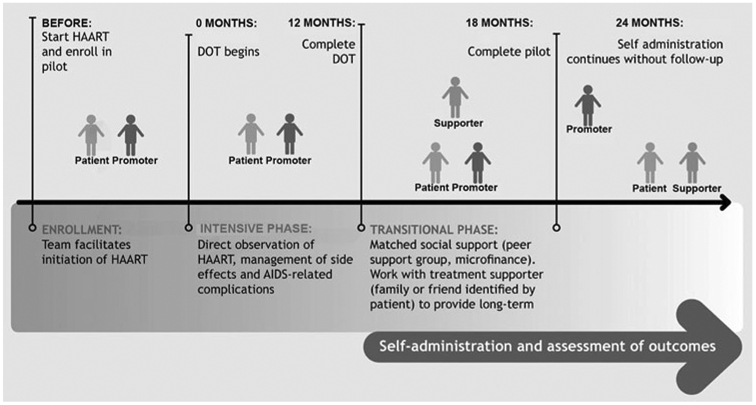
From December 2005 to April 2007, we enrolled 60 adults starting antiretroviral therapy (ART) in a health district of Lima, Peru to receive community-based accompaniment with supervised antiretroviral (CASA). Paid community health workers performed twice-daily home visits to directly observe ART and offered additional medical, social and economic support to CASA participants. We matched 60 controls from a neighboring district by age, CD4 and primary referral criteria (TB status, female, neither). Using validated instruments at baseline and 12 months (time of DOT-HAART completion) we measured depression, social support, quality of life, HIV-related stigma and self-efficacy. We compared 12 month clinical and psychosocial outcomes among CASA versus control groups. CASA participants experienced better clinical and psychosocial outcomes at 12 months, including proportion with virologic suppression, increase in social support and reduction in HIV-associated stigma.
从 2005 年 12 月到 2007 年 4 月,我们在秘鲁利马的一个卫生区招募了 60 名开始接受抗逆转录病毒治疗(ART)的成年人,接受社区为基础的监督抗逆转录病毒治疗(CASA)。付费的社区卫生工作者每天进行两次家访,直接观察 ART,并为 CASA 参与者提供额外的医疗、社会和经济支持。我们通过年龄、CD4 和主要转诊标准(TB 状况、女性、两者都不是),与来自邻近地区的 60 名对照组相匹配。使用基线和 12 个月(DOT-HAART 完成时间)的有效工具,我们测量了抑郁、社会支持、生活质量、与 HIV 相关的耻辱感和自我效能。我们比较了 CASA 组与对照组在 12 个月时的临床和心理社会结局。在 12 个月时,CASA 参与者的临床和心理社会结局更好,包括病毒学抑制的比例、社会支持的增加和与 HIV 相关的耻辱感的减少。