Coelho Margarida, Sequeira Fernando, Luiselli Donata, Beleza Sandra, Rocha Jorge
IPATIMUP, Instituto de Patologia e Imunologia Molecular da Universidade do Porto, R Dr Roberto Frias s/n, 4200-465 Porto, Portugal.
BMC Evol Biol. 2009 Apr 21;9:80. doi: 10.1186/1471-2148-9-80.
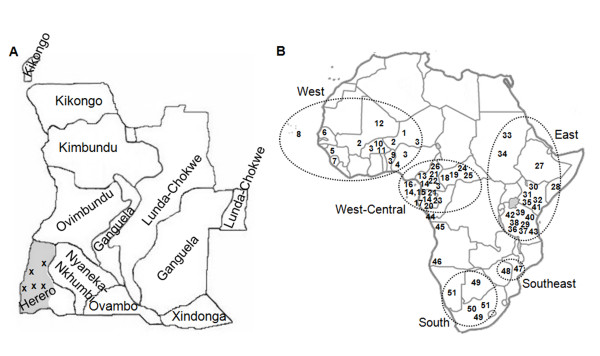
Current information about the expansion of Bantu-speaking peoples is hampered by the scarcity of genetic data from well identified populations from southern Africa. Here, we fill an important gap in the analysis of the western edge of the Bantu migrations by studying for the first time the patterns of Y-chromosome, mtDNA and lactase persistence genetic variation in four representative groups living around the Namib Desert in southwestern Angola (Ovimbundu, Ganguela, Nyaneka-Nkumbi and Kuvale). We assessed the differentiation between these populations and their levels of admixture with Khoe-San groups, and examined their relationship with other sub-Saharan populations. We further combined our dataset with previously published data on Y-chromosome and mtDNA variation to explore a general isolation with migration model and infer the demographic parameters underlying current genetic diversity in Bantu populations.
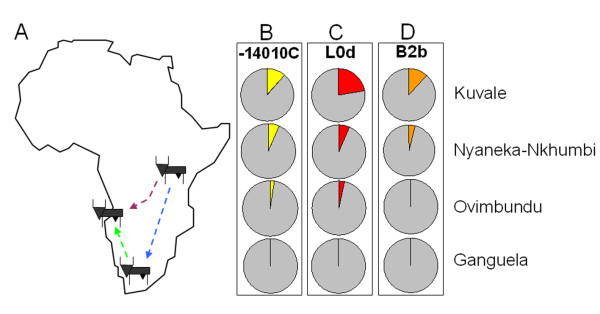
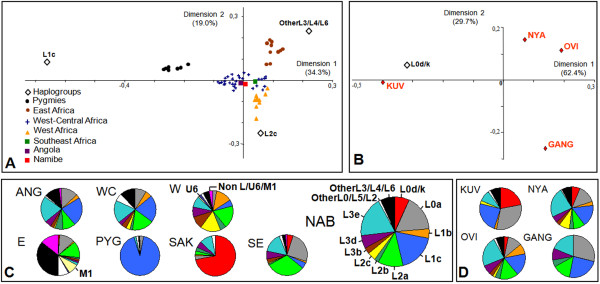
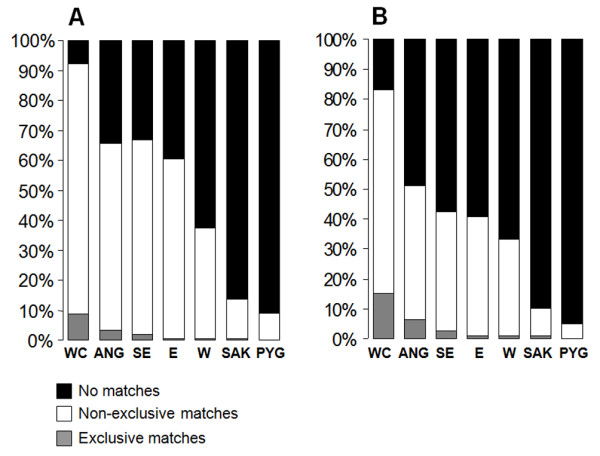
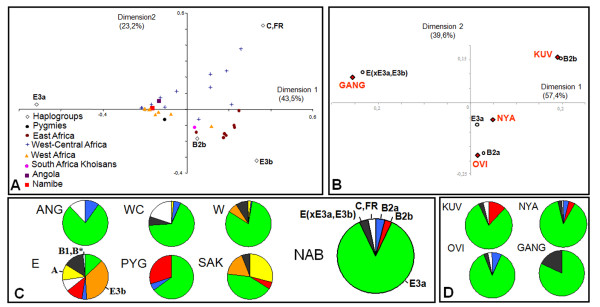
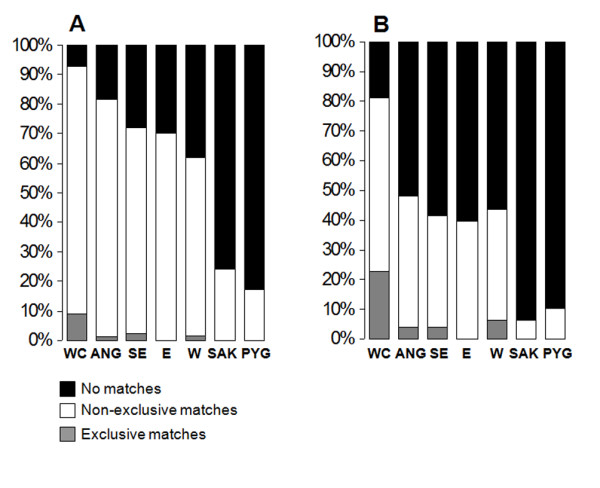
Correspondence analysis, lineage sharing patterns and admixture estimates indicate that the gene pool from southwestern Angola is predominantly derived from West-Central Africa. The pastoralist Herero-speaking Kuvale people were additionally characterized by relatively high frequencies of Y-chromosome (12%) and mtDNA (22%) Khoe-San lineages, as well as by the presence of the -14010C lactase persistence mutation (6%), which likely originated in non-Bantu pastoralists from East Africa. Inferred demographic parameters show that both male and female populations underwent significant size growth after the split between the western and eastern branches of Bantu expansions occurring 4000 years ago. However, males had lower population sizes and migration rates than females throughout the Bantu dispersals.
Genetic variation in southwestern Angola essentially results from the encounter of an offshoot of West-Central Africa with autochthonous Khoisan-speaking peoples from the south. Interactions between the Bantus and the Khoe-San likely involved cattle herders from the two groups sharing common aspects of their social organization. The presence of the -14010C mutation in southwestern Angola provides a link between the East and Southwest African pastoral scenes that might have been established indirectly, through migrations of Khoe herders across southern Africa. Differences in patterns of mtDNA and Y-chromosome intrapopulation diversity and interpopulation differentiation may be explained by contrasting demographic histories underlying the current female and male genetic variation.
目前关于说班图语民族扩张的信息因来自南部非洲明确界定人群的基因数据稀缺而受到阻碍。在此,我们通过首次研究安哥拉西南部纳米布沙漠周边四个代表性群体(奥温本杜人、甘盖拉人、尼亚内卡 - 恩昆比人和库瓦勒人)的Y染色体、线粒体DNA和乳糖酶持久性基因变异模式,填补了班图语迁徙西边缘分析中的一个重要空白。我们评估了这些人群之间的差异以及他们与科伊 - 桑群体的混合程度,并研究了他们与其他撒哈拉以南人群的关系。我们进一步将我们的数据集与先前发表的关于Y染色体和线粒体DNA变异的数据相结合,以探索一种带有迁徙的一般隔离模型,并推断班图人群当前遗传多样性背后的人口统计学参数。
对应分析、谱系共享模式和混合估计表明,安哥拉西南部的基因库主要源自中西部非洲。说赫雷罗语的牧民库瓦勒人还具有相对较高频率的Y染色体(12%)和线粒体DNA(22%)科伊 - 桑谱系,以及 -14010C乳糖酶持久性突变(6%)的存在,该突变可能起源于东非的非班图牧民。推断出的人口统计学参数表明,在4000年前班图语扩张的西支和东支分裂后,男性和女性群体的规模都经历了显著增长。然而,在整个班图语扩散过程中,男性的人口规模和迁移率低于女性。
安哥拉西南部的遗传变异基本上是由于中西部非洲的一个分支与南部当地说科伊桑语的民族相遇所致。班图人和科伊 - 桑人之间的互动可能涉及来自这两个群体的牧民共享他们社会组织的共同方面。安哥拉西南部 -14010C突变的存在为东非和西南非的牧业场景之间提供了一个联系,这可能是通过科伊牧民在南部非洲的迁徙间接建立的。线粒体DNA和Y染色体群体内多样性及群体间分化模式的差异可能由当前女性和男性遗传变异背后不同的人口历史所解释。