Theis Mirko, Slabicki Mikolaj, Junqueira Magno, Paszkowski-Rogacz Maciej, Sontheimer Jana, Kittler Ralf, Heninger Anne-Kristine, Glatter Timo, Kruusmaa Kristi, Poser Ina, Hyman Anthony A, Pisabarro M Teresa, Gstaiger Matthias, Aebersold Rudolf, Shevchenko Andrej, Buchholz Frank
Max Planck Institute for Molecular Cell Biology and Genetics, Dresden, Germany.
EMBO J. 2009 May 20;28(10):1453-65. doi: 10.1038/emboj.2009.114. Epub 2009 Apr 23.
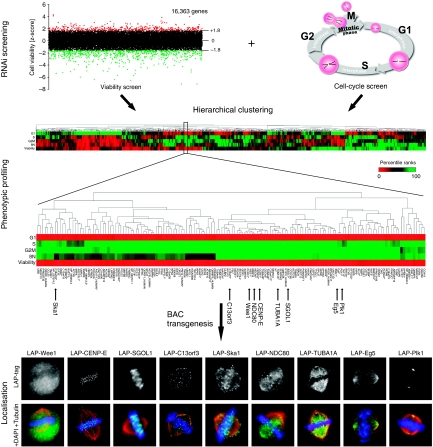
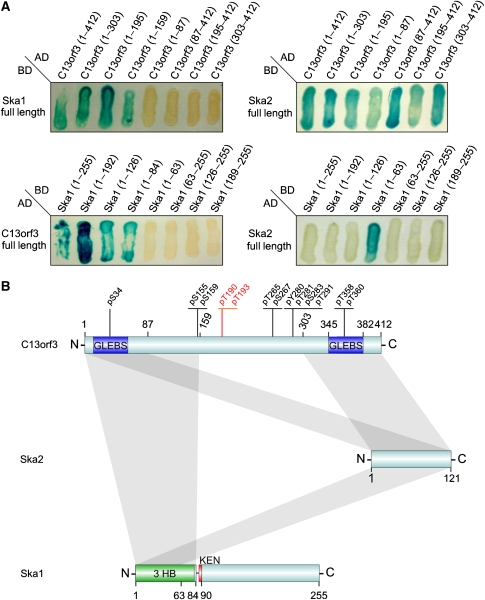
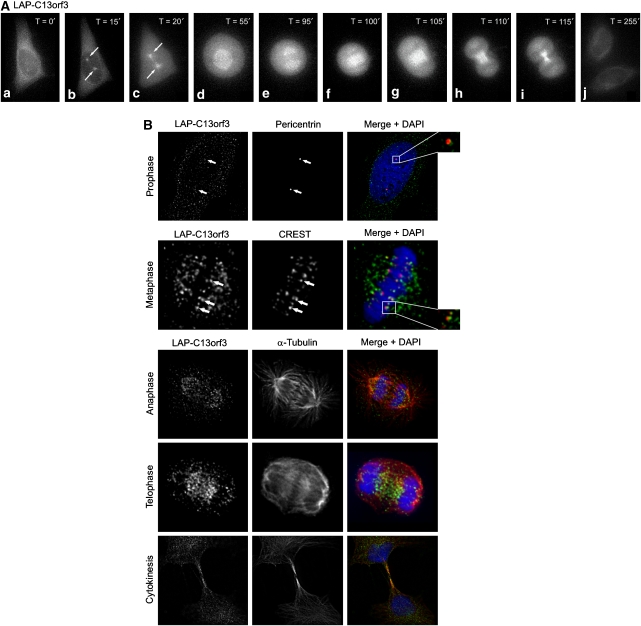
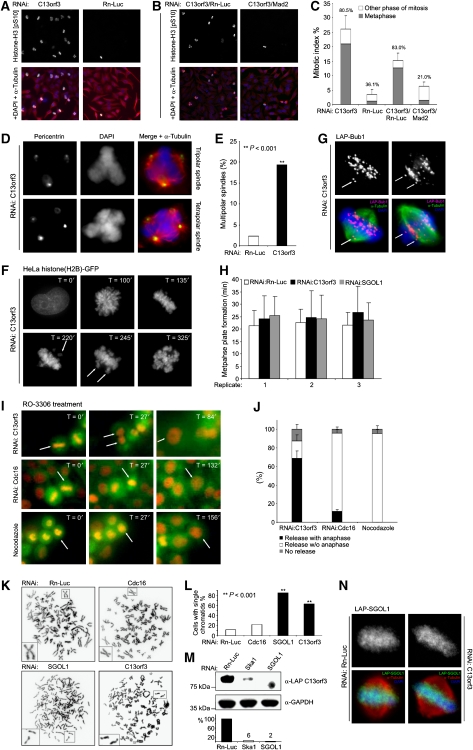
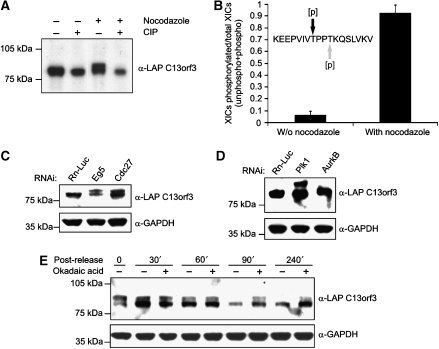
Proliferation of mammalian cells requires the coordinated function of many proteins to accurately divide a cell into two daughter cells. Several RNAi screens have identified previously uncharacterised genes that are implicated in mammalian cell division. The molecular function for these genes needs to be investigated to place them into pathways. Phenotypic profiling is a useful method to assign putative functions to uncharacterised genes. Here, we show that the analysis of protein localisation is useful to refine a phenotypic profile. We show the utility of this approach by defining a function of the previously uncharacterised gene C13orf3 during cell division. C13orf3 localises to centrosomes, the mitotic spindle, kinetochores, spindle midzone, and the cleavage furrow during cell division and is specifically phosphorylated during mitosis. Furthermore, C13orf3 is required for centrosome integrity and anaphase onset. Depletion by RNAi leads to mitotic arrest in metaphase with an activation of the spindle assembly checkpoint and loss of sister chromatid cohesion. Proteomic analyses identify C13orf3 (Ska3) as a new component of the Ska complex and show a direct interaction with a regulatory subunit of the protein phosphatase PP2A. All together, these data identify C13orf3 as an important factor for metaphase to anaphase progression and highlight the potential of combined RNAi screening and protein localisation analyses.
哺乳动物细胞的增殖需要多种蛋白质协同发挥作用,才能将一个细胞精确地分裂为两个子细胞。多项RNA干扰筛选已鉴定出一些此前未被表征的基因,这些基因与哺乳动物细胞分裂有关。需要对这些基因的分子功能进行研究,以便将它们纳入相关通路。表型分析是一种为未表征基因赋予推定功能的有用方法。在此,我们表明蛋白质定位分析有助于完善表型分析。我们通过确定此前未被表征的基因C13orf3在细胞分裂过程中的功能,展示了这种方法的实用性。C13orf3在细胞分裂过程中定位于中心体、有丝分裂纺锤体、动粒、纺锤体中间区和分裂沟,并在有丝分裂期间发生特异性磷酸化。此外,C13orf3是中心体完整性和后期起始所必需的。RNA干扰导致的基因敲低会导致中期有丝分裂停滞,纺锤体组装检查点激活,姐妹染色单体黏连丧失。蛋白质组学分析确定C13orf3(Ska3)是Ska复合体的一个新组分,并表明它与蛋白磷酸酶PP2A的一个调节亚基存在直接相互作用。总之,这些数据确定C13orf3是中期到后期进程的一个重要因子,并突出了RNA干扰筛选和蛋白质定位分析相结合的潜力。