Gaitanos Thomas N, Santamaria Anna, Jeyaprakash A Arockia, Wang Bin, Conti Elena, Nigg Erich A
Department of Cell Biology, Max Planck Institute of Biochemistry, Martinsried, Germany.
EMBO J. 2009 May 20;28(10):1442-52. doi: 10.1038/emboj.2009.96. Epub 2009 Apr 9.
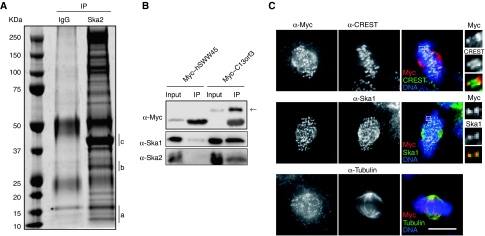
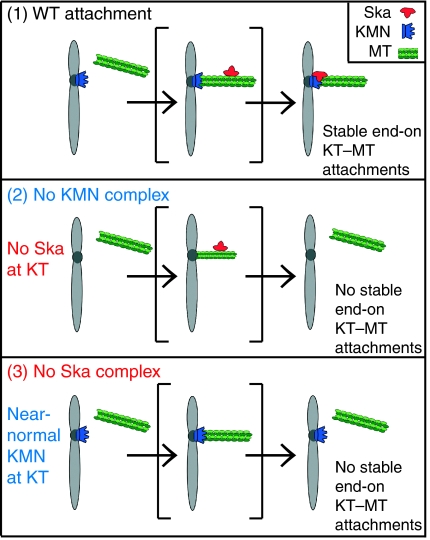
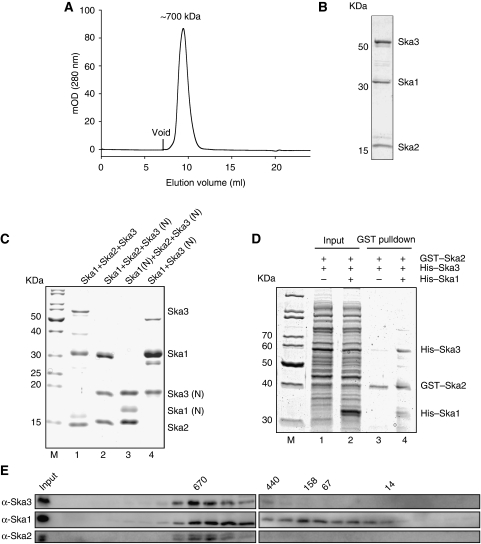
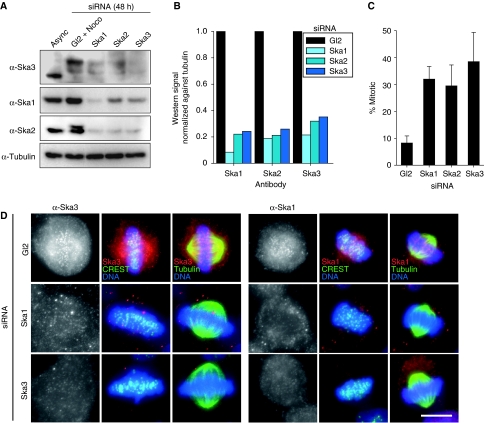
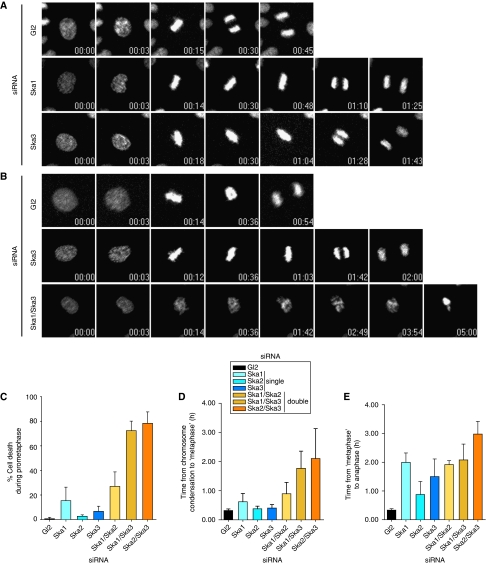
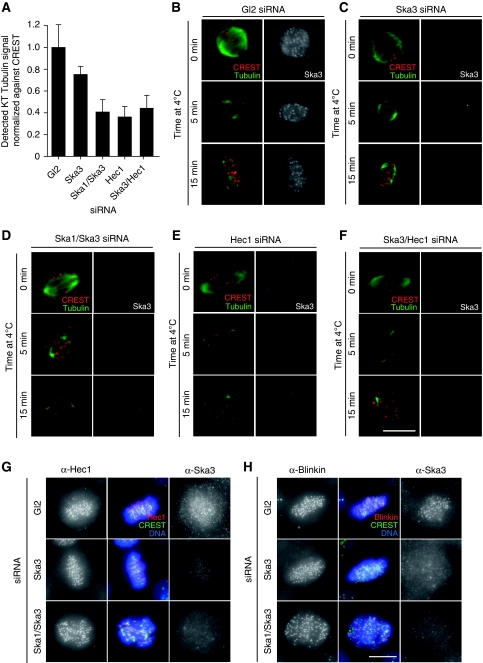
Ska1 and Ska2 form a complex at the kinetochore-microtubule (KT-MT) interface and are required for timely progression from metaphase to anaphase. Here, we use mass spectrometry to search for additional components of the Ska complex. We identify C13Orf3 (now termed Ska3) as a novel member of this complex and map the interaction domains among the three known components. Ska3 displays similar characteristics as Ska1 and Ska2: it localizes to the spindle and KT throughout mitosis and its depletion markedly delays anaphase transition. Interestingly, a more complete removal of the Ska complex by concomitant depletion of Ska1 and Ska3 results in a chromosome congression failure followed by cell death. This severe phenotype reflects a destabilization of KT-MT interactions, as demonstrated by reduced cold stability of KT fibres. Yet, the depletion of the Ska complex only marginally impairs KT localization of the KMN network responsible for MT attachment. We propose that the Ska complex functionally complements the KMN, providing an additional layer of stability to KT-MT attachment and possibly signalling completion of attachment to the spindle checkpoint.
Ska1和Ska2在动粒-微管(KT-MT)界面形成复合物,是中期到后期及时进展所必需的。在这里,我们使用质谱法寻找Ska复合物的其他成分。我们鉴定出C13Orf3(现称为Ska3)是该复合物的一个新成员,并绘制了三个已知成分之间的相互作用结构域。Ska3表现出与Ska1和Ska2相似的特征:它在整个有丝分裂过程中定位于纺锤体和动粒,其缺失显著延迟后期转换。有趣的是,通过同时缺失Ska1和Ska3更完全地去除Ska复合物会导致染色体排列失败,随后细胞死亡。这种严重的表型反映了KT-MT相互作用的不稳定,如KT纤维冷稳定性降低所证明的那样。然而,Ska复合物的缺失仅轻微损害负责微管附着的KMN网络的动粒定位。我们提出Ska复合物在功能上补充了KMN,为KT-MT附着提供了额外的稳定性层,并可能向纺锤体检查点发出附着完成的信号。