Du Huaidong, van der A Daphne L, Ginder Vanessa, Jebb Susan A, Forouhi Nita G, Wareham Nicholas J, Halkjaer Jytte, Tjønneland Anne, Overvad Kim, Jakobsen Marianne Uhre, Buijsse Brian, Steffen Annika, Palli Domenico, Masala Giovanna, Saris Wim H M, Sørensen Thorkild I A, Feskens Edith J M
National Institute for Public Health and the Environment (RIVM), Bilthoven, The Netherlands.
PLoS One. 2009;4(4):e5339. doi: 10.1371/journal.pone.0005339. Epub 2009 Apr 27.
Experimental studies show that a reduction in dietary energy density (ED) is associated with reduced energy intake and body weight. However, few observational studies have investigated the role of ED on long-term weight and waist circumference change.
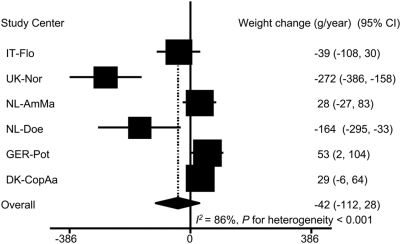
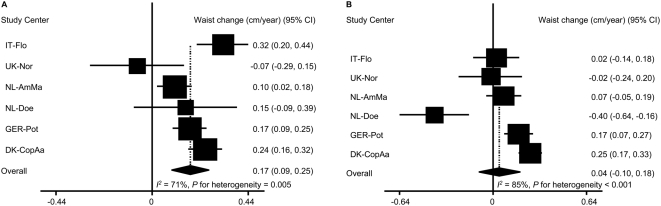
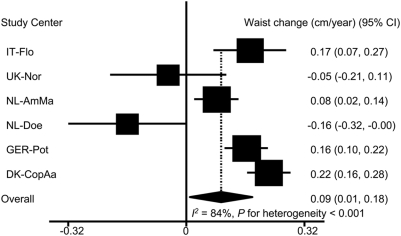
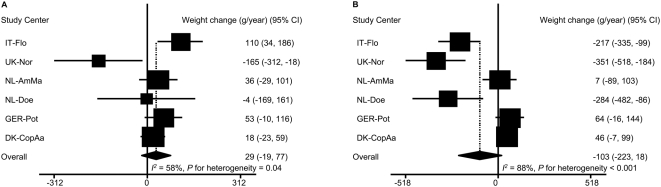
This population-based prospective cohort study included 89,432 participants from five European countries with mean age 53 years (range: 20-78 years) at baseline and were followed for an average of 6.5 years (range: 1.9-12.5 years). Participants were free of cancer, cardiovascular diseases and diabetes at baseline. ED was calculated as the energy intake (kcal) from foods divided by the weight (g) of foods. Multiple linear regression analyses were performed to investigate the associations of ED with annual weight and waist circumference change. Mean ED was 1.7 kcal/g and differed across study centers. After adjusting for baseline anthropometrics, demographic and lifestyle factors, follow-up duration and energy from beverages, ED was not associated with weight change, but significantly associated with waist circumference change overall. For 1 kcal/g ED, the annual weight change was -42 g/year [95% confidence interval (CI): -112, 28] and annual waist circumference change was 0.09 cm/year [95% CI: 0.01, 0.18]. In participants with baseline BMI<25 kg/m(2), 1 kcal/g ED was associated with a waist circumference change of 0.17 cm/year [95% CI: 0.09, 0.25].
Our results suggest that lower ED diets do not prevent weight gain but have a weak yet potentially beneficial effect on the prevention of abdominal obesity as measured by waist circumference.
实验研究表明,饮食能量密度(ED)的降低与能量摄入和体重的减少有关。然而,很少有观察性研究调查ED对长期体重和腰围变化的作用。
这项基于人群的前瞻性队列研究纳入了来自五个欧洲国家的89432名参与者,基线时平均年龄为53岁(范围:20 - 78岁),平均随访6.5年(范围:1.9 - 12.5年)。参与者在基线时无癌症、心血管疾病和糖尿病。ED计算为食物的能量摄入量(千卡)除以食物的重量(克)。进行多元线性回归分析以研究ED与年度体重和腰围变化之间的关联。平均ED为1.7千卡/克,各研究中心有所不同。在调整基线人体测量学、人口统计学和生活方式因素、随访持续时间以及饮料中的能量后,ED与体重变化无关,但总体上与腰围变化显著相关。对于1千卡/克的ED,年度体重变化为-42克/年[95%置信区间(CI):-112,28],年度腰围变化为0.09厘米/年[95% CI:0.01,0.18]。在基线BMI<25 kg/m²的参与者中,1千卡/克的ED与腰围变化0.17厘米/年相关[95% CI:0.09,0.25]。
我们的结果表明,低ED饮食不能预防体重增加,但对通过腰围测量的腹部肥胖预防有微弱但可能有益的作用。