Saito Masayuki, Okamatsu-Ogura Yuko, Matsushita Mami, Watanabe Kumiko, Yoneshiro Takeshi, Nio-Kobayashi Junko, Iwanaga Toshihiko, Miyagawa Masao, Kameya Toshimitsu, Nakada Kunihiro, Kawai Yuko, Tsujisaki Masayuki
Department of Nutrition, School of Nursing and Nutrition, Tenshi College, Sapporo, Japan.
Diabetes. 2009 Jul;58(7):1526-31. doi: 10.2337/db09-0530. Epub 2009 Apr 28.
The significant roles of brown adipose tissue (BAT) in the regulation of energy expenditure and adiposity are established in small rodents but have been controversial in humans. The objective is to examine the prevalence of metabolically active BAT in healthy adult humans and to clarify the effects of cold exposure and adiposity.
In vivo 2-[(18)F]fluoro-2-deoxyglucose (FDG) uptake into adipose tissue was measured in 56 healthy volunteers (31 male and 25 female subjects) aged 23-65 years by positron emission tomography (PET) combined with X-ray computed tomography (CT).
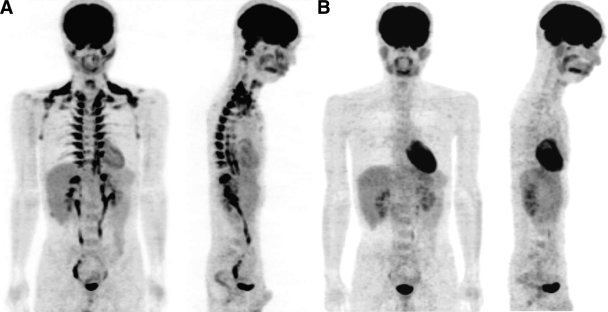
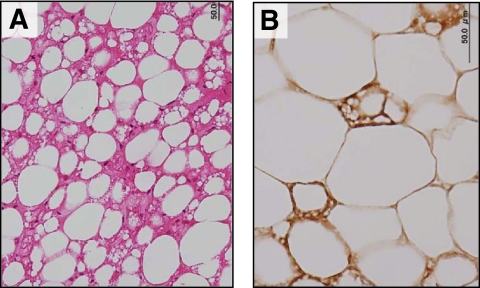
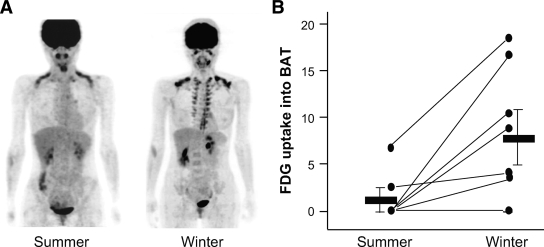
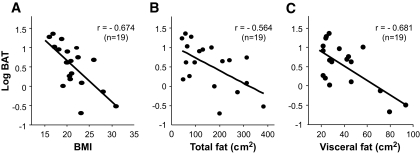
When exposed to cold (19 degrees C) for 2 h, 17 of 32 younger subjects (aged 23-35 years) and 2 of 24 elderly subjects (aged 38-65 years) showed a substantial FDG uptake into adipose tissue of the supraclavicular and paraspinal regions, whereas they showed no detectable uptake when kept warm (27 degrees C). Histological examinations confirmed the presence of brown adipocytes in these regions. The cold-activated FDG uptake was increased in winter compared with summer (P < 0.001) and was inversely related to BMI (P < 0.001) and total (P < 0.01) and visceral (P < 0.001) fat areas estimated from CT image at the umbilical level.
Our findings, being against the conventional view, indicate the high incidence of metabolically active BAT in adult humans and suggest a role in the control of body temperature and adiposity.
棕色脂肪组织(BAT)在能量消耗和肥胖调节中的重要作用在小型啮齿动物中已得到证实,但在人类中一直存在争议。本研究旨在调查健康成年人体内具有代谢活性的BAT的患病率,并阐明冷暴露和肥胖的影响。
采用正电子发射断层扫描(PET)结合X射线计算机断层扫描(CT),对56名年龄在23 - 65岁的健康志愿者(31名男性和25名女性)进行体内脂肪组织对2-[(18)F]氟-2-脱氧葡萄糖(FDG)的摄取测量。
在冷暴露(19摄氏度)2小时后,32名年轻受试者(23 - 35岁)中的17名和24名老年受试者(38 - 65岁)中的2名在锁骨上和脊柱旁区域的脂肪组织中显示出大量的FDG摄取,而在温暖环境(27摄氏度)下则未检测到摄取。组织学检查证实这些区域存在棕色脂肪细胞。与夏季相比,冬季冷激活的FDG摄取增加(P < 0.001),并且与BMI(P < 0.001)以及根据脐水平CT图像估计的总脂肪面积(P < 0.01)和内脏脂肪面积(P < 0.001)呈负相关。
我们的研究结果与传统观点相反,表明成年人体内具有代谢活性的BAT发生率很高,并提示其在体温调节和肥胖控制中发挥作用。