Fry Andrew E, Ghansa Anita, Small Kerrin S, Palma Alejandro, Auburn Sarah, Diakite Mahamadou, Green Angela, Campino Susana, Teo Yik Y, Clark Taane G, Jeffreys Anna E, Wilson Jonathan, Jallow Muminatou, Sisay-Joof Fatou, Pinder Margaret, Griffiths Michael J, Peshu Norbert, Williams Thomas N, Newton Charles R, Marsh Kevin, Molyneux Malcolm E, Taylor Terrie E, Koram Kwadwo A, Oduro Abraham R, Rogers William O, Rockett Kirk A, Sabeti Pardis C, Kwiatkowski Dominic P
Wellcome Trust Centre for Human Genetics, Roosevelt Drive, Oxford OX3 7BN, UK.
Hum Mol Genet. 2009 Jul 15;18(14):2683-92. doi: 10.1093/hmg/ddp192. Epub 2009 Apr 29.
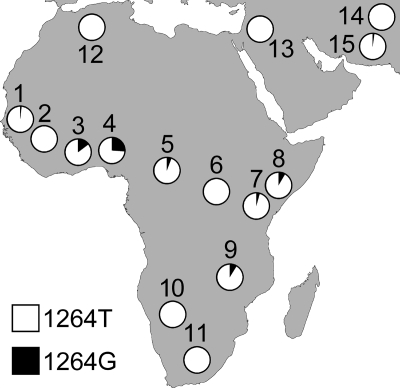
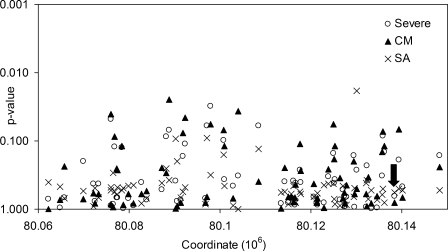
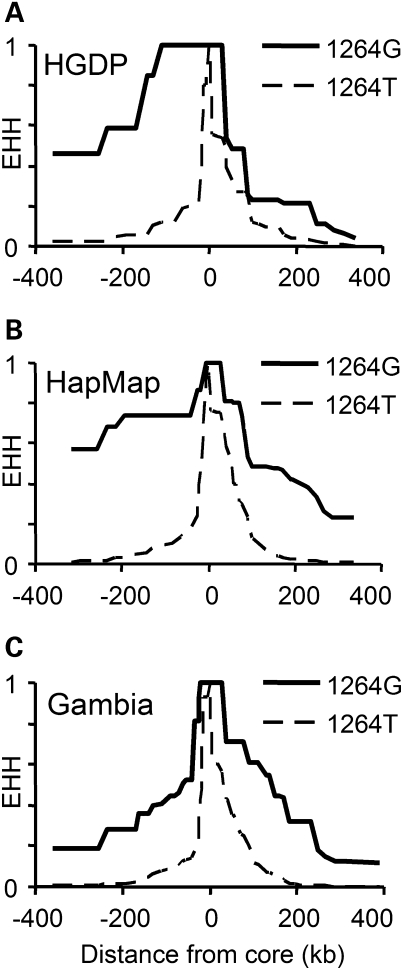
The prevalence of CD36 deficiency in East Asian and African populations suggests that the causal variants are under selection by severe malaria. Previous analysis of data from the International HapMap Project indicated that a CD36 haplotype bearing a nonsense mutation (T1264G; rs3211938) had undergone recent positive selection in the Yoruba of Nigeria. To investigate the global distribution of this putative selection event, we genotyped T1264G in 3420 individuals from 66 populations. We confirmed the high frequency of 1264G in the Yoruba (26%). However, the 1264G allele is less common in other African populations and absent from all non-African populations without recent African admixture. Using long-range linkage disequilibrium, we studied two West African groups in depth. Evidence for recent positive selection at the locus was demonstrable in the Yoruba, although not in Gambians. We screened 70 variants from across CD36 for an association with severe malaria phenotypes, employing a case-control study of 1350 subjects and a family study of 1288 parent-offspring trios. No marker was significantly associated with severe malaria. We focused on T1264G, genotyping 10,922 samples from four African populations. The nonsense allele was not associated with severe malaria (pooled allelic odds ratio 1.0; 95% confidence interval 0.89-1.12; P = 0.98). These results suggest a range of possible explanations including the existence of alternative selection pressures on CD36, co-evolution between host and parasite or confounding caused by allelic heterogeneity of CD36 deficiency.
东亚和非洲人群中CD36缺乏症的流行表明,致病变异正受到严重疟疾的选择。此前对国际人类基因组单体型图计划(International HapMap Project)数据的分析表明,携带无义突变(T1264G;rs3211938)的CD36单倍型在尼日利亚的约鲁巴人中经历了近期的正选择。为了研究这一假定选择事件的全球分布,我们对来自66个群体的3420名个体进行了T1264G基因分型。我们证实了约鲁巴人中1264G的高频出现(26%)。然而,1264G等位基因在其他非洲人群中不太常见,在所有没有近期非洲血统混合的非非洲人群中均不存在。利用长程连锁不平衡,我们深入研究了两个西非群体。该位点近期正选择的证据在约鲁巴人中得到证实,而在冈比亚人中则未得到证实。我们对CD36的70个变异进行了筛选,以寻找与严重疟疾病表型的关联,采用了一项对1350名受试者的病例对照研究和一项对1288个亲子三联体的家系研究。没有标记与严重疟疾显著相关。我们聚焦于T1264G,对来自四个非洲人群的10922个样本进行了基因分型。无义等位基因与严重疟疾无关(合并等位基因优势比为1.0;95%置信区间为0.89 - 1.12;P = 0.98)。这些结果提示了一系列可能的解释,包括CD36上存在其他选择压力、宿主与寄生虫的共同进化或CD36缺乏症等位基因异质性导致的混杂。