Gyurak Anett, Goodkind Madeleine S, Madan Anita, Kramer Joel H, Miller Bruce L, Levenson Robert W
Institute of Personality and Social Research, Department of Psychology, University of California, Berkeley, California 94720-5050, USA.
Cogn Affect Behav Neurosci. 2009 Jun;9(2):144-52. doi: 10.3758/CABN.9.2.144.
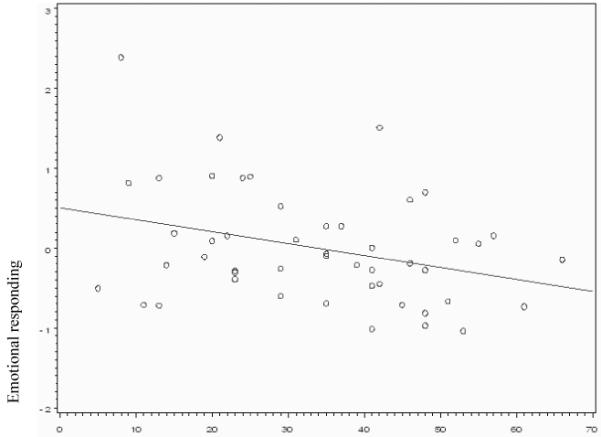
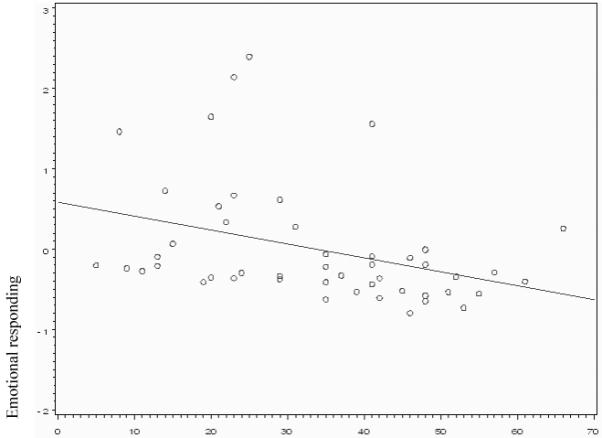
Behavioral regulation is a hallmark feature of executive functioning (EF). The present study investigated whether commonly used neuropsychological test measures of EF (i.e., working memory, Stroop, trail making, and verbal fluency) were related to ability to downregulate emotion both spontaneously and when instructed to suppress emotional expressions. To ensure a wide range of EF, 24 frontotemporal lobar degeneration patients, 7 Alzheimer's patients, and 17 neurologically normal controls participated. Participants were exposed to an acoustic startle stimulus (single aversive noise burst) under three conditions: (1) unwarned, (2) warned with no instructions (to measure spontaneous emotion downregulation), and (3) warned with instructions to suppress (to measure instructed emotion downregulation). Results indicated that higher verbal fluency scores were related to greater emotion regulation (operationalized as reduction in body movement and emotional facial behavior when warned of the impending startle) in both regulation conditions. No relationships were found between emotion regulation in these conditions and the other EF measures. We conclude that, of four commonly used measures of EF, verbal fluency best indexes the complex processes of monitoring, evaluation, and control necessary for successful emotion regulation, both spontaneously and following instructions to suppress.
行为调节是执行功能(EF)的一个标志性特征。本研究调查了常用的EF神经心理学测试指标(即工作记忆、斯特鲁普测试、连线测试和言语流畅性)是否与自发下调情绪以及接到抑制情绪表达指令时下调情绪的能力相关。为确保涵盖广泛的EF水平,24名额颞叶痴呆患者、7名阿尔茨海默病患者和17名神经功能正常的对照者参与了研究。参与者在三种条件下接受听觉惊吓刺激(单次厌恶噪声爆发):(1)无预警,(2)有预警但无指令(以测量自发情绪下调),以及(3)有预警并接到抑制指令(以测量指令性情绪下调)。结果表明,在两种调节条件下,较高的言语流畅性得分与更强的情绪调节能力相关(通过在接到即将到来的惊吓预警时身体动作和情绪面部行为的减少来衡量)。在这些条件下的情绪调节与其他EF指标之间未发现相关性。我们得出结论,在四种常用的EF测量指标中,言语流畅性最能代表成功进行自发情绪调节以及接到抑制指令后进行情绪调节所需的监测、评估和控制的复杂过程。