Lombard Catherine B, Deeks Amanda A, Ball Kylie, Jolley Damien, Teede Helena J
Monash University, Australia.
Nutr J. 2009 May 1;8:17. doi: 10.1186/1475-2891-8-17.
Preventing weight gain rather than treating established obesity is an important economic and public health response to the rapidly increasing rates of obesity worldwide. Treatment of established obesity is complex and costly requiring multiple resources. Preventing weight gain potentially requires fewer resources to reach broad population groups, yet there is little evidence for successful interventions to prevent weight gain in the community. Women with children are an important target group because of high rates of weight gain and the potential to influence the health behaviors in family members.
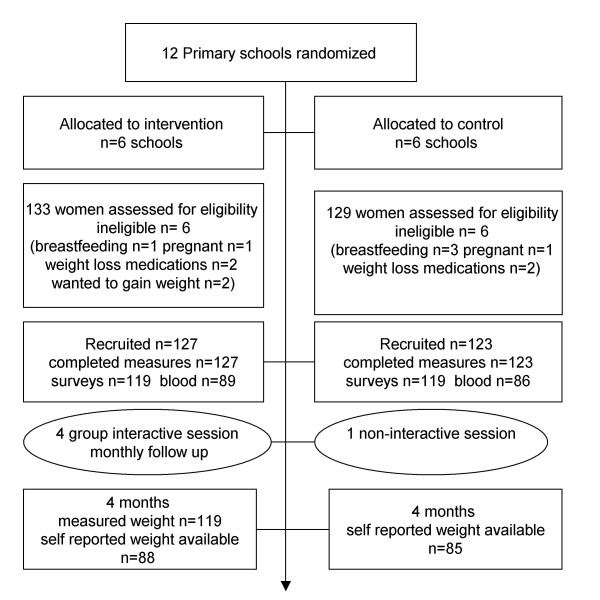
The aim of this cluster randomized controlled trial was to evaluate the short term effect of a community-based self-management intervention to prevent weight gain. Two hundred and fifty mothers of young children (mean age 40 years +/- 4.5, BMI 27.9 kg/m2 +/- 5.6) were recruited from the community in Melbourne, Australia. The intervention group (n = 127) attended four interactive group sessions over 4 months, held in 12 local primary schools in 2006, and was compared to a group (n = 123) receiving a single, non-interactive, health education session. Data collection included self-reported weight (both groups), measured weight (intervention only), self-efficacy, dietary intake and physical activity.
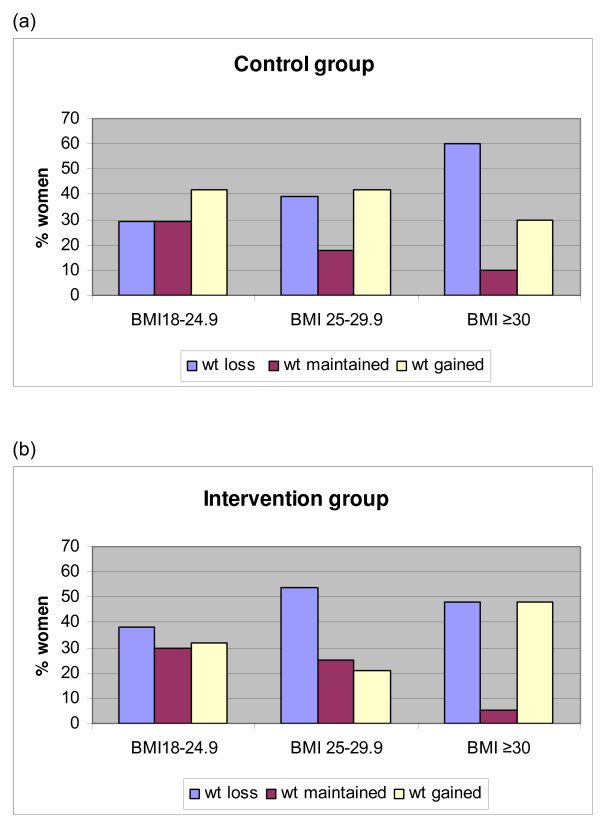
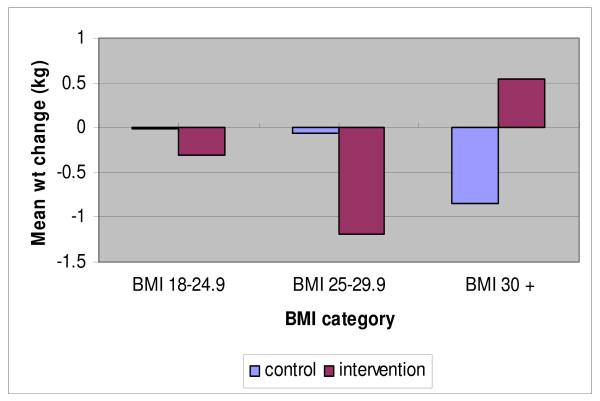
Mean measured weight decreased significantly in the intervention group (-0.78 kg 95% CI; -1.22 to -0.34, p < 0.001). Comparing groups using self-reported weight, both the intervention and comparison groups decreased weight, -0.75 kg (95% CI; -1.57 to 0.07, p = 0.07) and -0.72 kg (95% CI; -1.59 to 0.14 p = 0.10) respectively with no significant difference between groups (-0.03 kg, 95% CI; -1.32 to 1.26, p = 0.95). More women lost or maintained weight in the intervention group. The intervention group tended to have the greatest effect in those who were overweight at baseline and in those who weighed themselves regularly. Intervention women who rarely self-weighed gained weight (+0.07 kg) and regular self-weighers lost weight (-1.66 kg) a difference of -1.73 kg (95% CI; -3.35 to -0.11 p = 0.04). The intervention reported increased physical activity although the difference between groups did not reach significance. Both groups reported replacing high fat foods with low fat alternatives and self-efficacy deteriorated in the comparison group only.
Both a single health education session and interactive behavioral intervention will result in a similar weight loss in the short term, although more participants in the interactive intervention lost or maintained weight. There were small non-significant changes to physical activity and changes to fat intake specifically replacing high fat foods with low fat alternatives such as fruit and vegetables. Self-monitoring appears to enhance weight loss when part of an intervention.
ACTRN12608000110381.
预防体重增加而非治疗已有的肥胖症,是应对全球肥胖率迅速上升的一项重要经济和公共卫生举措。治疗已有的肥胖症复杂且成本高昂,需要多种资源。预防体重增加可能需要较少资源就能惠及广大人群,但几乎没有证据表明社区中有成功预防体重增加的干预措施。有孩子的女性是一个重要目标群体,因为她们体重增加率高,且有可能影响家庭成员的健康行为。
本整群随机对照试验的目的是评估基于社区的自我管理干预措施预防体重增加的短期效果。从澳大利亚墨尔本的社区招募了250名幼儿母亲(平均年龄40岁±4.5岁,体重指数27.9 kg/m²±5.6)。干预组(n = 127)于2006年在12所当地小学参加了为期4个月的4次互动小组课程,并与接受单次非互动式健康教育课程的组(n = 123)进行比较。数据收集包括自我报告的体重(两组)、测量的体重(仅干预组)、自我效能感、饮食摄入和身体活动。
干预组测量的平均体重显著下降(-0.78 kg,95%可信区间:-1.22至-