Vizza Lisa, Smith Caroline A, Swaraj Soji, Agho Kingsley, Cheema Birinder S
School of Science and Health, Western Sydney University, Locked Bag 1797, Penrith, NSW 2751 Australia.
The National Institute of Complementary Medicine, Western Sydney University, Penrith, NSW 2751 Australia.
BMC Sports Sci Med Rehabil. 2016 May 11;8:14. doi: 10.1186/s13102-016-0039-8. eCollection 2016.
To evaluate the feasibility of executing a randomized controlled trial of progressive resistance training (PRT) in women with polycystic ovary syndrome (PCOS).
Women with PCOS were randomized to an experimental (PRT) group or a no-exercise (usual care) control group. The PRT group was prescribed two supervised and two unsupervised (home-based) training sessions per week for 12 weeks. Feasibility outcomes included recruitment and attrition, adherence, adverse events, and completion of assessments. Secondary outcomes, collected pre and post intervention, included a range of pertinent physiological, functional and psychological measures.
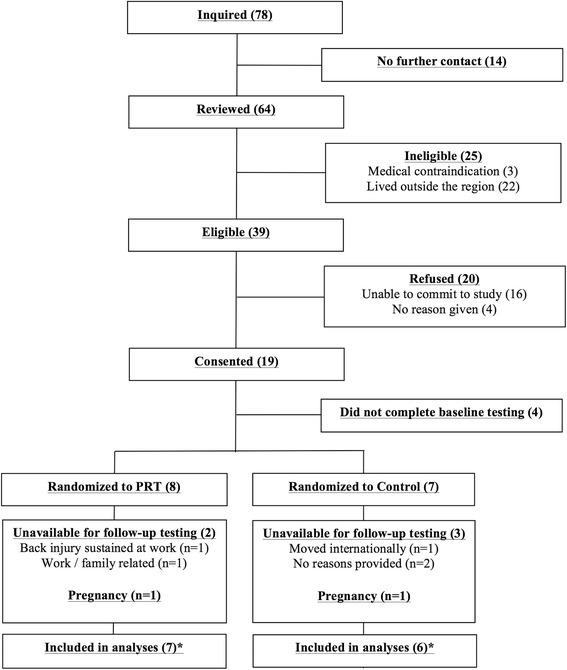
Fifteen participants were randomised into the PRT group (n = 8) or control group (n = 7); five women (n = 2 in PRT group and n = 3 in control group) withdrew from the study. The most successful recruitment sources were Facebook (40 %) and online advertisement (27 %), while least successful methods were referrals by clinicians, colleagues and flyers. In the PRT group, attendance to supervised sessions was higher (95 %; standard deviation ±6 %) compared to unsupervised sessions (51 %; standard deviation ±28 %). No adverse events were attributed to PRT. Change in menstrual cycle status was not significantly different between groups over time (p = 0.503). However, the PRT group significantly increased body weight (p = 0.01), BMI (p = 0.04), lean mass (p = 0.01), fat-free mass (p = 0.005) and lower body strength (p = 0.03), while reducing waist circumference (p = 0.03) and HbA1c (p = 0.033) versus the control group. The PRT group also significantly improved across several domains of disease-specific and general health-related quality of life, depression, anxiety and exercise self-efficacy.
A randomized controlled trial of PRT in PCOS would be feasible, and this mode of exercise may elicit a therapeutic effect on clinically important outcomes in this cohort. The success of a large-scale trial required to confirm these findings would be contingent on addressing the feasibility hurdles identified in this study with respect to recruitment, attrition, compliance, and collection of standardized clinical data.
Australia New Zealand Clinical Trials Registry; ACTRN12614000517673 Registered 15 May 2014.
评估对多囊卵巢综合征(PCOS)女性进行渐进性抗阻训练(PRT)随机对照试验的可行性。
将PCOS女性随机分为试验组(PRT组)或无运动(常规护理)对照组。PRT组每周安排两次有监督和两次无监督(居家)训练课程,共12周。可行性结果包括招募和损耗、依从性、不良事件以及评估完成情况。干预前后收集的次要结果包括一系列相关的生理、功能和心理指标。
15名参与者被随机分为PRT组(n = 8)或对照组(n = 7);5名女性(PRT组2名,对照组3名)退出研究。最成功的招募来源是脸书(40%)和网络广告(27%),而最不成功的方法是临床医生、同事推荐和传单。在PRT组中,有监督课程的出勤率(95%;标准差±6%)高于无监督课程(51%;标准差±28%)。未发现PRT导致不良事件。两组间月经周期状态随时间的变化无显著差异(p = 0.503)。然而,与对照组相比,PRT组体重(p = 0.01)、体重指数(BMI,p = 0.04)、瘦体重(p = 0.01)、去脂体重(p = 0.005)和下肢力量(p = 0.03)显著增加,腰围(p = 0.03)和糖化血红蛋白(HbA1c,p = 0.033)降低。PRT组在疾病特异性和一般健康相关生活质量、抑郁、焦虑和运动自我效能等多个领域也有显著改善。
对PCOS患者进行PRT的随机对照试验是可行的,这种运动方式可能对该队列的临床重要结局产生治疗效果。要证实这些发现所需的大规模试验的成功将取决于解决本研究中在招募、损耗、依从性和标准化临床数据收集方面发现的可行性障碍。
澳大利亚新西兰临床试验注册中心;ACTRN12614000517673,于2014年5月15日注册。