Tomlinson Suzanne M, Malmstrom Robert D, Russo Andrew, Mueller Niklaus, Pang Yuan-Ping, Watowich Stanley J
Department of Biochemistry and Molecular Biology, University of Texas Medical Branch, Galveston, 77555, United States.
Antiviral Res. 2009 Jun;82(3):110-4. doi: 10.1016/j.antiviral.2009.02.190. Epub 2009 Feb 21.
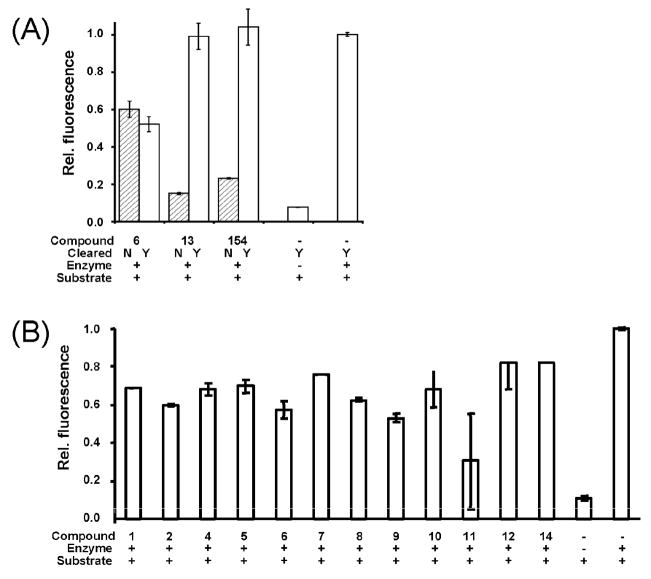
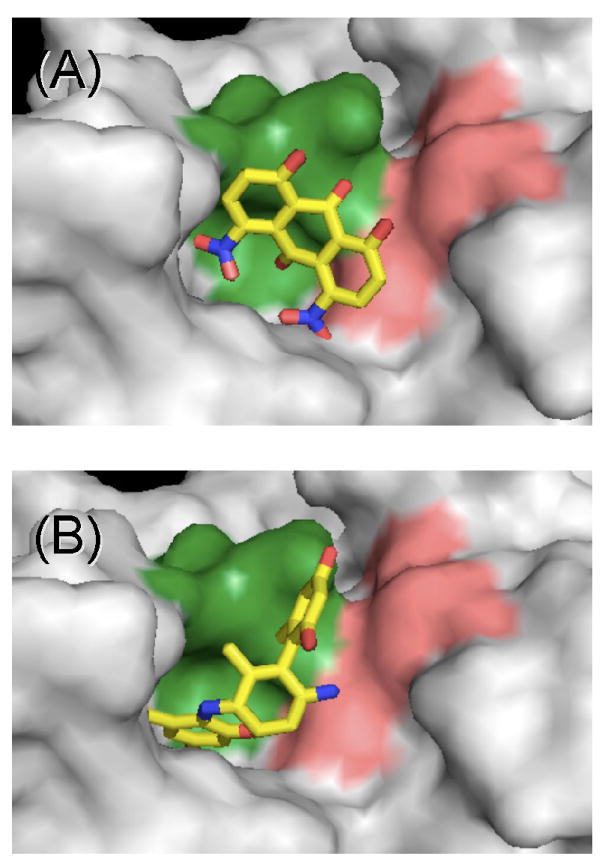
Dengue virus belongs to the family Flaviviridae and is a major emerging pathogen for which the development of vaccines and antiviral therapy has seen little success. The NS3 viral protease is a potential target for antiviral drugs since it is required for virus replication. The goal of this study was to identify novel dengue virus (type 2; DEN2V) protease inhibitors for eventual development as effective anti-flaviviral drugs. The EUDOC docking program was used to computationally screen a small-molecule library for compounds that dock into the P1 pocket and the catalytic site of the DEN2V NS3 protease domain apo-structure [Murthy, K., Clum, S., Padmanabhan, R., 1999. Crystal structure and insights into interaction of the active site with substrates by molecular modeling and structural analysis of mutational effects. J. Biol. Chem. 274, 5573-5580] and the Bowman-Birk inhibitor-bound structure [Murthy, K., Judge, K., DeLucas, L., Padmanabhan, R., 2000. Crystal structure of dengue virus NS3 protease in complex with a Bowman-Birk inhibitor: implications for flaviviral polyprotein processing and drug design. J. Mol. Biol. 301, 759-767]. The top 20 computer-identified hits that demonstrated the most favorable scoring "energies" were selected for in vitro assessment of protease inhibition. Preliminary protease activity assays demonstrated that more than half of the tested compounds were soluble and exhibited in vitro inhibition of the DEN2V protease. Two of these compounds also inhibited viral replication in cell culture experiments, and thus are promising compounds for further development.
登革病毒属于黄病毒科,是一种主要的新兴病原体,针对其疫苗和抗病毒疗法的研发成效甚微。NS3病毒蛋白酶是抗病毒药物的潜在靶点,因为它是病毒复制所必需的。本研究的目的是鉴定新型登革病毒(2型;DEN2V)蛋白酶抑制剂,最终开发成为有效的抗黄病毒药物。使用EUDOC对接程序对小分子文库进行计算机筛选,以寻找能够对接至DEN2V NS3蛋白酶结构域无配体结构[Murthy, K., Clum, S., Padmanabhan, R., 1999. 通过分子建模和突变效应的结构分析对活性位点与底物相互作用的晶体结构和见解。《生物化学杂志》274, 5573 - 5580]以及与鲍曼-伯克抑制剂结合的结构[Murthy, K., Judge, K., DeLucas, L., Padmanabhan, R., 2000. 登革病毒NS3蛋白酶与鲍曼-伯克抑制剂复合物的晶体结构:对黄病毒多蛋白加工和药物设计的启示。《分子生物学杂志》301, 759 - 767]的P1口袋和催化位点的化合物。选择计算机鉴定出的得分“能量”最有利的前20种化合物进行蛋白酶抑制的体外评估。初步蛋白酶活性测定表明,超过一半的测试化合物可溶,并在体外表现出对DEN2V蛋白酶的抑制作用。其中两种化合物在细胞培养实验中也抑制了病毒复制,因此是有前景的进一步开发化合物。