Mitra Amal K, Haque Akhlaque, Islam Manirul, Bashar S A M K
Department of Community Health Sciences, The University of Southern Mississippi, Hattiesburg, Mississippi, US.
Int J Environ Res Public Health. 2009 Jan;6(1):84-95. doi: 10.3390/ijerph6010084. Epub 2009 Jan 5.
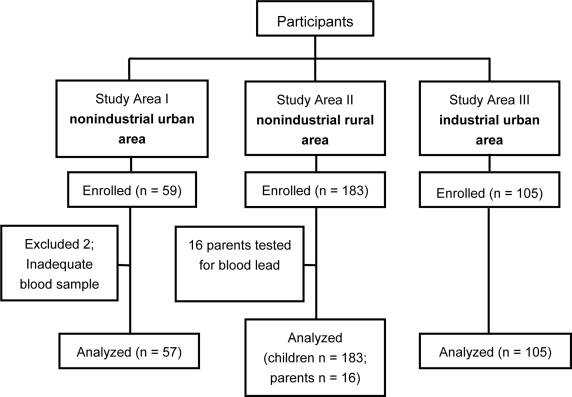
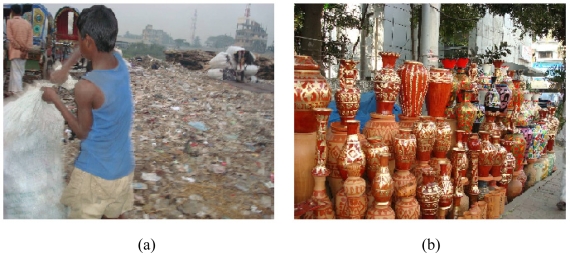
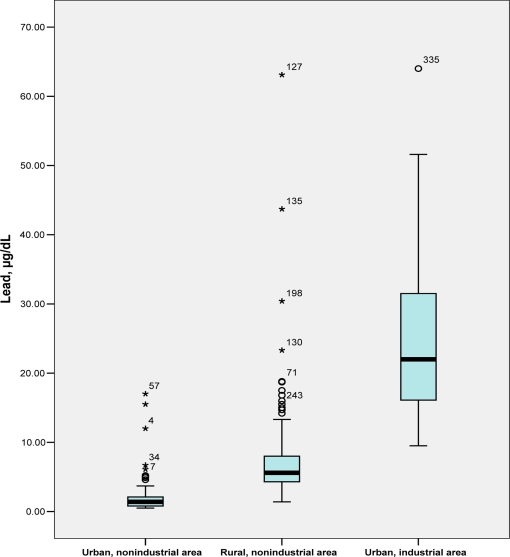
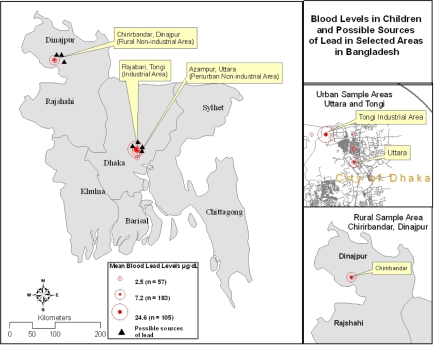
To assess the risk of lead poisoning among preschool and school-aged children in Bangladesh, 345 children were screened for blood lead levels (BLLs) from one rural and two urban areas in Bangladesh from September 2007 through January 2008. An urban industrial area at Tongi was identified as a disaster area, where 99% (104/105) of those tested had BLLs >or= 10 microg/dL. Industrial emissions and use of leaded gasoline by two-stroke engine vehicles were identified as possible sources of lead in that area. A rural nonindustrial area at Chirirbandar, Dinajpur was identified as another high-risk area, where 14% of the children screened had BLLs >or= 10 microg/dL. BLLs at the urban industrial area were significantly higher than those at the rural and urban nonindustrial areas (24.58 +/- 10.32, 7.24 +/- 6.31, and 2.47 +/- 3.32 microg/dL, respectively; p <0.001). Weight-for-age z-scores of the urban children were significantly lower than that of the rural children (-1.41 +/- 1.88 vs. 0.20 +/- 1.16, p <0.001). Children with elevated BLLs had poorer nutritional status (p = 0.05) than those with normal BLLs. Over 90% of the parents did not know that lead causes health problems. In conclusion, the problem of lead poisoning in children was found to be high in both urban and rural Bangladesh. A universal lead screening for preschool and school-aged children and a lead education program for parents are recommended for implementation in Bangladesh.
为评估孟加拉国学龄前和学龄儿童的铅中毒风险,于2007年9月至2008年1月期间,对来自孟加拉国一个农村地区和两个城市地区的345名儿童进行了血铅水平(BLLs)筛查。通吉的一个城市工业区被确定为灾区,在那里接受检测的儿童中有99%(104/105)的血铅水平≥10微克/分升。工业排放以及二冲程发动机车辆使用含铅汽油被确定为该地区铅的可能来源。迪纳杰布尔县奇里尔班达尔的一个农村非工业区被确定为另一个高风险地区,在那里接受筛查的儿童中有14%的血铅水平≥10微克/分升。城市工业区的血铅水平显著高于农村和城市非工业区(分别为24.58±10.32、7.24±6.31和2.47±3.32微克/分升;p<0.001)。城市儿童的年龄别体重z评分显著低于农村儿童(-1.41±1.88对0.20±1.16,p<0.001)。血铅水平升高的儿童营养状况比血铅水平正常的儿童更差(p=0.05)。超过90%的家长不知道铅会导致健康问题。总之,发现孟加拉国城乡儿童铅中毒问题都很严重。建议在孟加拉国对学龄前和学龄儿童进行普遍的铅筛查,并为家长开展铅教育项目。