Sadagopan Ramaswamy, Bencomo Jose A, Martin Rafael L, Nilsson Gorgen, Matzen Thomas, Balter Peter A
Department of Radiation Physics, The University of Texas M. D. Anderson Cancer Center, Houston, Texas, U.S.A.
Department of Physics, Universidad Central de Venezuela, Caracas, Venezuela.
J Appl Clin Med Phys. 2009 May 7;10(2):104-119. doi: 10.1120/jacmp.v10i2.2928.
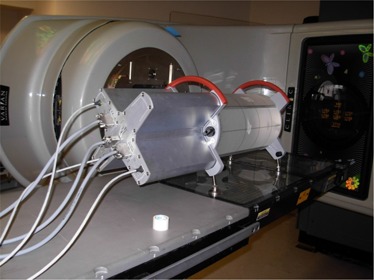
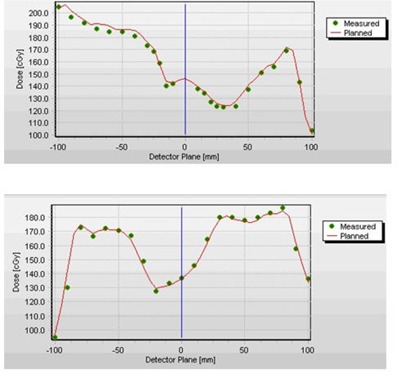
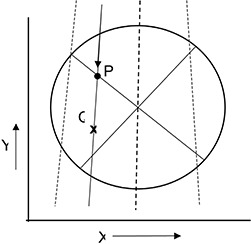
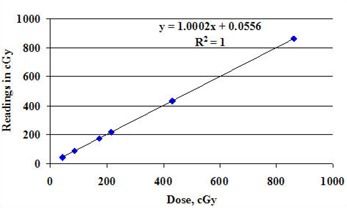
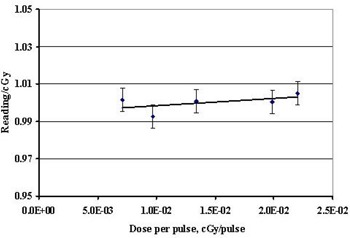
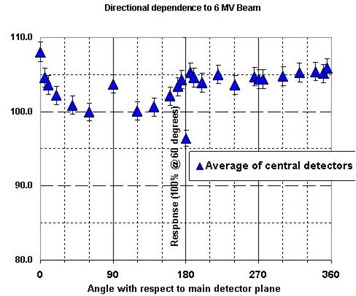
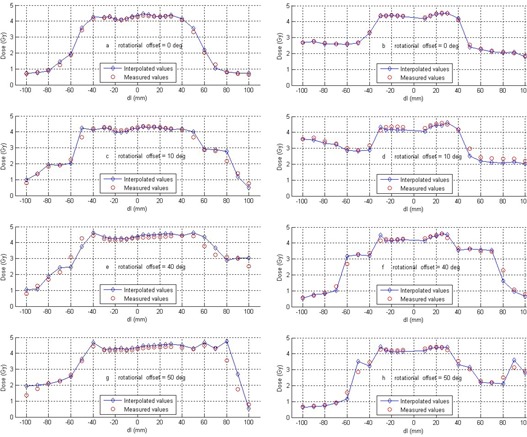
Intensity-modulated radiation therapy (IMRT) is a complex procedure that involves the delivery of complex intensity patterns from various gantry angles. Due to the complexity of the treatment plans, the standard-of-care is to perform measurement based patient-specific quality assurance (QA). IMRT QA is traditionally done with film for relative dose in a plane and an ion chamber for absolute dose. This is a laborious and time-consuming process. In this work, we characterized, commissioned, and evaluated the QA capabilities of a novel commercial IMRT device Delta4, (Scandidos, Uppsala, Sweden). This device consists of diode matrices in 2 orthogonal planes inserted in a cylindrical acrylic phantom that is 22 cm in diameter. Although the system has detectors in only 2 planes, it provides a novel interpolation algorithm that is capable of estimating doses at points where no detectors are present. Each diode is sampled per beam pulse so that the dose distribution can be evaluated on segment-by-segment, beam-by-beam, or as a composite plan from a single set of measurements. The end user can calibrate the system to perform absolute dosimetry eliminating the need for additional ion chamber measurements. The patient's IMRT plan is imported into the device over the hospital LAN and the results of measurements can be displayed as gamma profiles, distance-to-agreement maps, dose difference maps, or the measured dose distribution can be superimposed of the patient's anatomy to display an as-delivered plan. We evaluated the system's reproducibility, stability, pulse-rate dependence, dose-rate dependence, angular dependence, linearity of dose response and energy response using carefully planned measurements. We also validated the system's interpolation algorithm by measuring a complex dose distribution from an IMRT treatment. Several simple and complex isodose distributions planned using a treatment planning system were delivered to the QA device; the planned and measured dose distributions were then compared and analyzed. In addition, the dose distributions measured by conventional IMRT QA, which uses an ion chamber and film, were compared. We found that this device is accurate and reproducible and that its interpolation algorithm is valid. In addition the supplied software and network interface allow a streamlined IMRT QA process.
调强放射治疗(IMRT)是一种复杂的程序,涉及从不同机架角度输送复杂的强度模式。由于治疗计划的复杂性,护理标准是进行基于测量的患者特异性质量保证(QA)。传统上,IMRT QA通过平面相对剂量的胶片和绝对剂量的电离室来完成。这是一个费力且耗时的过程。在这项工作中,我们对一种新型商用IMRT设备Delta4(瑞典乌普萨拉的Scandidos公司)的QA能力进行了表征、调试和评估。该设备由插入直径为22 cm的圆柱形丙烯酸体模中的两个正交平面内的二极管矩阵组成。尽管该系统仅在两个平面上有探测器,但它提供了一种新颖的插值算法,能够估计没有探测器的点处的剂量。每个二极管在每个束流脉冲时进行采样,以便可以逐段、逐束地评估剂量分布,或者从一组测量中作为复合计划进行评估。最终用户可以校准系统以进行绝对剂量测定,从而无需额外的电离室测量。患者的IMRT计划通过医院局域网导入到设备中,测量结果可以显示为伽马曲线、一致性距离图、剂量差异图,或者测量的剂量分布可以叠加在患者的解剖结构上以显示实际交付的计划。我们使用精心规划的测量评估了系统的可重复性、稳定性、脉冲率依赖性、剂量率依赖性、角度依赖性、剂量响应的线性和能量响应。我们还通过测量IMRT治疗的复杂剂量分布来验证系统的插值算法。使用治疗计划系统规划的几个简单和复杂的等剂量分布被输送到QA设备;然后比较和分析计划和测量的剂量分布。此外,还比较了使用电离室和胶片的传统IMRT QA测量的剂量分布。我们发现该设备准确且可重复,其插值算法有效。此外,所提供的软件和网络接口允许简化IMRT QA过程。