Zheng Meiying, Cierpicki Tomasz, Momotani Ko, Artamonov Mykhaylo V, Derewenda Urszula, Bushweller John H, Somlyo Avril V, Derewenda Zygmunt S
Department of Molecular Physiology and Biological Physics, University of Virginia, PO Box 800736, Charlottesville, Virginia, 22908-0736, USA.
BMC Struct Biol. 2009 May 21;9:36. doi: 10.1186/1472-6807-9-36.
The Dbl-family of guanine nucleotide exchange factors (GEFs) activate the cytosolic GTPases of the Rho family by enhancing the rate of exchange of GTP for GDP on the cognate GTPase. This catalytic activity resides in the DH (Dbl-homology) domain, but typically GEFs are multidomain proteins containing other modules. It is believed that GEFs are autoinhibited in the cytosol due to supramodular architecture, and become activated in diverse signaling pathways through conformational change and exposure of the DH domain, as the protein is translocated to the membrane. A small family of RhoA-specific GEFs, containing the RGSL (regulators of G-protein signaling-like) domain, act as effectors of select GPCRs via Galpha12/13, although the molecular mechanism by which this pathway operates is not known. These GEFs include p115, LARG and PDZRhoGEF (PRG).
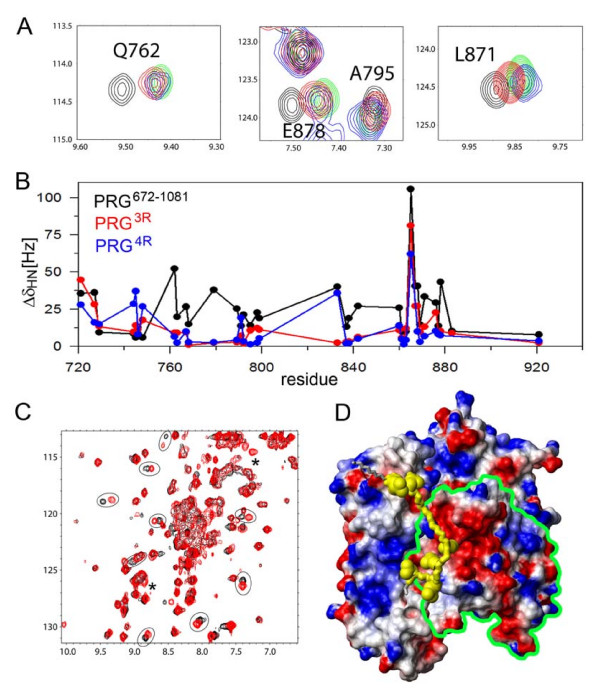
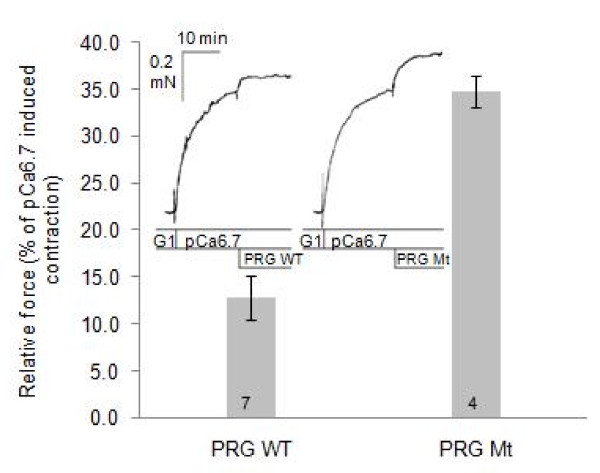
Here we show that the autoinhibition of PRG is caused largely by an interaction of a short negatively charged sequence motif, immediately upstream of the DH-domain and including residues Asp706, Glu708, Glu710 and Asp712, with a patch on the catalytic surface of the DH-domain including Arg867 and Arg868. In the absence of both PDZ and RGSL domains, the DH-PH tandem with additional 21 residues upstream, is 50% autoinhibited. However, within the full-length protein, the PDZ and/or RGSL domains significantly restore autoinhibition.
Our results suggest a mechanism for autoinhibition of RGSL family of GEFs, in which the RGSL domain and a unique sequence motif upstream of the DH domain, act cooperatively to reduce the ability of the DH domain to bind the nucleotide free RhoA. The activation mechanism is likely to involve two independent steps, i.e. displacement of the RGSL domain and conformational change involving the autoinhibitory sequence motif containing several negatively charged residues.
鸟嘌呤核苷酸交换因子(GEFs)的Dbl家族通过提高同源GTP酶上GTP与GDP的交换速率来激活Rho家族的胞质GTP酶。这种催化活性存在于DH(Dbl同源)结构域中,但通常GEFs是包含其他模块的多结构域蛋白。据信,由于超模块结构,GEFs在胞质溶胶中处于自抑制状态,并在蛋白质转运到膜上时,通过构象变化和DH结构域的暴露在多种信号通路中被激活。一小类含有RGSL(G蛋白信号调节样)结构域的RhoA特异性GEFs,通过Gα12/13作为特定GPCR的效应器,尽管该途径运作的分子机制尚不清楚。这些GEFs包括p115、LARG和PDZRhoGEF(PRG)。
我们在此表明PRG的自抑制主要是由一个短的带负电荷的序列基序与DH结构域催化表面上包括Arg867和Arg868的区域相互作用引起的,该序列基序紧邻DH结构域上游,包括Asp706、Glu708、Glu710和Asp712残基。在没有PDZ和RGSL结构域的情况下,带有上游额外21个残基的DH-PH串联体有50%的自抑制。然而,在全长蛋白中,PDZ和/或RGSL结构域显著恢复自抑制。
我们的结果提示了一种GEFs的RGSL家族自抑制机制,其中RGSL结构域和DH结构域上游的一个独特序列基序协同作用,以降低DH结构域结合无核苷酸RhoA的能力。激活机制可能涉及两个独立步骤,即RGSL结构域的置换和涉及包含几个带负电荷残基的自抑制序列基序的构象变化。