Akide-Ndunge Oscar Bate, Tambini Elisa, Giribaldi Giuliana, McMillan Paul J, Müller Sylke, Arese Paolo, Turrini Francesco
Department of Genetics, Biology and Biochemistry, University of Torino Medical School, Torino, Italy.
Malar J. 2009 May 29;8:113. doi: 10.1186/1475-2875-8-113.
Plasmodium falciparum-parasitized red blood cells (RBCs) are equipped with protective antioxidant enzymes and heat shock proteins (HSPs). The latter are only considered to protect against thermal stress. Important issues are poorly explored: first, it is insufficiently known how both systems are expressed in relation to the parasite developmental stage; secondly, it is unknown whether P. falciparum HSPs are redox-responsive, in view of redox sensitivity of HSP in eukaryotic cells; thirdly, it is poorly known how the antioxidant defense machinery would respond to increased oxidative stress or inhibited antioxidant defense. Those issues are interesting as several antimalarials increase the oxidative stress or block antioxidant defense in the parasitized RBC. In addition, numerous inhibitors of HSPs are currently developed for cancer therapy and might be tested as anti-malarials. Thus, the joint disruption of the parasite antioxidant enzymes/HSP system would interfere with parasite growth and open new perspectives for anti-malaria therapy.
Stage-dependent mRNA expression of ten representative P. falciparum antioxidant enzymes and hsp60/70-2/70-3/75/90 was studied by quantitative real-time RT-PCR in parasites growing in normal RBCs, in RBCs oxidatively-stressed by moderate H2O2 generation and in G6PD-deficient RBCs. Protein expression of antioxidant enzymes was assayed by Western blotting. The pentosephosphate-pathway flux was measured in isolated parasites after Sendai-virus lysis of RBC membrane.
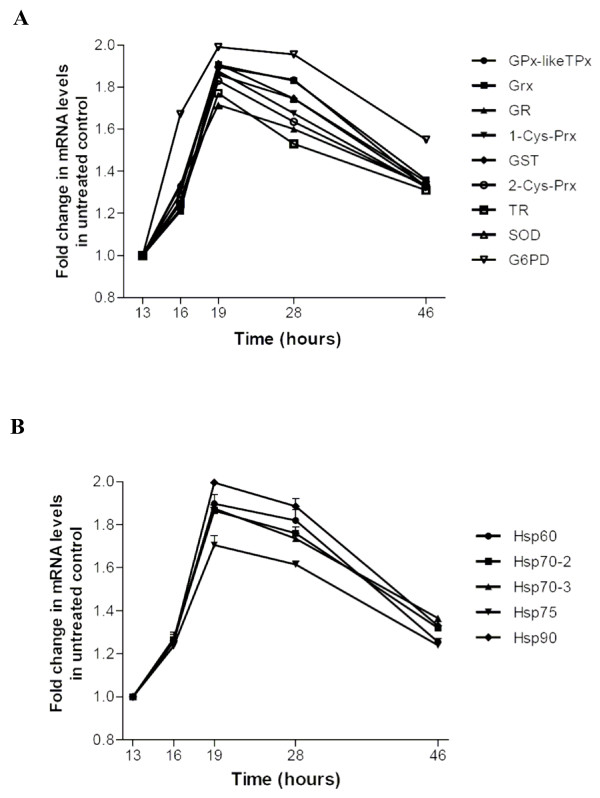
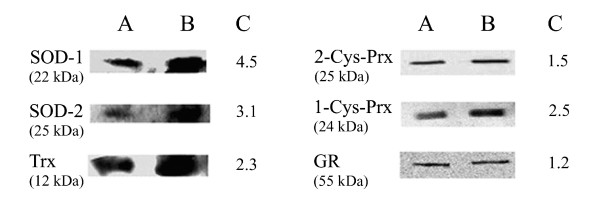
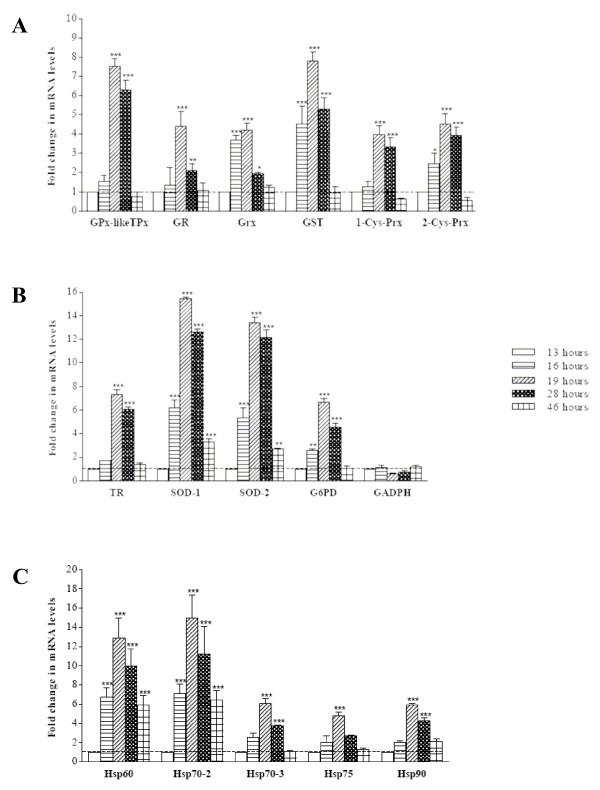
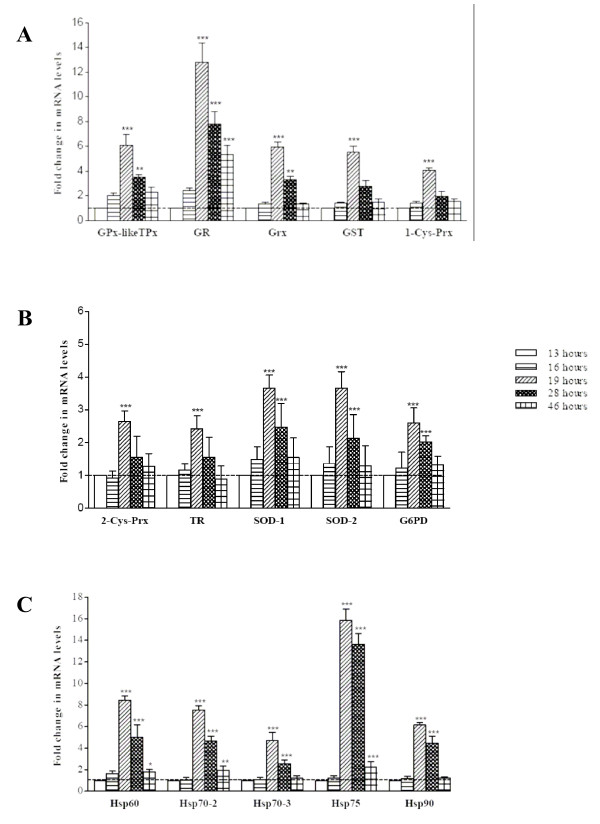
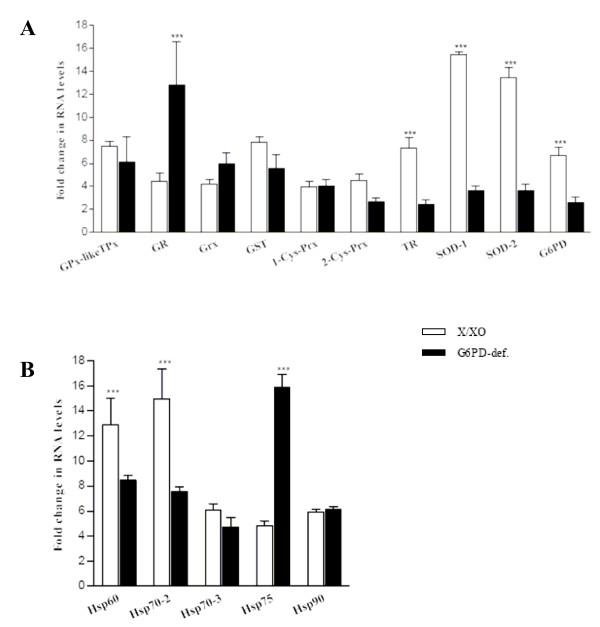
In parasites growing in normal RBCs, mRNA expression of antioxidant enzymes and HSPs displayed co-ordinated stage-dependent modulation, being low at ring, highest at early trophozoite and again very low at schizont stage. Additional exogenous oxidative stress or growth in antioxidant blunted G6PD-deficient RBCs indicated remarkable flexibility of both systems, manifested by enhanced, co-ordinated mRNA expression of antioxidant enzymes and HSPs. Protein expression of antioxidant enzymes was also increased in oxidatively-stressed trophozoites.
Results indicated that mRNA expression of parasite antioxidant enzymes and HSPs was co-ordinated and stage-dependent. Secondly, both systems were redox-responsive and showed remarkably increased and co-ordinated expression in oxidatively-stressed parasites and in parasites growing in antioxidant blunted G6PD-deficient RBCs. Lastly, as important anti-malarials either increase oxidant stress or impair antioxidant defense, results may encourage the inclusion of anti-HSP molecules in anti-malarial combined drugs.
恶性疟原虫寄生的红细胞(RBC)配备有保护性抗氧化酶和热休克蛋白(HSP)。后者仅被认为可抵御热应激。一些重要问题尚未得到充分探索:其一,对于这两个系统如何随寄生虫发育阶段表达了解不足;其二,鉴于真核细胞中HSP的氧化还原敏感性,尚不清楚恶性疟原虫HSP是否具有氧化还原反应性;其三,对于抗氧化防御机制如何应对增加的氧化应激或抗氧化防御受抑制的情况了解甚少。这些问题很有意思,因为几种抗疟药会增加寄生红细胞中的氧化应激或阻断抗氧化防御。此外,目前正在开发多种HSP抑制剂用于癌症治疗,可能会作为抗疟药进行测试。因此,联合破坏寄生虫抗氧化酶/HSP系统将干扰寄生虫生长,并为抗疟疾治疗开辟新的前景。
通过定量实时RT-PCR研究了十种代表性恶性疟原虫抗氧化酶以及hsp60/70-2/70-3/75/90在正常红细胞、由适度产生H2O2导致氧化应激的红细胞以及葡萄糖-6-磷酸脱氢酶(G6PD)缺乏的红细胞中生长的寄生虫中的阶段依赖性mRNA表达。通过蛋白质印迹法检测抗氧化酶的蛋白质表达。在仙台病毒裂解红细胞膜后,测量分离出的寄生虫中的磷酸戊糖途径通量。
在正常红细胞中生长的寄生虫中,抗氧化酶和HSP的mRNA表达呈现出协调的阶段依赖性调节,在环状体阶段较低,在早期滋养体阶段最高,在裂殖体阶段再次非常低。额外的外源性氧化应激或在抗氧化能力减弱的G6PD缺乏红细胞中生长表明这两个系统具有显著的灵活性,表现为抗氧化酶和HSP的mRNA表达增强且协调。在氧化应激的滋养体中,抗氧化酶的蛋白质表达也增加。
结果表明,寄生虫抗氧化酶和HSP的mRNA表达是协调的且具有阶段依赖性。其次,这两个系统具有氧化还原反应性,并且在氧化应激的寄生虫以及在抗氧化能力减弱的G6PD缺乏红细胞中生长的寄生虫中表现出显著增加且协调的表达。最后,由于重要的抗疟药要么增加氧化应激,要么损害抗氧化防御,结果可能会促使在抗疟疾联合药物中加入抗HSP分子。