Intensive Care Unit, Centro Hospitalar Unimed Joinville, Joinville, SC, Brazil.
Clinics (Sao Paulo). 2009;64(4):337-43. doi: 10.1590/s1807-59322009000400012.
To compare variations of plethysmographic wave amplitude (DeltaPpleth) and to determine the percent difference between inspiratory and expiratory pulse pressure (DeltaPp) cutoff values for volume responsiveness in a homogenous population of postoperative cardiac surgery patients.
Intra-thoracic pressure variations interfere with stroke volume variation. Pulse pressure variations through arterial lines during mechanical ventilation have been recommended for the estimation of fluid responsiveness. Pulse oximetry may offer a non-invasive plethysmographic method to evaluate pulse pressure; this may be useful for guiding fluid replacement.
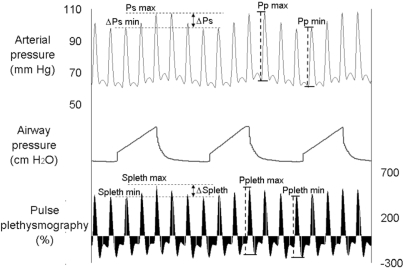
Controlled, prospective study in cardiac surgery patients under controlled ventilation. Simultaneous digital recordings of arterial pressure and plethysmographic waves were performed. DeltaPp, systolic pressure (DeltaPs), DPpleth, and systolic component (DeltaSpleth) were calculated. A DPp > or = 13% identified fluid-responsive patients. Volume expansion was performed in responsive subjects. Systolic and amplitude components of pressure and plethysmographic waves were compared.
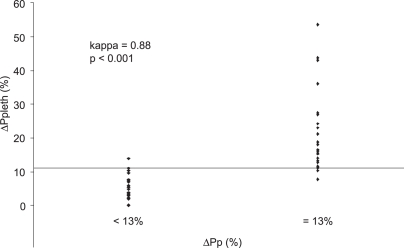
In 50 measurements from 43 patients, DeltaPp was correlated with (Ppleth (r=0.90, p<0.001), (Ps (r=0.90, p<0.001), and (Spleth (r=0.73, p<0.001). An aArea under ROC curve (AUC) identified the fluid responsiveness thresholds: (Ppleth of 11% (AUC = 0.95+/-0.04), (Ps of 8% (AUC=0.93+/-0.05), and (Spleth of 32% (AUC=0.82+/-0.07). A (Ppleth value > or = 11% predicted (Pp > or = 13% with 100% specificity and 91% sensitivity. Volume expansion, performed in 20 patients, changed (Pp, (Ppleth, (Ps and (Spleth significantly (p<0.008).
DeltaPpleth is well correlated with DPp and constitutes a simple and non-invasive method for assessing fluid responsiveness in patients following cardiac surgery.
比较容积反应性患者群体中 pleth 波幅度(DeltaPpleth)的变化,并确定吸气和呼气脉搏压(DeltaPp)的截断值之间的百分比差异。
胸腔内压力变化会干扰每搏量变化。机械通气期间通过动脉线路测量的脉搏压变化已被推荐用于估计液体反应性。脉搏血氧饱和度仪可提供一种非侵入性的 pleth 波方法来评估脉搏压;这可能有助于指导液体替代。
对接受控制通气的心脏手术患者进行对照、前瞻性研究。同时记录动脉压和 pleth 波的数字记录。计算 DeltaPp、收缩压(DeltaPs)、DPpleth 和收缩成分(DeltaSpleth)。DPp>或=13% 可识别出液体反应性患者。在有反应的患者中进行容量扩张。比较压力和 pleth 波的收缩和幅度成分。
在 43 名患者的 50 次测量中,DeltaPp 与 Ppleth(r=0.90,p<0.001)、Ps(r=0.90,p<0.001)和 Spleth(r=0.73,p<0.001)相关。ROC 曲线下面积(AUC)确定了液体反应性的阈值:Ppleth 为 11%(AUC=0.95+/-0.04)、Ps 为 8%(AUC=0.93+/-0.05)和 Spleth 为 32%(AUC=0.82+/-0.07)。Ppleth 值>或=11%(预测 Pp>或=13%)具有 100%特异性和 91%敏感性。在 20 名患者中进行的容量扩张显著改变了 Pp、Ppleth、Ps 和 Spleth(p<0.008)。
DeltaPpleth 与 DPp 密切相关,是一种简单、非侵入性的方法,可用于评估心脏手术后患者的液体反应性。