Exercise Metabolism Unit, Centre for Ageing, Rehabilitation, Exercise and Sport, School of Biomedical and Health Sciences, Victoria University, Melbourne, Australia.
Exercise & Sport Nutrition Lab, Center for Exercise, Nutrition and Preventive Health, Department of Health, Human Performance & Recreation, Baylor University, Waco, Texas, USA.
J Int Soc Sports Nutr. 2009 Jun 2;6:13. doi: 10.1186/1550-2783-6-13.
Eccentric exercise-induced damage leads to reductions in muscle force, increased soreness, and impaired muscle function. Creatine monohydrate's (Cr) ergogenic potential is well established; however few studies have directly examined the effects of Cr supplementation on recovery after damage. We examined the effects of Cr supplementation on muscle proteins and force recovery after eccentrically-induced muscle damage in healthy individuals.
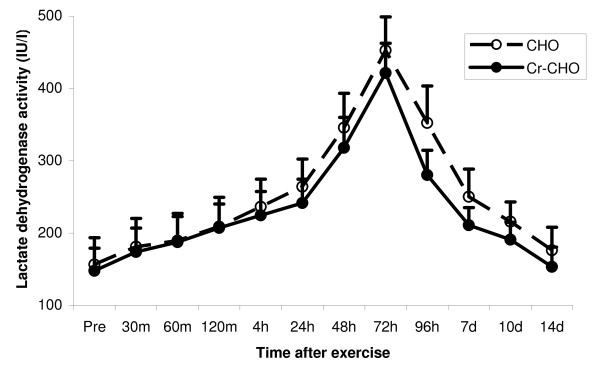
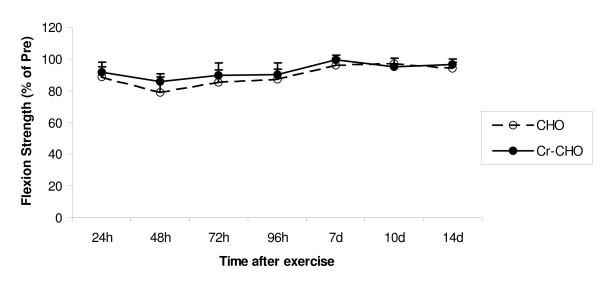
Fourteen untrained male participants (22.1 +/- 2.3 yrs, 173 +/- 7.7 cm, 76.2 +/- 9.3 kg) were randomly separated into 2 supplement groups: i) Cr and carbohydrate (Cr-CHO; n = 7); or ii) carbohydrate (CHO; n = 7). Participants consumed their supplement for a period of 5 days prior to, and 14 days following a resistance exercise session. Participants performed 4 sets of 10 eccentric-only repetitions at 120% of their maximum concentric 1-RM on the leg press, leg extension and leg flexion exercise machine. Plasma creatine kinase (CK) and lactate dehydrogenase (LDH) activity were assessed as relevant blood markers of muscle damage. Muscle strength was examined by voluntary isokinetic knee extension using a Cybex dynamometer. Data were analyzed using repeated measures ANOVA with an alpha of 0.05.
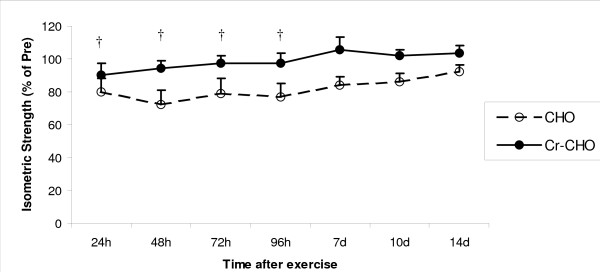
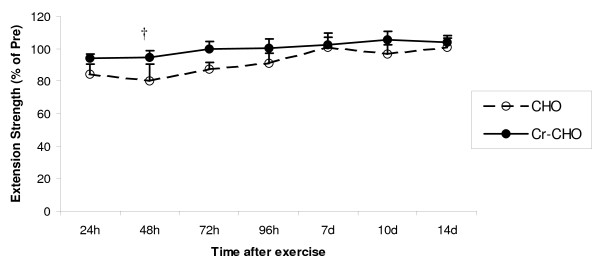
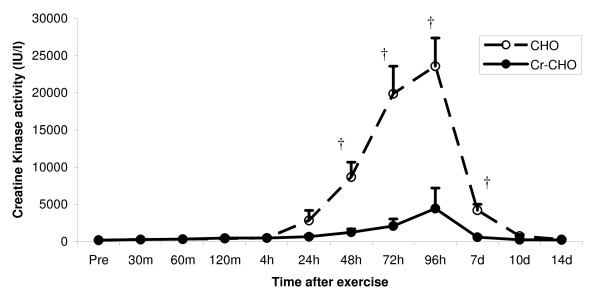
The Cr-supplemented group had significantly greater isokinetic (10% higher) and isometric (21% higher) knee extension strength during recovery from exercise-induced muscle damage. Furthermore, plasma CK activity was significantly lower (by an average of 84%) after 48 hrs (P < 0.01), 72 hrs (P < 0.001), 96 hrs (P < 0.0001), and 7 days (P < 0.001) recovery in the Cr-supplemented group.
The major finding of this investigation was a significant improvement in the rate of recovery of knee extensor muscle function after Cr supplementation following injury.
离心运动引起的损伤会导致肌肉力量下降、酸痛加剧和肌肉功能受损。肌酸单水合物(Cr)的运动表现增强作用已经得到充分证实;然而,很少有研究直接检查 Cr 补充对损伤后恢复的影响。我们研究了 Cr 补充对健康个体离心性肌肉损伤后肌肉蛋白和力量恢复的影响。
14 名未经训练的男性参与者(22.1 ± 2.3 岁,173 ± 7.7cm,76.2 ± 9.3kg)被随机分为 2 个补充组:i)Cr 和碳水化合物(Cr-CHO;n = 7);或 ii)碳水化合物(CHO;n = 7)。参与者在阻力运动前 5 天和 14 天内消耗补充剂。参与者在腿推、腿伸和腿弯运动机上进行 4 组 10 次仅离心重复,每组重复 120%的最大向心 1-RM。血浆肌酸激酶(CK)和乳酸脱氢酶(LDH)活性作为肌肉损伤的相关血液标志物进行评估。使用 Cybex 测力计通过等速膝关节伸展来检查肌肉力量。数据使用重复测量方差分析进行分析,alpha 值为 0.05。
Cr 补充组在运动引起的肌肉损伤恢复过程中,等速(高 10%)和等长(高 21%)膝关节伸展力量明显更大。此外,Cr 补充组在 48 小时(P < 0.01)、72 小时(P < 0.001)、96 小时(P < 0.0001)和 7 天(P < 0.001)恢复时,血浆 CK 活性显著降低(平均降低 84%)。
本研究的主要发现是,在受伤后补充 Cr 可以显著提高膝关节伸肌功能的恢复速度。