Cancer Research UK Epidemiology and Genetics Group, Department of Epidemiology and Population Health, London School of Hygiene and Tropical Medicine, London, UK.
Breast Cancer Res. 2009;11(3):R33. doi: 10.1186/bcr2318. Epub 2009 Jun 3.
Mammographic breast density is one of the strongest known markers of susceptibility to breast cancer. To date research into density has relied on a single measure (for example, percent density (PD)) summarising the average level of density for the whole breast, with no consideration of how the radiodense tissue may be distributed. This study aims to investigate the spatial distribution of density within the breast using 493 mammographic images from a sample of 165 premenopausal women (~3 medio-lateral oblique views per woman).
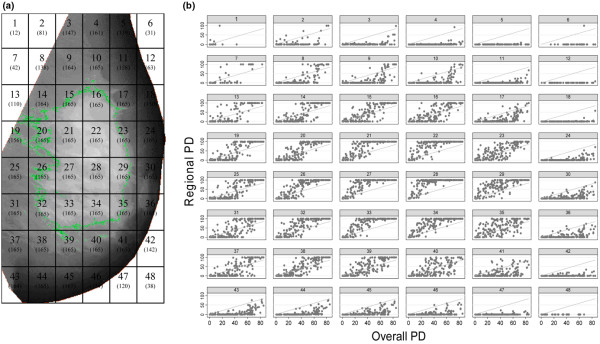
Each breast image was divided into 48 regions and the PD for the whole breast (overall PD) and for each one of its regions (regional PD) was estimated. The spatial autocorrelation (Moran's I value) of regional PD for each image was calculated to investigate spatial clustering of density, whether the degree of clustering varied between a woman's two breasts and whether it was affected by age and other known density correlates.
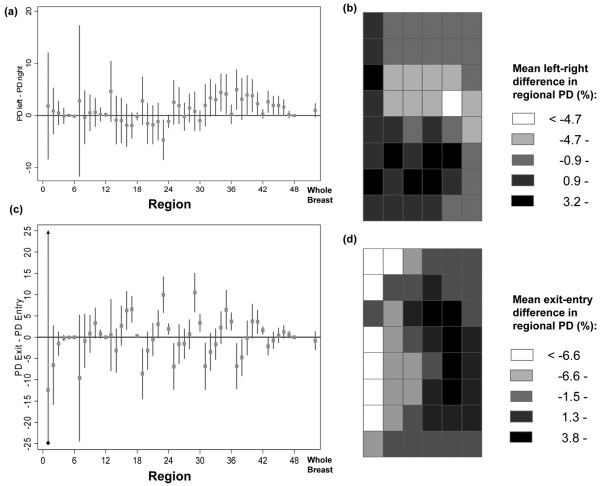
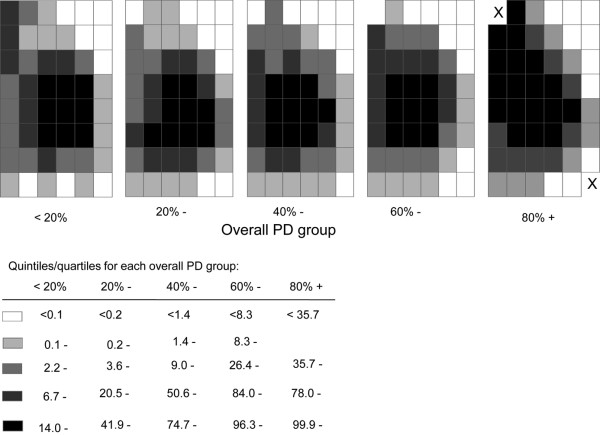
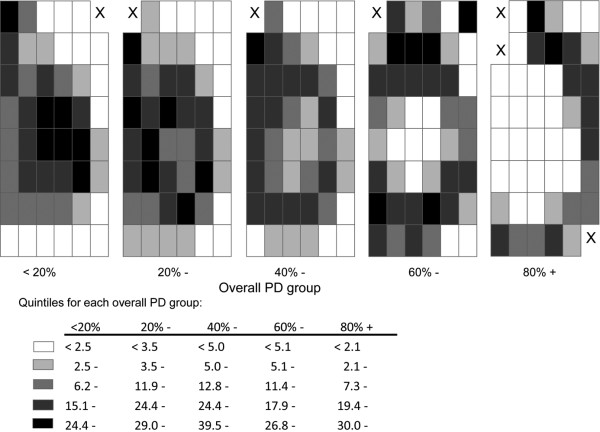
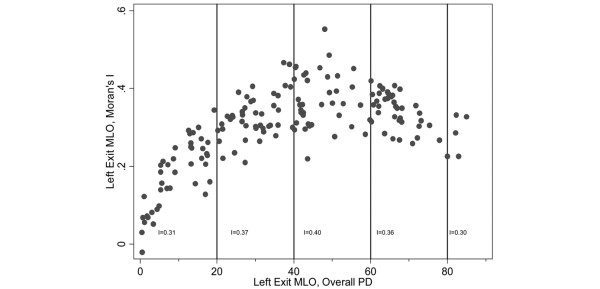
The median Moran's I value for 165 women was 0.31 (interquartile range: 0.26, 0.37), indicating a clustered pattern. High-density areas tended to cluster in the central regions of the breast, regardless of the level of overall PD, but with considerable between-woman variability in regional PD. The degree of clustering was similar between a woman's two breasts (mean within-woman difference in Moran's I values between left and right breasts = 0.00 (95% confidence interval (CI) = -0.01, 0.01); P = 0.76) and did not change with aging (mean within-woman difference in I values between screens taken on average 8 years apart = 0.01 (95% CI = -0.01, 0.02); P = 0.30). Neither parity nor age at first birth affected the level of spatial autocorrelation of density, but increasing body mass index (BMI) was associated with a decrease in the degree of spatial clustering.
This study is the first to demonstrate that the distribution of radiodense tissue within the breast is spatially autocorrelated, generally with the high-density areas clustering in the central regions of the breast. The degree of clustering was similar within a woman's two breasts and between women, and was little affected by age or reproductive factors although it declined with increasing BMI.
乳腺密度是已知的乳腺癌易感性最强的标志物之一。迄今为止,对密度的研究依赖于单一指标(例如,百分比密度(PD))来总结整个乳房的平均密度水平,而没有考虑到致密组织可能的分布方式。本研究旨在使用来自 165 名绝经前女性的 493 张乳房 X 光片(每个女性约有 3 张侧斜位视图)来研究乳房内密度的空间分布。
将每个乳房图像分为 48 个区域,并估计整个乳房的 PD(总体 PD)和每个区域的 PD(区域 PD)。计算每个图像的区域 PD 的空间自相关(Moran's I 值),以研究密度的空间聚类,聚类程度是否在女性的两个乳房之间有所不同,以及是否受年龄和其他已知密度相关因素的影响。
165 名女性的中位数 Moran's I 值为 0.31(四分位距:0.26,0.37),表明存在聚类模式。高密度区域往往聚集在乳房的中央区域,无论总体 PD 水平如何,但区域 PD 在女性之间存在很大的差异。女性两个乳房之间的聚类程度相似(左、右乳房之间 Moran's I 值的平均女性内差异= 0.00(95%置信区间(CI)= -0.01,0.01);P = 0.76),并且不会随年龄变化(两次拍摄之间 I 值的平均女性内差异= 0.01(95% CI = -0.01,0.02);P = 0.30)。生育次数和初产年龄均不影响密度的空间自相关水平,但体重指数(BMI)增加与空间聚类程度降低有关。
本研究首次证明,乳房内致密组织的分布具有空间自相关性,通常高密度区域聚集在乳房的中央区域。在女性的两个乳房之间以及女性之间,聚类程度相似,并且受年龄或生殖因素的影响较小,尽管它随 BMI 的增加而下降。