Department of Medical Oncology, The First Affiliated Hospital, China Medical University, 155 North Nanjing Street, Heping District, Shenyang, PR China.
Lung Cancer. 2010 Feb;67(2):221-6. doi: 10.1016/j.lungcan.2009.04.006. Epub 2009 Jun 3.
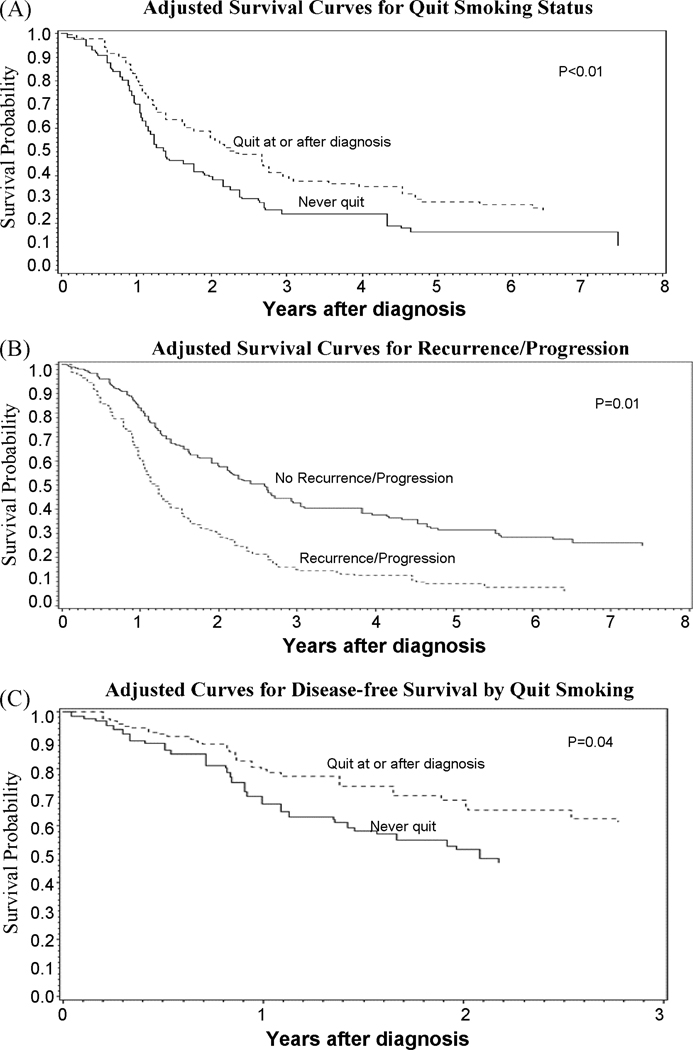
Combined modality therapy is the standard care for limited stage-small cell lung cancer (LS-SCLC) and has led to a significant improvement in patients' survival. This study sought to investigate and define the importance of prognostic effects of known and controversial factors especially the impact of smoking status and treatment strategies. A total of 284 patients with LS-SCLC were diagnosed and prospectively followed from 1997 to 2008 at Mayo Clinic; their characteristics and survival outcome were assessed on the basis of age, gender, smoking history, performance status (PS), tumor recurrence or progression, and treatment using Cox proportional hazards models. Our main results are as follows: (1) Although neither smoking status (former or current smokers) nor intensity (pack-years smoked) at the time of SCLC diagnosis were significant survival predictors, compared to continued smokers (who never quit smoking), patients who quit at or after diagnosis cut the risk of death by 45% (HR=0.55, 95% CI 0.38-0.79); patients who quit before lung cancer diagnosis also experienced survival benefit (HR=0.72, 95% CI 0.52-1.00). (2) Thoracic radiotherapy and platinum-based chemotherapy could significantly improve survival but the timing (within or after one month of diagnosis) of starting chemotherapy or radiation therapy did not. (3) After adjusting for other known factors, a lower PS did not predict poorer survival, suggesting that PS should not be the only factor for making treatment decisions. In conclusion, this study demonstrated the negative impact of continued cigarette smoking on survival; therefore, clinicians and all care providers should strongly encourage smoking cessation at diagnosis of LS-SCLC.
联合治疗模式是局限期小细胞肺癌(LS-SCLC)的标准治疗方法,显著提高了患者的生存率。本研究旨在调查和定义已知和有争议因素的预后作用的重要性,尤其是吸烟状况和治疗策略的影响。1997 年至 2008 年,共有 284 例 LS-SCLC 患者在梅奥诊所被诊断并进行前瞻性随访;根据年龄、性别、吸烟史、体力状态(PS)、肿瘤复发或进展以及治疗情况,使用 Cox 比例风险模型评估其特征和生存结果。我们的主要结果如下:(1)虽然在 SCLC 诊断时的吸烟状况(曾经或现在吸烟)或吸烟量(吸烟年数)均不是显著的生存预测因素,但与持续吸烟者(从不戒烟者)相比,在诊断时或之后戒烟的患者死亡风险降低了 45%(HR=0.55,95%CI 0.38-0.79);在肺癌诊断前戒烟的患者也有生存获益(HR=0.72,95%CI 0.52-1.00)。(2)胸部放疗和铂类化疗均可显著提高生存率,但开始化疗或放疗的时间(在诊断后 1 个月内或之后)并不影响生存率。(3)在调整其他已知因素后,PS 较低并不预示着生存较差,这表明 PS 不应是制定治疗决策的唯一因素。总之,本研究表明持续吸烟对生存有负面影响;因此,临床医生和所有护理提供者应在 LS-SCLC 诊断时强烈鼓励戒烟。