Vasilakis Nikos, Deardorff Eleanor R, Kenney Joan L, Rossi Shannan L, Hanley Kathryn A, Weaver Scott C
Center for Biodefense and Emerging Infectious Diseases and Department of Pathology, University of Texas Medical Branch, Galveston, Texas, United States of America.
PLoS Pathog. 2009 Jun;5(6):e1000467. doi: 10.1371/journal.ppat.1000467. Epub 2009 Jun 5.
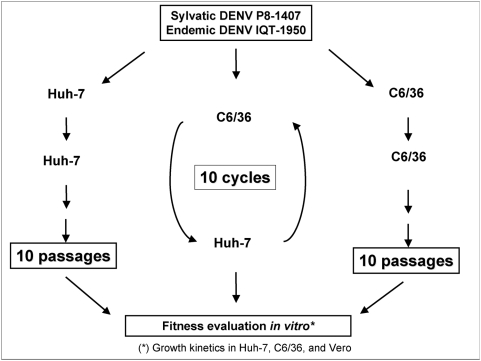
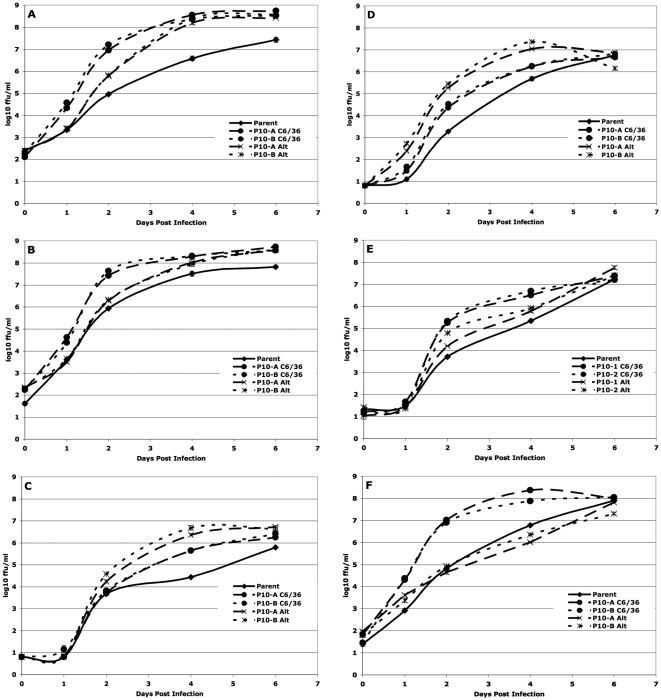
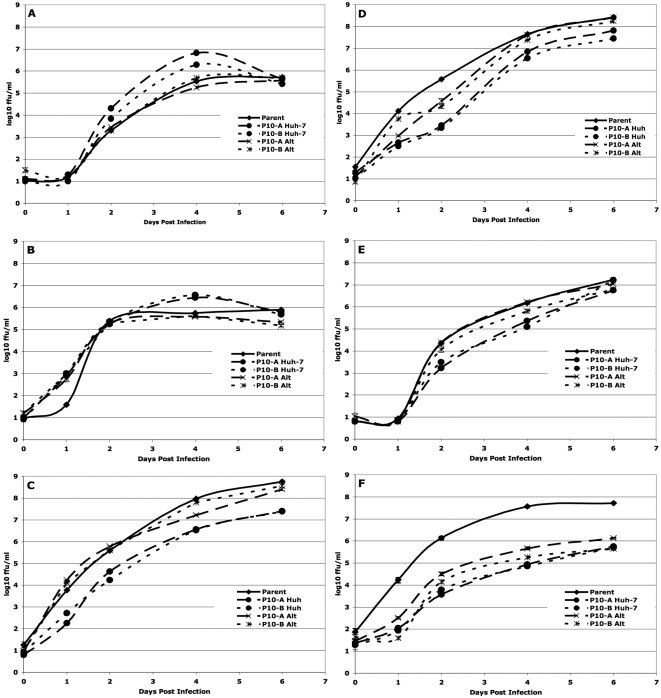
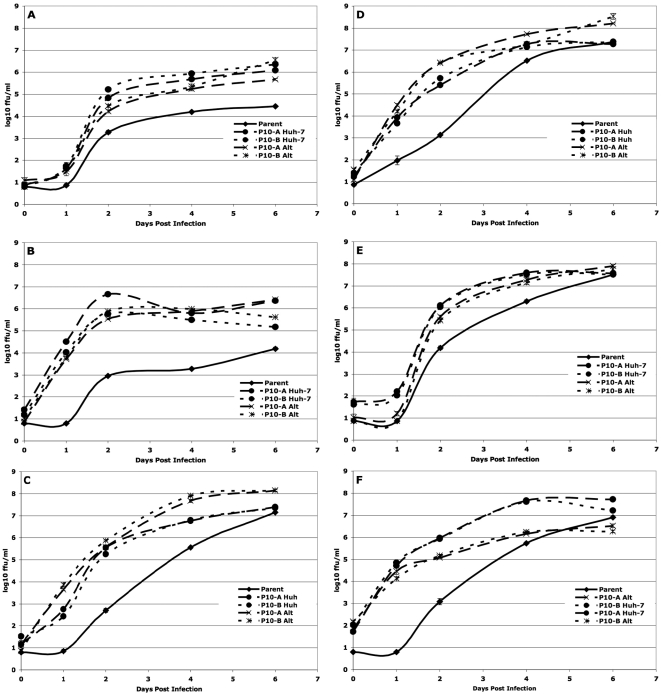
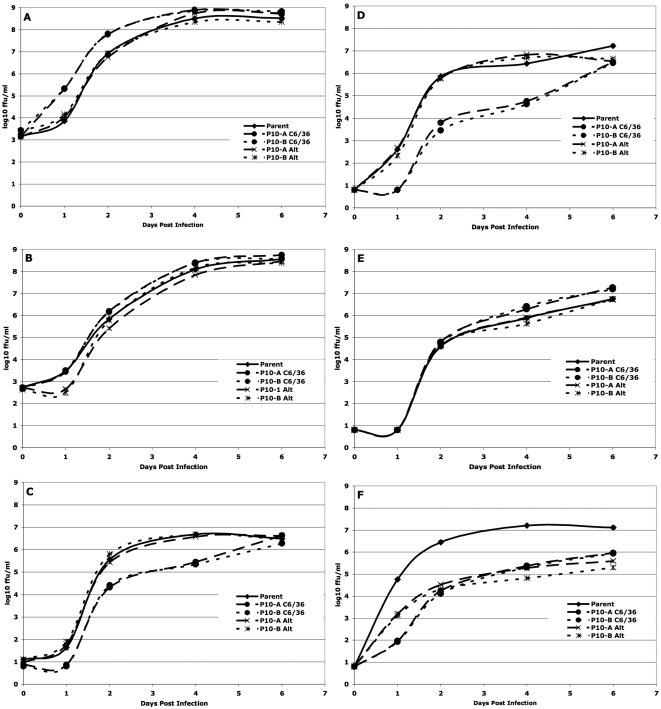
Like other arthropod-borne viruses (arboviruses), mosquito-borne dengue virus (DENV) is maintained in an alternating cycle of replication in arthropod and vertebrate hosts. The trade-off hypothesis suggests that this alternation constrains DENV evolution because a fitness increase in one host usually diminishes fitness in the other. Moreover, the hypothesis predicts that releasing DENV from host alternation should facilitate adaptation. To test this prediction, DENV was serially passaged in either a single human cell line (Huh-7), a single mosquito cell line (C6/36), or in alternating passages between Huh-7 and C6/36 cells. After 10 passages, consensus mutations were identified and fitness was assayed by evaluating replication kinetics in both cell types as well as in a novel cell type (Vero) that was not utilized in any of the passage series. Viruses allowed to specialize in single host cell types exhibited fitness gains in the cell type in which they were passaged, but fitness losses in the bypassed cell type, and most alternating passages, exhibited fitness gains in both cell types. Interestingly, fitness gains were observed in the alternately passaged, cloned viruses, an observation that may be attributed to the acquisition of both host cell-specific and amphi-cell-specific adaptations or to recovery from the fitness losses due to the genetic bottleneck of biological cloning. Amino acid changes common to both passage series suggested convergent evolution to replication in cell culture via positive selection. However, intriguingly, mutations accumulated more rapidly in viruses passed in Huh-7 cells than in those passed in C6/36 cells or in alternation. These results support the hypothesis that releasing DENV from host alternation facilitates adaptation, but there is limited support for the hypothesis that such alternation necessitates a fitness trade-off. Moreover, these findings suggest that patterns of genetic evolution may differ between viruses replicating in mammalian and mosquito cells.
与其他节肢动物传播的病毒(虫媒病毒)一样,蚊媒登革病毒(DENV)在节肢动物宿主和脊椎动物宿主中交替进行复制循环。权衡假说认为,这种交替限制了DENV的进化,因为在一种宿主中适应性的增加通常会降低在另一种宿主中的适应性。此外,该假说预测,使DENV脱离宿主交替应有助于其适应。为了验证这一预测,DENV在单一人类细胞系(Huh-7)、单一蚊细胞系(C6/36)中连续传代,或在Huh-7和C6/36细胞之间交替传代。传代10次后,鉴定出共有突变,并通过评估在两种细胞类型以及在任何传代系列中均未使用的新型细胞类型(Vero)中的复制动力学来测定适应性。在单一宿主细胞类型中传代的病毒在其传代的细胞类型中表现出适应性增加,但在未传代的细胞类型中表现出适应性损失,而大多数交替传代在两种细胞类型中均表现出适应性增加。有趣的是,在交替传代的克隆病毒中观察到适应性增加,这一观察结果可能归因于获得了宿主细胞特异性和双细胞特异性适应性,或归因于从由于生物克隆的遗传瓶颈导致的适应性损失中恢复。两个传代系列共有的氨基酸变化表明通过正选择在细胞培养中趋同进化至复制。然而,有趣的是,在Huh-7细胞中传代的病毒比在C6/36细胞中传代或交替传代的病毒积累突变的速度更快。这些结果支持了使DENV脱离宿主交替有助于适应的假说,但对于这种交替需要适应性权衡的假说支持有限。此外,这些发现表明,在哺乳动物细胞和蚊细胞中复制的病毒之间,遗传进化模式可能不同。