Laboratorio de Arbovirología, Centro de Investigaciones Regionales "Dr. Hideyo Noguchi", Universidad Autónoma de Yucatán, Mérida, México.
Department of Microbiology, Immunology and Pathology, College of Veterinary Medicine and Biomedical Sciences, Colorado State University, Fort Collins, CO, USA.
Parasit Vectors. 2021 May 18;14(1):261. doi: 10.1186/s13071-021-04726-1.
Zika virus (ZIKV) is an arthropod-borne virus (arbovirus) with an urban transmission cycle that primarily involves humans and Aedes aegypti. Evidence suggests that the evolution of some arboviruses is constrained by their dependency on alternating between disparate (vertebrate and invertebrate) hosts. The goals of this study are to compare the genetic changes that occur in ZIKV after serial passaging in mosquito or vertebrate cell lines or alternate passaging in both cell types and to compare the replication, dissemination, and transmission efficiencies of the cell culture-derived viruses in Ae. aegypti.
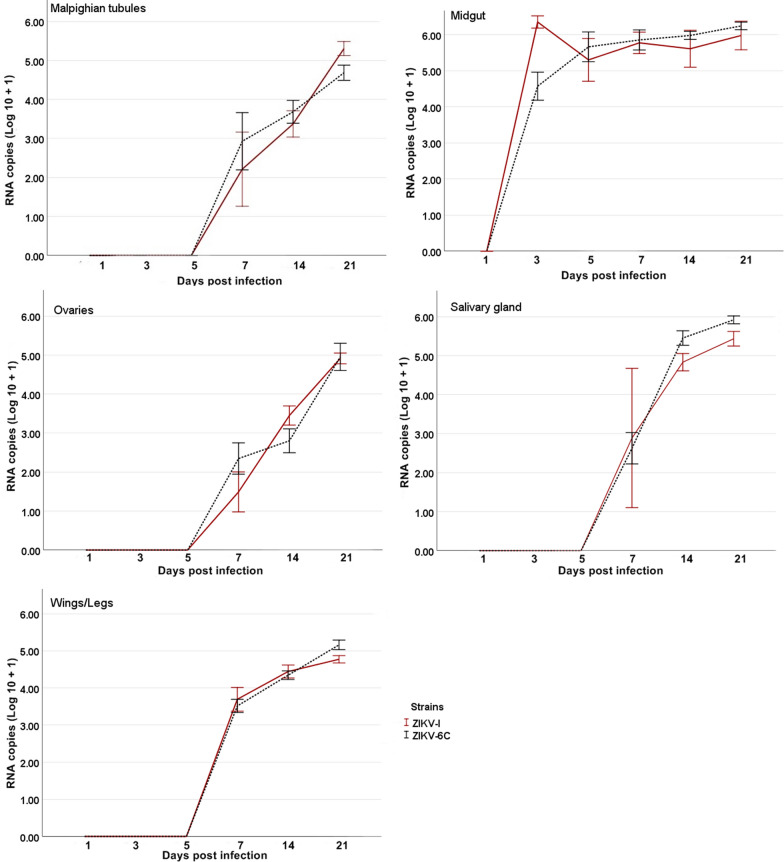
An isolate of ZIKV originally acquired from a febrile patient in Yucatan, Mexico, was serially passaged six times in African green monkey kidney (Vero) cells or Aedes albopictus (C6/36) cells or both cell types by alternating passage. A colony of Ae. aegypti from Yucatan was established, and mosquitoes were challenged with the cell-adapted viruses. Midguts, Malpighian tubules, ovaries, salivary glands, wings/legs and saliva were collected at various times after challenge and tested for evidence of virus infection.
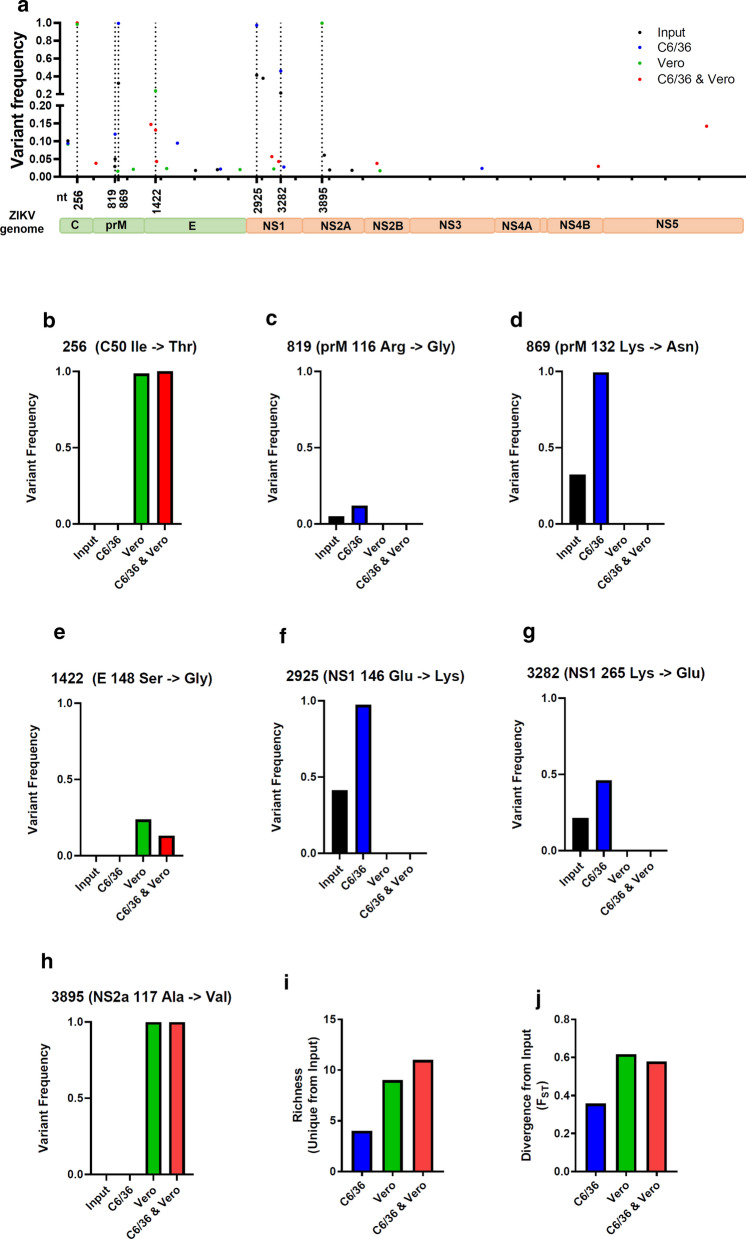
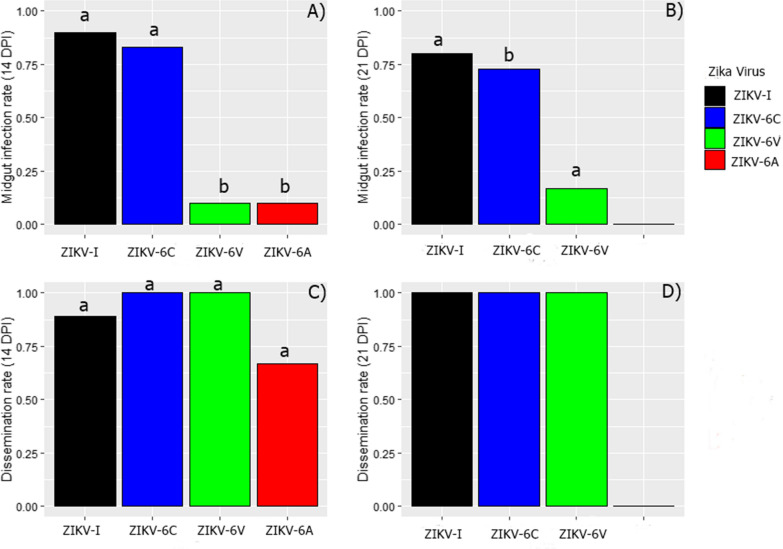
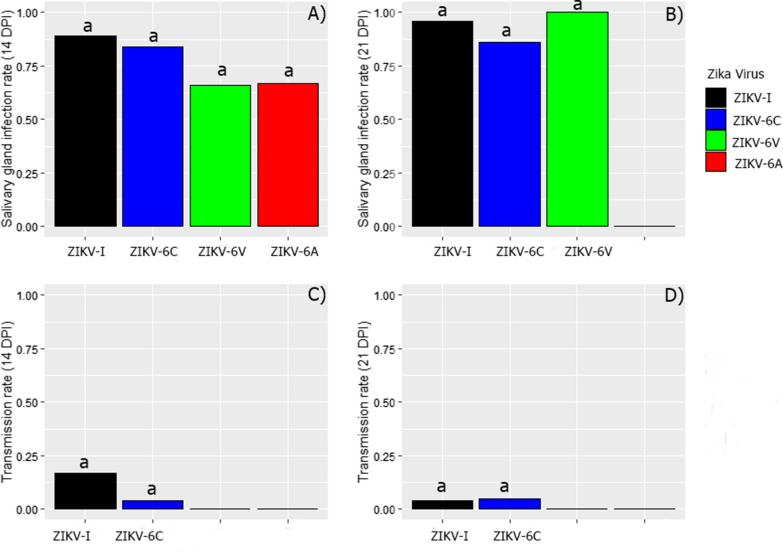
Genome sequencing revealed the presence of two non-synonymous substitutions in the premembrane and NS1 regions of the mosquito cell-adapted virus and two non-synonymous substitutions in the capsid and NS2A regions of both the vertebrate cell-adapted and alternate-passaged viruses. Additional genetic changes were identified by intrahost variant frequency analysis. Virus maintained by continuous C6/36 cell passage was significantly more infectious in Ae. aegypti than viruses maintained by alternating passage and consecutive Vero cell passage.
Mosquito cell-adapted ZIKV displayed greater in vivo fitness in Ae. aegypti compared to the other viruses, indicating that obligate cycling between disparate hosts carries a fitness cost. These data increase our understanding of the factors that drive ZIKV adaptation and evolution and underscore the important need to consider the in vivo passage histories of flaviviruses to be evaluated in vector competence studies.
Zika 病毒(ZIKV)是一种虫媒病毒(arbovirus),具有城市传播周期,主要涉及人类和埃及伊蚊。有证据表明,一些虫媒病毒的进化受到其在不同宿主(脊椎动物和无脊椎动物)之间交替的限制。本研究的目的是比较 ZIKV 在蚊或脊椎动物细胞系中连续传代或在两种细胞类型中交替传代后发生的遗传变化,并比较细胞培养衍生病毒在埃及伊蚊中的复制、传播和传播效率。
从墨西哥尤卡坦州发热患者中分离出的 ZIKV 分离株,在非洲绿猴肾(Vero)细胞或白纹伊蚊(C6/36)细胞或两种细胞类型中连续传代 6 次。建立了来自尤卡坦的埃及伊蚊种群,并对蚊子进行了细胞适应病毒的挑战。在挑战后不同时间收集中肠、马尔皮基小管、卵巢、唾液腺、翅膀/腿和唾液,并检测病毒感染的证据。
基因组测序显示,蚊细胞适应病毒的前膜和 NS1 区存在两个非同义取代,以及脊椎动物细胞适应和交替传代病毒的衣壳和 NS2A 区存在两个非同义取代。通过宿主内变异频率分析鉴定了其他遗传变化。与连续 Vero 细胞传代维持的病毒相比,连续 C6/36 细胞传代维持的病毒在埃及伊蚊中更具感染力。
与其他病毒相比,蚊细胞适应的 ZIKV 在埃及伊蚊中表现出更高的体内适应性,表明在不同宿主之间的强制性循环会带来适应性成本。这些数据增加了我们对驱动 ZIKV 适应和进化的因素的理解,并强调了在媒介效能研究中评估黄病毒的体内传代历史的重要性。