Miranda J Jaime, Gilman Robert H, García Héctor H, Smeeth Liam
Department of Epidemiology and Population Health, London School of Hygiene and Tropical Medicine, London, UK.
BMC Cardiovasc Disord. 2009 Jun 8;9:23. doi: 10.1186/1471-2261-9-23.
Mass-migration observed in Peru from the 1970s occurred because of the need to escape from politically motivated violence and work related reasons. The majority of the migrant population, mostly Andean peasants from the mountainous areas, tends to settle in clusters in certain parts of the capital and their rural environment could not be more different than the urban one. Because the key driver for migration was not the usual economic and work-related reasons, the selection effects whereby migrants differ from non-migrants are likely to be less prominent in Peru. Thus the Peruvian context offers a unique opportunity to test the effects of migration.
METHODS/DESIGN: The PERU MIGRANT (PEru's Rural to Urban MIGRANTs) study was designed to investigate the magnitude of differences between rural-to-urban migrant and non-migrant groups in specific CVD risk factors. For this, three groups were selected: Rural, people who have always have lived in a rural environment; Rural-urban, people who migrated from rural to urban areas; and, Urban, people who have always lived in a urban environment.
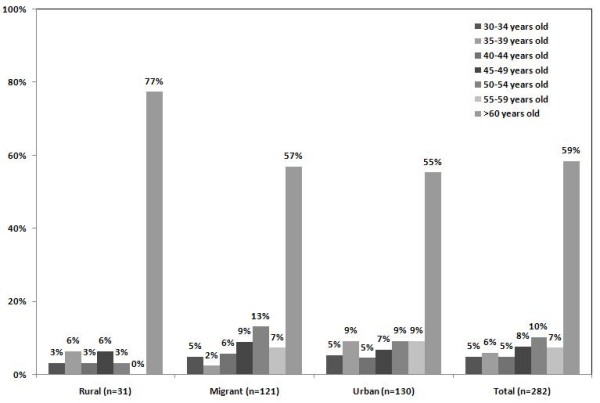
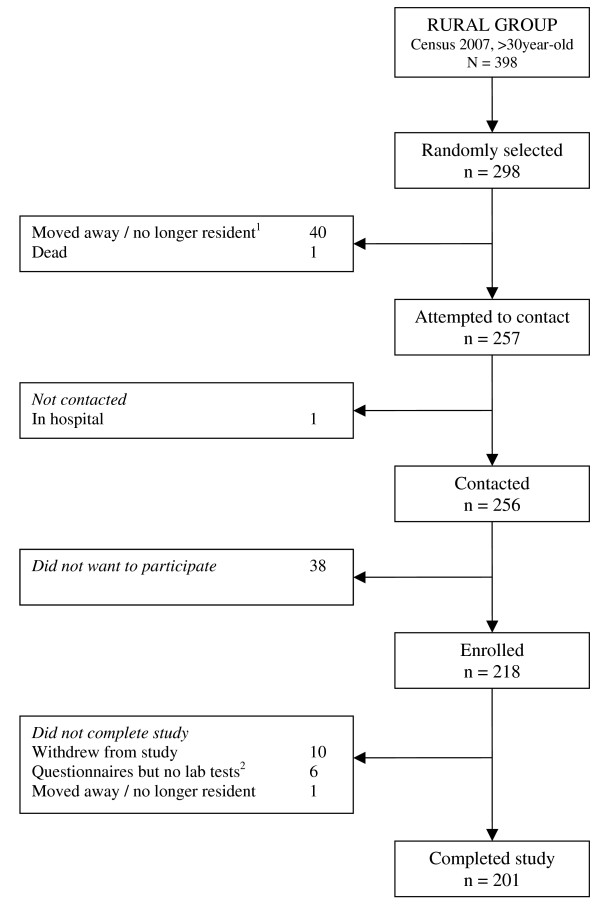
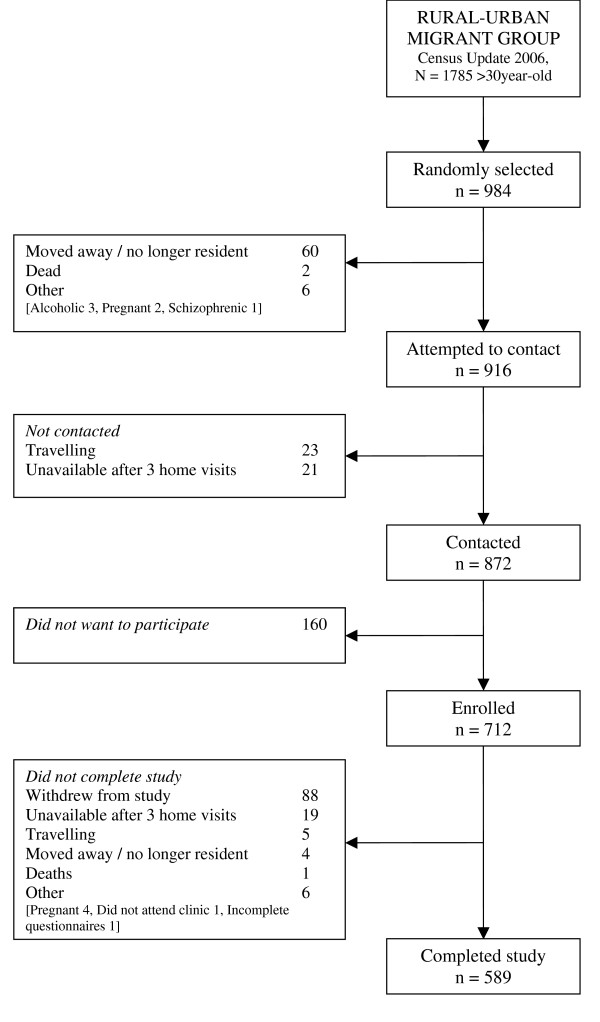
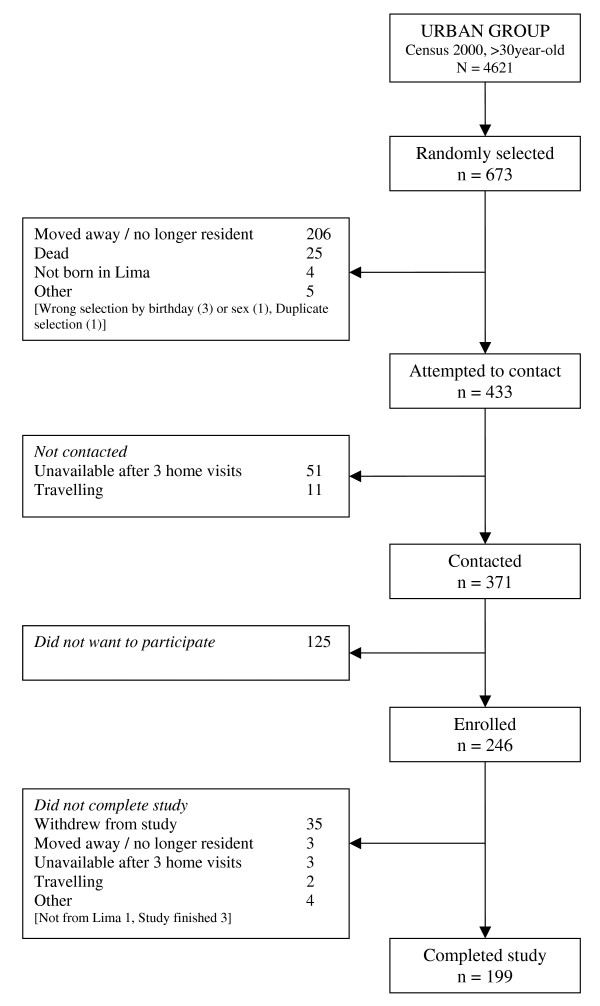
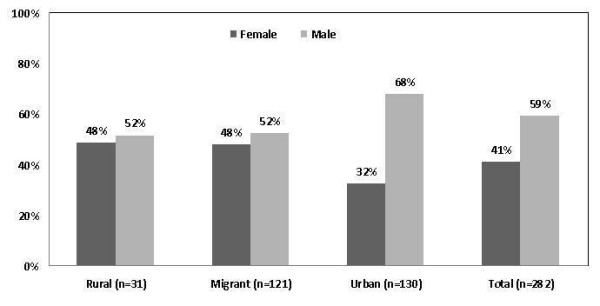
Overall response rate at enrolment was 73.2% and overall response rate at completion of the study was 61.6%. A rejection form was obtained in 282/323 people who refused to take part in the study (87.3%). Refusals did not differ by sex in rural and migrant groups, but 70% of refusals in the urban group were males. In terms of age, most refusals were observed in the oldest age-group (>60 years old) in all study groups. The final total sample size achieved was 98.9% of the target sample size (989/1000). Of these, 52.8% (522/989) were females. Final size of the rural, migrant and urban study groups were 201, 589 and 199 urban people, respectively. Migrant's average age at first migration and years lived in an urban environment were 14.4 years (IQR 10-17) and 32 years (IQR 25-39), respectively. This paper describes the PERU MIGRANT study design together with a critical analysis of the potential for bias and confounding in migrant studies, and strategies for reducing these problems. A discussion of the potential advantages provided by the case of migration in Peru to the field of migration and health is also presented.
20世纪70年代在秘鲁观察到的大规模移民现象,是由于人们需要逃避出于政治动机的暴力以及工作相关原因。大多数移民人口,主要是来自山区的安第斯农民,倾向于在首都的某些地区聚居,他们的农村环境与城市环境截然不同。由于移民的主要驱动因素并非通常的经济和工作相关原因,在秘鲁,移民与非移民之间的选择效应可能不太显著。因此,秘鲁的情况为检验移民的影响提供了独特的机会。
方法/设计:秘鲁移民(从农村到城市的秘鲁移民)研究旨在调查农村到城市的移民群体与非移民群体在特定心血管疾病风险因素方面的差异程度。为此,选取了三组人群:农村组,一直生活在农村环境中的人;农村-城市组,从农村迁移到城市地区的人;以及城市组,一直生活在城市环境中的人。
入组时的总体应答率为73.2%,研究结束时的总体应答率为61.6%。在282/323名拒绝参与研究的人中获得了拒绝表格(87.3%)。农村和移民群体中拒绝参与的情况在性别上没有差异,但城市组中70%的拒绝者为男性。在年龄方面,所有研究组中,大多数拒绝者出现在年龄最大的组(>60岁)。最终达到的总样本量为目标样本量的98.9%(989/1000)。其中,52.8%(522/989)为女性。农村、移民和城市研究组的最终规模分别为201名、589名和199名城市居民。移民首次迁移时的平均年龄和在城市环境中生活的年限分别为14.4岁(四分位间距10 - 17岁)和32岁(四分位间距25 - 39岁)。本文介绍了秘鲁移民研究的设计,以及对移民研究中潜在偏差和混杂因素的批判性分析,还有减少这些问题的策略。还讨论了秘鲁的移民案例为移民与健康领域带来的潜在优势。