Kos Katrina, Wong Steve, Tan Bee, Gummesson Anders, Jernas Margareta, Franck Niclas, Kerrigan David, Nystrom Fredrik H, Carlsson Lena M S, Randeva Harpal S, Pinkney Jonathan H, Wilding John P H
Diabetes and Endocrinology Research Unit, Clinical Sciences Centre, University Hospital Aintree, Liverpool, UK.
Diabetes. 2009 Aug;58(8):1780-8. doi: 10.2337/db09-0211. Epub 2009 Jun 9.
Matricellular Secreted Protein, Acidic and Rich in Cysteine (SPARC), originally discovered in bone as osteonectin, is a mediator of collagen deposition and promotes fibrosis. Adipose tissue collagen has recently been found to be linked with metabolic dysregulation. Therefore, we tested the hypothesis that SPARC in human adipose tissue is influenced by glucose metabolism and adipokines.
Serum and adipose tissue biopsies were obtained from morbidly obese nondiabetic subjects undergoing bariatric surgery and lean control subjects for analysis of metabolic markers, SPARC, and various cytokines (RT-PCR). Additionally, 24 obese subjects underwent a very-low-calorie diet of 1,883 kJ (450 kcal)/day for 16 weeks and serial subcutaneous-abdominal-adipose tissue (SCAT) biopsies (weight loss: 28 +/- 3.7 kg). Another six lean subjects underwent fast-food-based hyperalimentation for 4 weeks (weight gain: 7.2 +/- 1.6 kg). Finally, visceral adipose tissue explants were cultured with recombinant leptin, insulin, and glucose, and SPARC mRNA and protein expression determined by Western blot analyses.
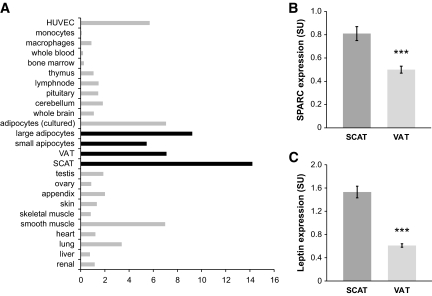
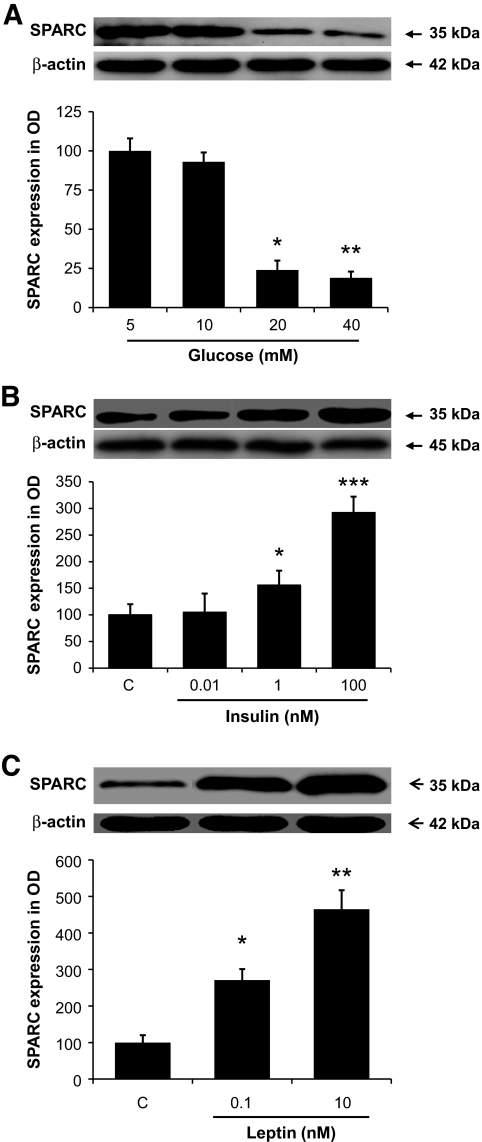
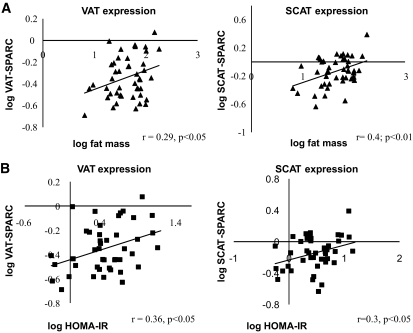
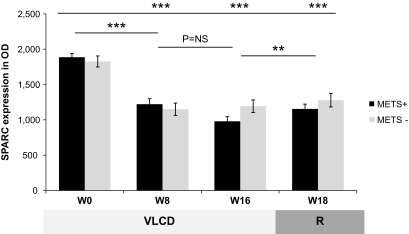
SPARC expression in human adipose tissue correlated with fat mass and was higher in SCAT. Weight loss induced by very-low-calorie diet lowered SPARC expression by 33% and increased by 30% in adipose tissue of subjects gaining weight after a fast-food diet. SPARC expression was correlated with leptin independent of fat mass and correlated with homeostasis model assessment-insulin resistance. In vitro experiments showed that leptin and insulin potently increased SPARC production dose dependently in visceral adipose tissue explants, while glucose decreased SPARC protein.
Our data suggest that SPARC expression is predominant in subcutaneous fat and its expression and secretion in adipose tissue are influenced by fat mass, leptin, insulin, and glucose. The profibrotic effects of SPARC may contribute to metabolic dysregulation in obesity.
基质细胞分泌蛋白,酸性且富含半胱氨酸(SPARC),最初作为骨连接蛋白在骨中被发现,是胶原蛋白沉积的介质并促进纤维化。最近发现脂肪组织胶原蛋白与代谢失调有关。因此,我们检验了这样一个假设,即人类脂肪组织中的SPARC受葡萄糖代谢和脂肪因子影响。
从接受减肥手术的病态肥胖非糖尿病受试者和瘦对照受试者中获取血清和脂肪组织活检样本,以分析代谢标志物、SPARC和各种细胞因子(逆转录聚合酶链反应)。此外,24名肥胖受试者接受了为期16周、每天1883千焦(450千卡)的极低热量饮食,并进行系列皮下腹部脂肪组织(SCAT)活检(体重减轻:28±3.7千克)。另外6名瘦受试者接受了为期4周的基于快餐的高热量饮食(体重增加:7.2±1.6千克)。最后,用重组瘦素、胰岛素和葡萄糖培养内脏脂肪组织外植体,并通过蛋白质免疫印迹分析确定SPARC mRNA和蛋白表达。
人类脂肪组织中SPARC的表达与脂肪量相关,且在SCAT中更高。极低热量饮食导致的体重减轻使SPARC表达降低33%,而在快餐饮食后体重增加的受试者的脂肪组织中增加了30%。SPARC的表达与瘦素相关,独立于脂肪量,并且与稳态模型评估胰岛素抵抗相关。体外实验表明,瘦素和胰岛素在内脏脂肪组织外植体中剂量依赖性地显著增加SPARC的产生,而葡萄糖降低SPARC蛋白。
我们的数据表明,SPARC表达在皮下脂肪中占主导,其在脂肪组织中的表达和分泌受脂肪量、瘦素、胰岛素和葡萄糖影响。SPARC的促纤维化作用可能导致肥胖中的代谢失调。