Kechagias S, Ernersson A, Dahlqvist O, Lundberg P, Lindström T, Nystrom F H
Division of Internal Medicine, Department of Medicine and Care, Faculty of Health Sciences, Linköping University, Linköping, Sweden.
Gut. 2008 May;57(5):649-54. doi: 10.1136/gut.2007.131797. Epub 2008 Feb 14.
To study the effect of fast-food-based hyper-alimentation on liver enzymes and hepatic triglyceride content (HTGC).
Prospective interventional study with parallel control group.
University Hospital of Linköping, Sweden.
12 healthy men and six healthy women with a mean (SD) age of 26 (6.6) years and a matched control group.
Subjects in the intervention group aimed for a body weight increase of 5-15% by eating at least two fast-food-based meals a day with the goal to double the regular caloric intake in combination with adoption of a sedentary lifestyle for 4 weeks.
Weekly changes of serum aminotransferases and HTGC measured by proton nuclear magnetic resonance spectroscopy at baseline and after the intervention.
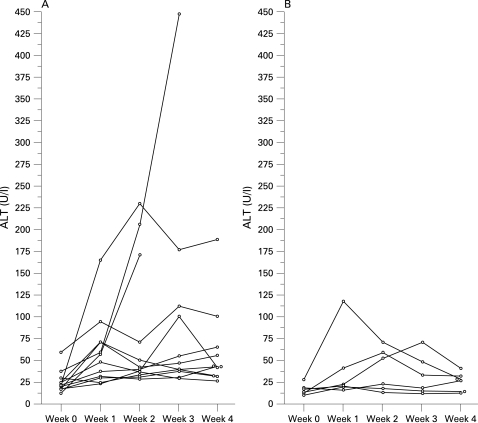
Subjects in the intervention group increased from 67.6 (9.1) kg to 74.0 (11) kg in weight (p<0.001). Serum ALT increased from 22.1 (11.4) U/l at study start to an individual mean maximum level of 97 (103) U/l (range 19.4-447 U/l). Eleven of the 18 subjects persistently showed ALT above reference limits (women >19 U/l, men >30 U/l) during the intervention. Sugar (mono- and disaccharides) intake during week 3 correlated with the maximal ALT/baseline ALT ratio (r = 0.62, p = 0.006). HTGC increased from 1.1 (1.9)% to 2.8 (4.8)%, although this was not related to the increase in ALT levels. ALT levels were unchanged in controls.
Hyper-alimentation per se can induce profound ALT elevations in less than 4 weeks. Our study clearly shows that in the evaluation of subjects with elevated ALT the medical history should include not only questions about alcohol intake but also explore whether recent excessive food intake has occurred.
研究以快餐为主的高热量营养支持对肝酶及肝脏甘油三酯含量(HTGC)的影响。
设有平行对照组的前瞻性干预研究。
瑞典林雪平大学医院。
12名健康男性和6名健康女性,平均(标准差)年龄为26(6.6)岁,以及一个匹配的对照组。
干预组受试者通过每天至少食用两顿以快餐为主的餐食,目标是体重增加5 - 15%,以使常规热量摄入翻倍,并采用久坐不动的生活方式持续4周。
在基线和干预后,通过质子核磁共振波谱法测量血清转氨酶和HTGC的每周变化。
干预组受试者体重从67.6(9.1)千克增加至74.0(11)千克(p<0.001)。血清谷丙转氨酶(ALT)从研究开始时的22.1(11.4)U/L升至个体平均最高水平97(103)U/L(范围为19.4 - 447 U/L)。18名受试者中有11名在干预期间ALT持续高于参考限值(女性>19 U/L,男性>30 U/L)。第3周的糖(单糖和双糖)摄入量与ALT最高值/基线ALT比值相关(r = 0.62,p = 0.006)。HTGC从1.1(1.9)%增至2.8(4.8)%,尽管这与ALT水平升高无关。对照组的ALT水平未发生变化。
高热量营养支持本身可在不到4周的时间内导致ALT显著升高。我们的研究清楚地表明,在评估ALT升高的受试者时,病史不仅应包括关于酒精摄入的问题,还应探究近期是否发生过过量食物摄入。