Griesbach Grace Sophia, Hovda David Allen, Gomez-Pinilla Fernando
Department of Neurosurgery, David Geffen School of Medicine, UCLA, Los Angeles, CA 90095-7039, USA.
Brain Res. 2009 Sep 8;1288:105-15. doi: 10.1016/j.brainres.2009.06.045. Epub 2009 Jun 23.
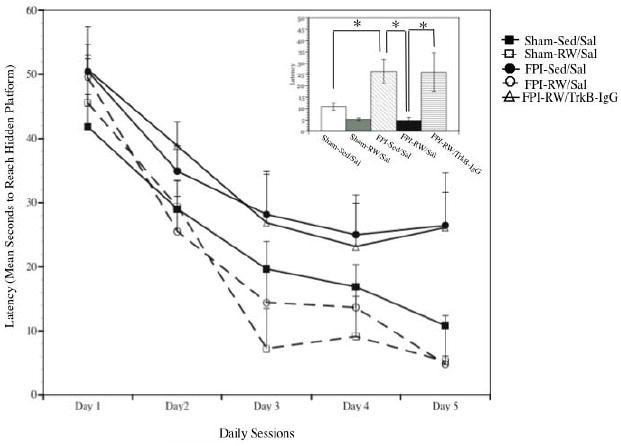
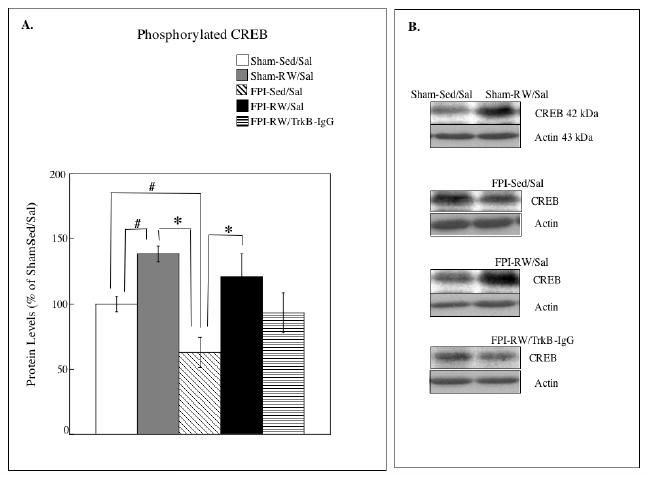
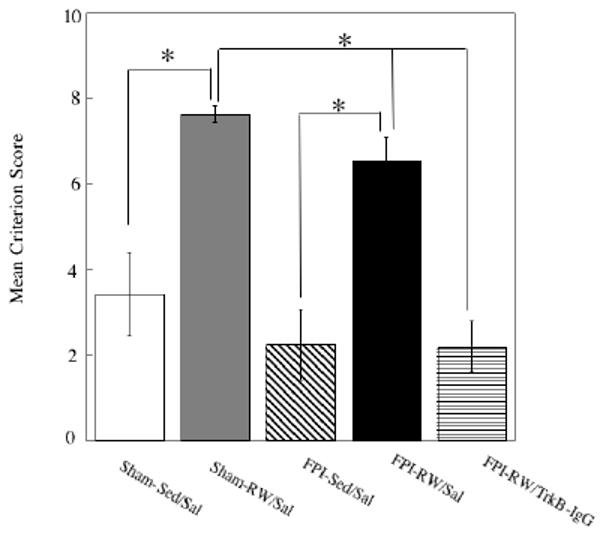
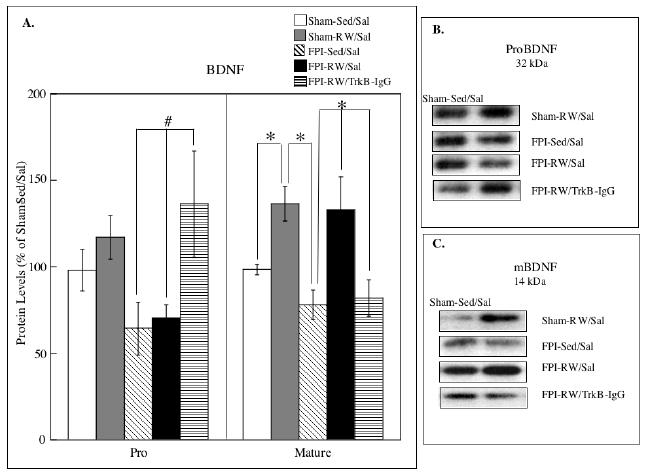
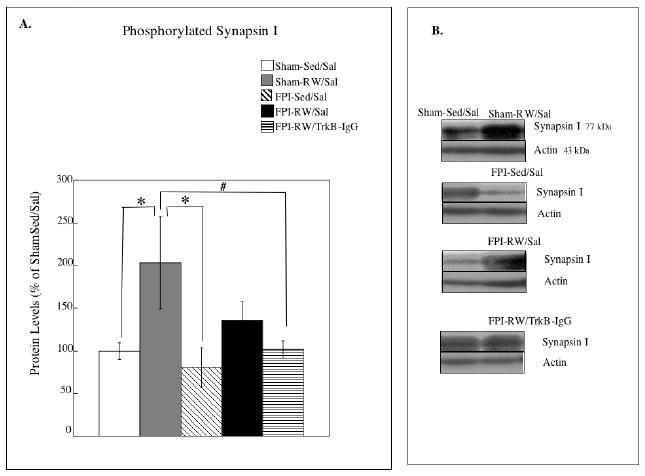
We have previously shown that voluntary exercise upregulates brain derived neurotrophic factor (BDNF) within the hippocampus and is associated with an enhancement of cognitive recovery after a lateral fluid percussion injury (FPI). In order to determine if BDNF is critical to this effect we used an immunoadhesin chimera (TrkB-IgG) that inactivates free BDNF. This BDNF inhibitor was administered to adult male rats two weeks after they had received a mild fluid percussion injury (FPI) or sham surgery. These animals were then housed with or without access to a running wheel (RW) from post-injury-day (PID) 14 to 20. On PID 21, rats were tested for spatial learning in a Morris Water Maze. Results showed that exercise counteracted the cognitive deficits associated with the injury. However this exercise-induced cognitive improvement was attenuated in the FPI-RW rats that were treated with TrkB-IgG. Molecules important for synaptic plasticity and learning were measured in a separate group of rats that were sacrificed immediately after exercise (PID 21). Western blot analyses showed that exercise increased the mature form of BDNF, synapsin I and cyclic-AMP response-element-binding protein (CREB) in the vehicle treated Sham-RW group. However, only the mature form of BDNF and CREB were increased in the vehicle treated FPI-RW group. Blocking BDNF (pre administration of TrkB-IgG) greatly reduced the molecular effects of exercise in that exercise-induced increases of BDNF, synapsin I and CREB were not observed. These studies provide evidence that BDNF has a major role in exercise's cognitive effects in traumatically injured brain.
我们之前已经表明,自愿运动可上调海马体内的脑源性神经营养因子(BDNF),并与侧方流体冲击伤(FPI)后认知恢复的增强相关。为了确定BDNF对这种效应是否至关重要,我们使用了一种使游离BDNF失活的免疫粘附素嵌合体(TrkB-IgG)。在成年雄性大鼠接受轻度流体冲击伤(FPI)或假手术后两周,给它们施用这种BDNF抑制剂。然后,从损伤后第14天(PID)到第20天,将这些动物饲养在有或没有跑步机(RW)的环境中。在PID 21时,对大鼠进行莫里斯水迷宫中的空间学习测试。结果表明,运动抵消了与损伤相关的认知缺陷。然而,在用TrkB-IgG治疗的FPI-RW大鼠中,这种运动诱导的认知改善减弱了。在另一组运动后立即处死(PID 21)的大鼠中,测量了对突触可塑性和学习重要的分子。蛋白质印迹分析表明,在给予载体的假手术-RW组中,运动增加了BDNF的成熟形式、突触素I和环磷酸腺苷反应元件结合蛋白(CREB)。然而,在给予载体的FPI-RW组中,只有BDNF和CREB的成熟形式增加。阻断BDNF(预先施用TrkB-IgG)大大降低了运动的分子效应,因为未观察到运动诱导的BDNF、突触素I和CREB的增加。这些研究提供了证据,表明BDNF在运动对创伤性脑损伤的认知效应中起主要作用。