Mitchell Katelyn M, Dalton Kristine N, Cinelli Michael E
University of Toronto, Toronto, ON, Canada.
University of Waterloo, Waterloo, ON, Canada.
BMC Sports Sci Med Rehabil. 2024 May 17;16(1):112. doi: 10.1186/s13102-024-00900-x.
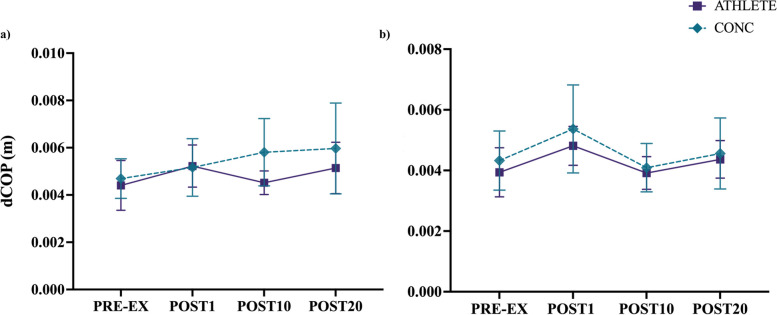
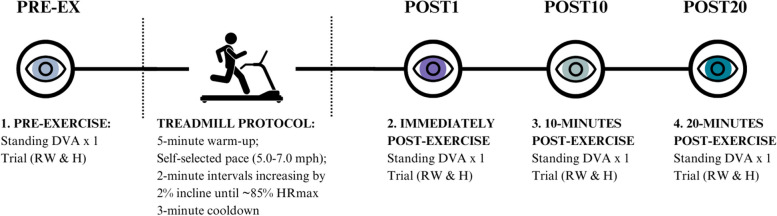
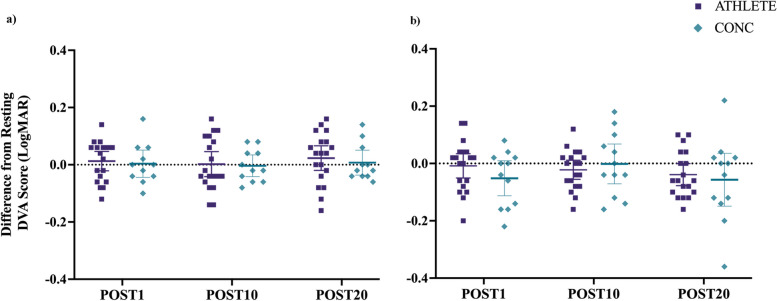
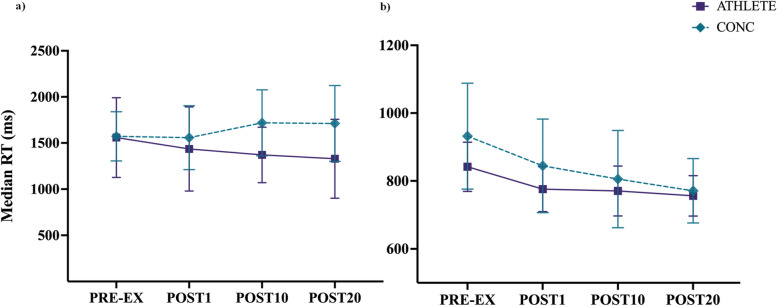
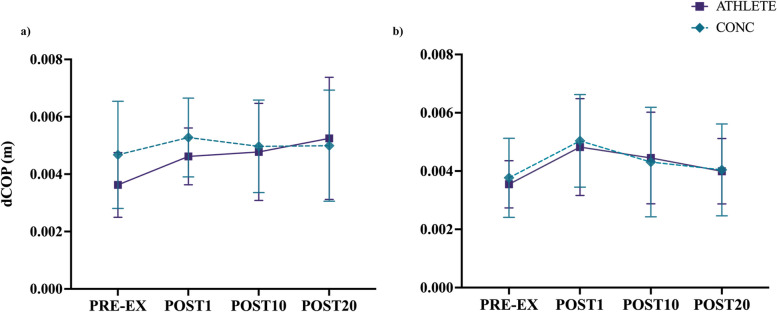
Athletes interpret dynamic visual scenes quickly and accurately during physical exertion. It is important to understand how increased exertion may impact vision and cognition following sport-related concussion (SRC).Purpose To examine the effect of a treadmill running research protocol on the assessment of dynamic visual acuity (DVA) and balance for athletes with and without recent history of SRC.Methods Varsity athletes following recent SRC (CONC=12) were compared to athletes without SRC (ATHLETE=19). The DVA task presented a Tumbling 'E' target in four possible orientations during random walk (RW) or horizontal (H) motion at a speed of 30°/s. Participants performed DVA trials standing on a force plate (1000Hz) at four time points: 1) pre-exercise (PRE-EX), 2) immediately (POST1), 3) 10-minutes (POST10), and 4) 20-minutes post- exercise (POST20). Performance was calculated as a change in DVA score from PRE-EX and median response time (RT, ms). Balance control was analyzed using the root mean square of centre of pressure displacement (dCOP).Results Both groups maintained DVA scores for both motion types and exhibited immediate exercise-induced benefits on RT. Both groups had similar change in balance control strategy following treadmill exercise.Conclusion Both groups elicited similar exercise-induced benefits on DVA following exercise. A repeated measures assessment following vigorous exercise may provide meaningful insights about visual and neurocognitive functions for athletes returning to sport following concussion.
运动员在体力消耗过程中能够快速准确地解读动态视觉场景。了解运动相关脑震荡(SRC)后体力消耗增加如何影响视力和认知非常重要。目的:研究跑步机跑步研究方案对有或无近期SRC病史的运动员动态视力(DVA)和平衡评估的影响。方法:将近期发生SRC的大学生运动员(CONC = 12)与无SRC的运动员(ATHLETE = 19)进行比较。DVA任务在随机行走(RW)或水平(H)运动过程中,以30°/秒的速度呈现四个可能方向的翻转“E”目标。参与者在四个时间点站在测力板(1000Hz)上进行DVA试验:1)运动前(PRE - EX),2)运动后立即(POST1),3)运动后10分钟(POST10),4)运动后20分钟(POST20)。表现以DVA分数相对于运动前的变化和中位反应时间(RT,毫秒)来计算。使用压力中心位移的均方根(dCOP)分析平衡控制。结果:两组在两种运动类型中均保持DVA分数,并且在反应时间上均表现出运动立即带来的益处。两组在跑步机运动后平衡控制策略的变化相似。结论:两组在运动后DVA方面均产生了相似的运动诱导益处。对剧烈运动后的运动员进行重复测量评估可能会为脑震荡后恢复运动的运动员的视觉和神经认知功能提供有意义的见解。