Department of Epidemiology and Biostatistics, Case Western Reserve University, Cleveland, OH, USA.
Cancer Causes Control. 2009 Dec;20(10):1915-26. doi: 10.1007/s10552-009-9385-0.
Genetic polymorphisms that modify the detoxifying activity of glutathione S-transferases (GSTs) can affect the level of carcinogenic metabolites created by endogenous steroid hormones and exogenous chemical substances. Although the GSTM1 null genotype has been shown to increase prostate cancer mortality in Caucasians, potential associations between GST polymorphisms and prostate cancer biochemical recurrence (BCR) have not been well studied, particularly in African-Americans.
We examined potential associations between the GSTM1 null, GSTT1 null and GSTP1 Ile105Val polymorphisms and BCR, after prostatectomy, in 168 African-American and 226 Caucasian patients treated at Henry Ford Hospital in Detroit, Michigan using Cox proportional hazards modeling.
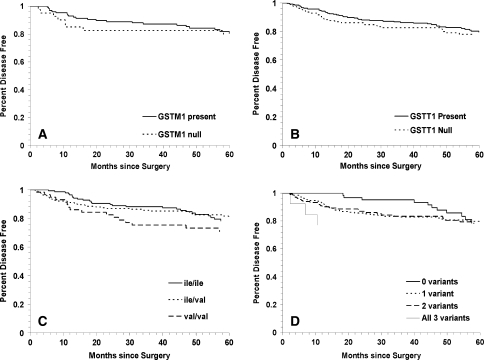
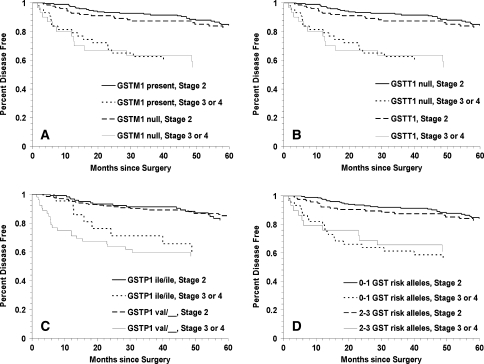
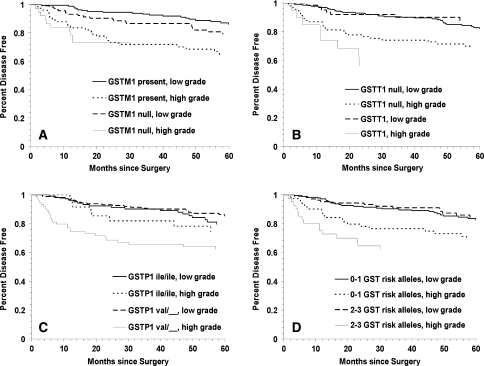
We found that African-Americans with the GSTT1 null genotype had increased BCR risk compared to those having GSTT1 present (hazard ratio (HR) = 2.30; 95% CI = 1.01–5.18; p = 0.04); and African-Americans with the GSTT1 null genotype and high grade tumors had an even greater risk (HR = 7.82; 95% CI = 2.49–24.50; p < 0.001). In Caucasians, an increased risk was observed in those patients with high grade tumors and the GSTM1 null genotype (HR = 2.88; 95% CI = 1.16–7.14; p = 0.02). Similar associations were observed for advanced stage and more aggressive (high grade or advanced stage) disease.
Our results suggest GSTs may hold promise as therapeutic targets in more advanced prostate cancers, particularly, in African-Americans.
能够改变谷胱甘肽 S-转移酶 (GSTs) 解毒活性的遗传多态性,可能会影响内源性甾体激素和外源性化学物质产生的致癌代谢物水平。虽然 GSTM1 缺失基因型已被证明会增加白种人前列腺癌的死亡率,但 GST 多态性与前列腺癌生化复发 (BCR) 之间的潜在关联尚未得到很好的研究,尤其是在非裔美国人中。
我们使用 Cox 比例风险模型,在密歇根州底特律亨利福特医院接受治疗的 168 名非裔美国人和 226 名白种人中,检查了 GSTM1 缺失、GSTT1 缺失和 GSTP1 Ile105Val 多态性与前列腺切除术后 BCR 之间的潜在关联。
我们发现,与 GSTT1 存在的患者相比,具有 GSTT1 缺失基因型的非裔美国人 BCR 风险增加(风险比 (HR) = 2.30;95%置信区间 (CI) = 1.01–5.18;p = 0.04);具有 GSTT1 缺失基因型和高级别肿瘤的非裔美国人风险更高(HR = 7.82;95% CI = 2.49–24.50;p < 0.001)。在白种人中,在具有高级别肿瘤和 GSTM1 缺失基因型的患者中观察到风险增加(HR = 2.88;95% CI = 1.16–7.14;p = 0.02)。在晚期和侵袭性更强(高级别或晚期)疾病中也观察到类似的关联。
我们的结果表明,GST 可能是治疗更晚期前列腺癌的有希望的靶点,特别是在非裔美国人中。