Randall Graham L, Zechiedrich Lynn, Pettitt B Montgomery
Baylor College of Medicine, Houston, TX 77030-3498, USA.
Nucleic Acids Res. 2009 Sep;37(16):5568-77. doi: 10.1093/nar/gkp556. Epub 2009 Jul 8.
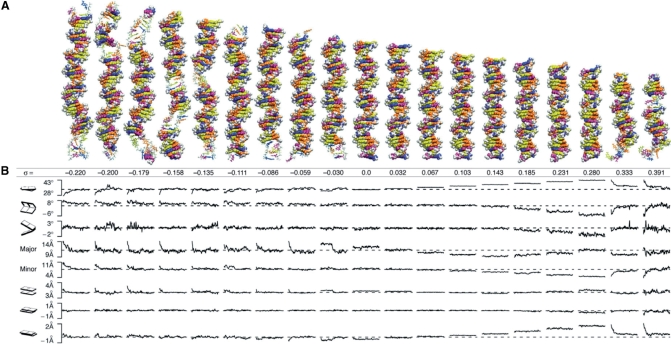
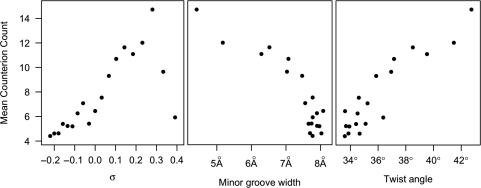
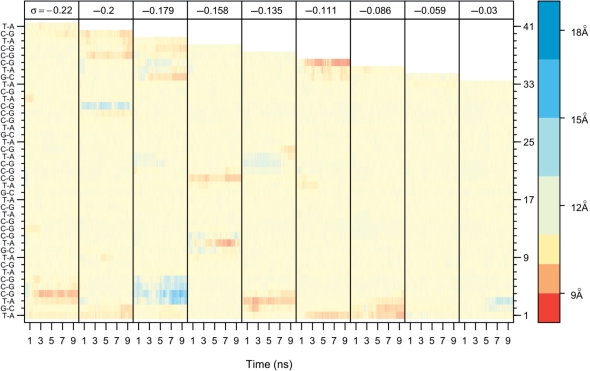
To understand how underwinding and overwinding the DNA helix affects its structure, we simulated 19 independent DNA systems with fixed degrees of twist using molecular dynamics in a system that does not allow writhe. Underwinding DNA induced spontaneous, sequence-dependent base flipping and local denaturation, while overwinding DNA induced the formation of Pauling-like DNA (P-DNA). The winding resulted in a bimodal state simultaneously including local structural failure and B-form DNA for both underwinding and extreme overwinding. Our simulations suggest that base flipping and local denaturation may provide a landscape influencing protein recognition of DNA sequence to affect, for examples, replication, transcription and recombination. Additionally, our findings help explain results from single-molecule experiments and demonstrate that elastic rod models are strictly valid on average only for unstressed or overwound DNA up to P-DNA formation. Finally, our data support a model in which base flipping can result from torsional stress.
为了理解DNA螺旋的欠旋和过旋如何影响其结构,我们在一个不允许扭曲的系统中使用分子动力学模拟了19个具有固定扭转度的独立DNA系统。DNA欠旋会诱导自发的、序列依赖性的碱基翻转和局部变性,而过旋则会诱导类鲍林DNA(P-DNA)的形成。对于欠旋和极端过旋,这种缠绕会导致一种双峰状态,同时包括局部结构破坏和B型DNA。我们的模拟表明,碱基翻转和局部变性可能提供一种影响蛋白质对DNA序列识别的态势,从而影响例如复制、转录和重组等过程。此外,我们的发现有助于解释单分子实验的结果,并表明弹性杆模型平均而言仅在P-DNA形成之前对于无应力或过旋的DNA严格有效。最后,我们的数据支持一个碱基翻转可能由扭转应力导致的模型。