Kollmann Fabian, Ramakrishnan Saminathan, Shen Boxuan, Grundmeier Guido, Kostiainen Mauri A, Linko Veikko, Keller Adrian
Technical and Macromolecular Chemistry, Paderborn University, Warburger Str. 100, 33098 Paderborn, Germany.
Biohybrid Materials, Department of Bioproducts and Biosystems, Aalto University, P.O. Box 16100, FI-00076 Aalto, Finland.
ACS Omega. 2018 Aug 20;3(8):9441-9448. doi: 10.1021/acsomega.8b00934. eCollection 2018 Aug 31.
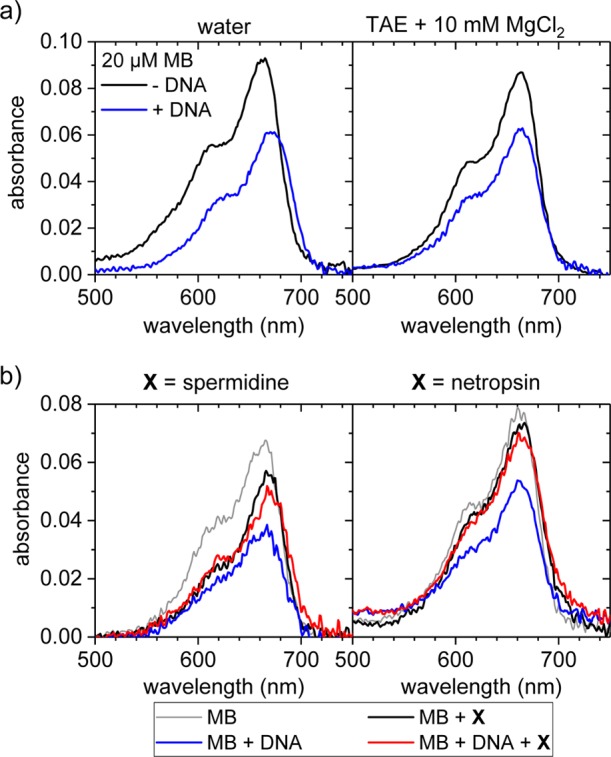
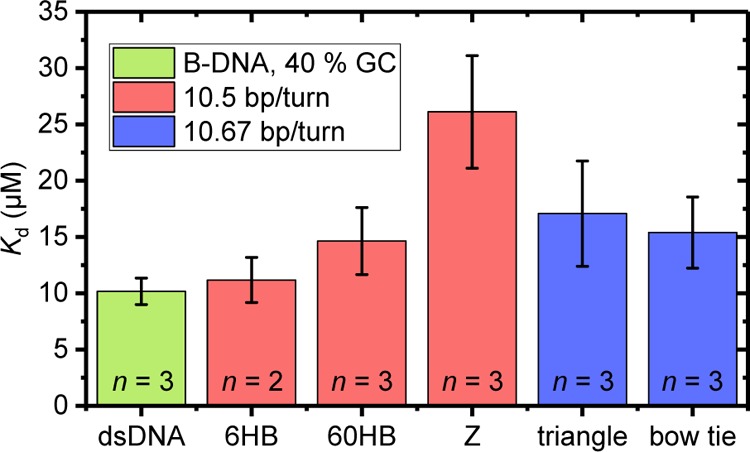
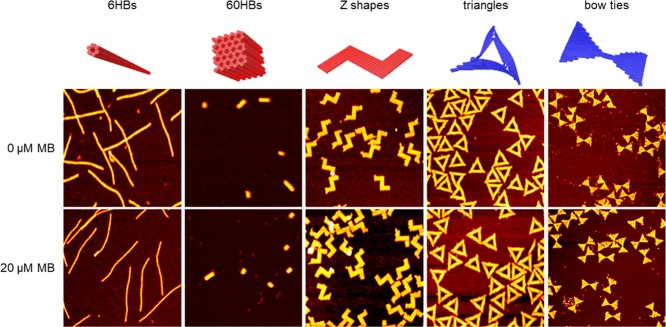
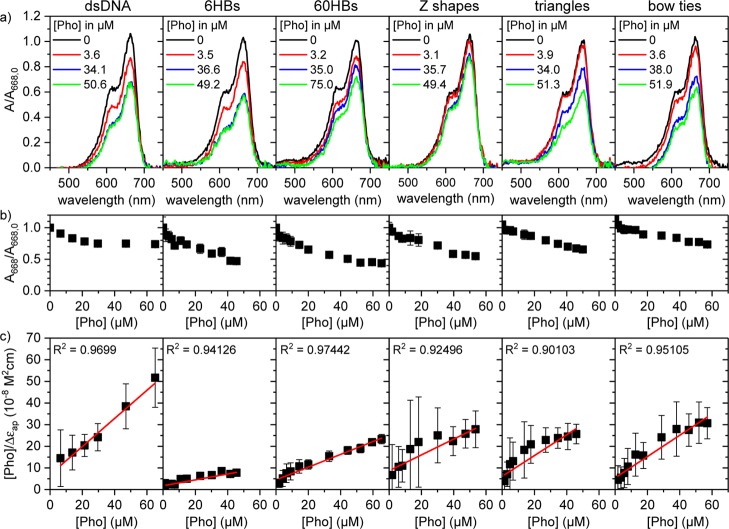
DNA origami nanostructures are regarded as powerful and versatile vehicles for targeted drug delivery. So far, DNA origami-based drug delivery strategies mostly use intercalation of the therapeutic molecules between the base pairs of the DNA origami's double helices for drug loading. The binding of nonintercalating drugs to DNA origami nanostructures, however, is less studied. Therefore, in this work, we investigate the interaction of the drug methylene blue (MB) with different DNA origami nanostructures under conditions that result in minor groove binding. We observe a noticeable effect of DNA origami superstructure on the binding affinity of MB. In particular, non-B topologies as for instance found in designs using the square lattice with 10.67 bp/turn may result in reduced binding affinity because groove binding efficiency depends on groove dimensions. Also, mechanically flexible DNA origami shapes that are prone to structural fluctuations may exhibit reduced groove binding, even though they are based on the honeycomb lattice with 10.5 bp/turn. This can be attributed to the induction of transient over- and underwound DNA topologies by thermal fluctuations. These issues should thus be considered when designing DNA origami nanostructures for drug delivery applications that employ groove-binding drugs.
DNA折纸纳米结构被视为用于靶向药物递送的强大且通用的载体。到目前为止,基于DNA折纸的药物递送策略大多利用治疗分子插入DNA折纸双螺旋的碱基对之间来实现药物装载。然而,非嵌入性药物与DNA折纸纳米结构的结合研究较少。因此,在这项工作中,我们研究了药物亚甲蓝(MB)在导致小沟结合的条件下与不同DNA折纸纳米结构的相互作用。我们观察到DNA折纸超结构对MB结合亲和力有显著影响。特别是,在使用每圈10.67个碱基对的方形晶格设计中发现的非B型拓扑结构可能会导致结合亲和力降低,因为沟结合效率取决于沟的尺寸。此外,易于发生结构波动的机械柔性DNA折纸形状可能表现出较低的沟结合,即使它们基于每圈10.5个碱基对的蜂窝晶格。这可归因于热波动引起的瞬时过度缠绕和欠缠绕DNA拓扑结构。因此,在设计用于使用沟结合药物的药物递送应用的DNA折纸纳米结构时,应考虑这些问题。