Banerjee Ayan, Sammarco Mimi C, Ditch Scott, Wang Jeffrey, Grabczyk Ed
The Department of Genetics, Louisiana State University Health Sciences Center, New Orleans, Louisiana, USA.
PLoS One. 2009 Jul 9;4(7):e6193. doi: 10.1371/journal.pone.0006193.
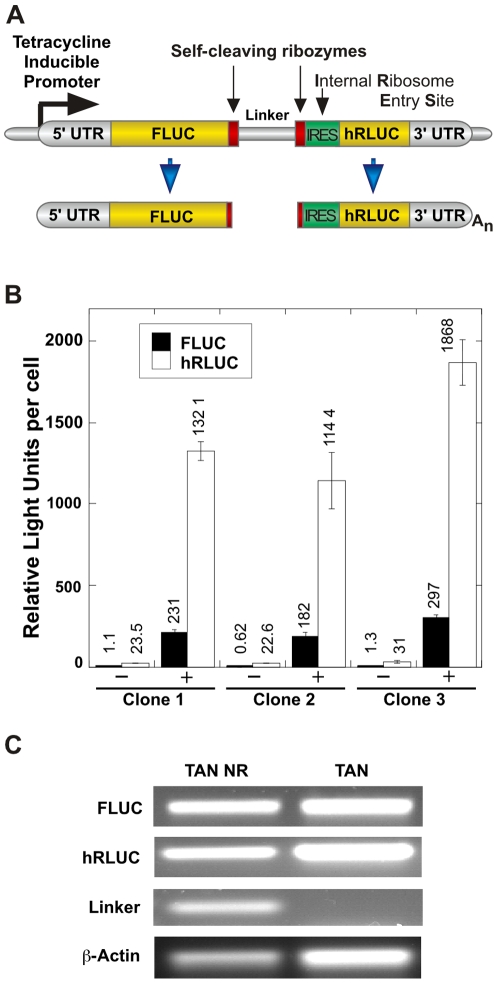
Making the correct choice between transcription elongation and transcription termination is essential to the function of RNA polymerase II, and fundamental to gene expression. This choice can be influenced by factors modifying the transcription complex, factors modifying chromatin, or signals mediated by the template or transcript. To aid in the study of transcription elongation and termination we have developed a transcription elongation reporter system that consists of tandem luciferase reporters flanking a test sequence of interest. The ratio of expression from the reporters provides a measure of the relative rates of successful elongation through the intervening sequence.
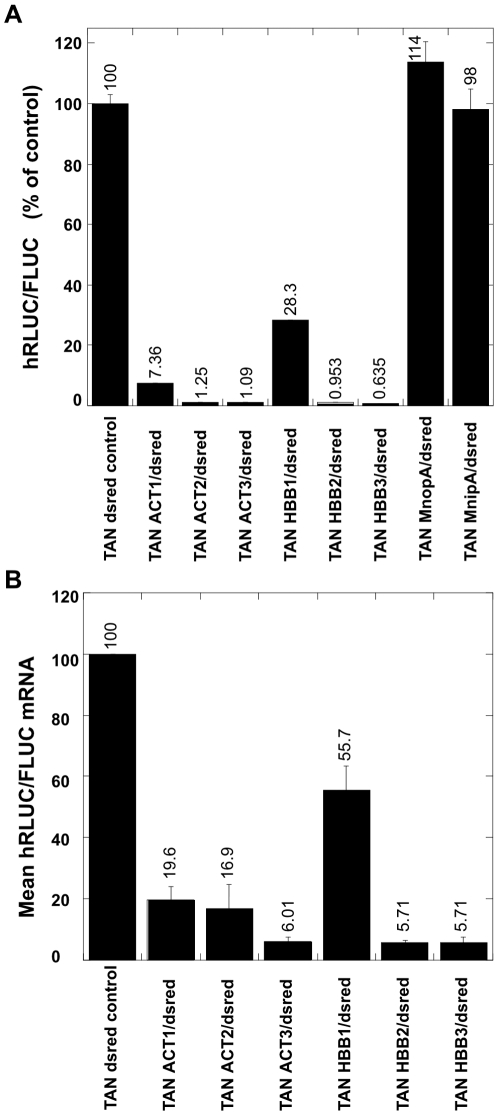
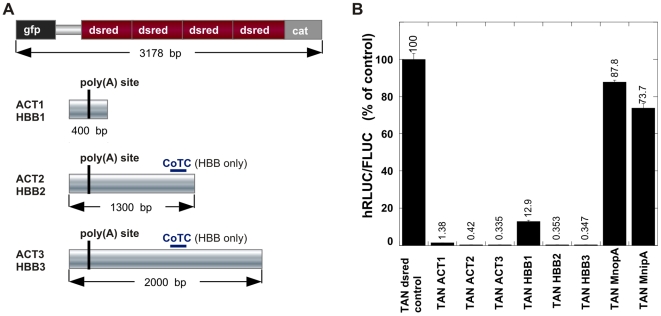
METHODOLOGY/PRINCIPAL FINDINGS: Size matched fragments containing the polyadenylation signal of the human beta-actin gene (ACTB) and the human beta-globin gene (HBB) were evaluated for transcription termination using this new ratiometric tandem reporter assay. Constructs bearing just 200 base pairs on either side of the consensus poly(A) addition site terminated 98% and 86% of transcription for ACTB and HBB sequences, respectively. The nearly 10-fold difference in read-through transcription between the two short poly(A) regions was eclipsed when additional downstream poly(A) sequence was included for each gene. Both poly(A) regions proved very effective at termination when 1100 base pairs were included, stopping 99.6% of transcription. To determine if part of the increased termination was simply due to the increased template length, we inserted several kilobases of heterologous coding sequence downstream of each poly(A) region test fragment. Unexpectedly, the additional length reduced the effectiveness of termination of HBB sequences 2-fold and of ACTB sequences 3- to 5-fold.
CONCLUSIONS/SIGNIFICANCE: The tandem construct provides a sensitive measure of transcription termination in human cells. Decreased Xrn2 or Senataxin levels produced only a modest release from termination. Our data support overlap in allosteric and torpedo mechanisms of transcription termination and suggest that efficient termination is ensured by redundancy.
在转录延伸和转录终止之间做出正确选择对于RNA聚合酶II的功能至关重要,也是基因表达的基础。这种选择会受到修饰转录复合物的因子、修饰染色质的因子或由模板或转录本介导的信号的影响。为了辅助转录延伸和终止的研究,我们开发了一种转录延伸报告系统,该系统由位于感兴趣的测试序列两侧的串联荧光素酶报告基因组成。报告基因的表达比率提供了通过中间序列成功延伸的相对速率的度量。
方法/主要发现:使用这种新的比率式串联报告基因检测法,评估了包含人类β-肌动蛋白基因(ACTB)和人类β-珠蛋白基因(HBB)聚腺苷酸化信号的大小匹配片段的转录终止情况。在共有聚腺苷酸加尾位点两侧仅带有200个碱基对的构建体分别使ACTB和HBB序列的转录终止了98%和86%。当为每个基因包含额外的下游聚腺苷酸序列时,两个短聚腺苷酸区域之间通读转录近10倍的差异就消失了。当包含1100个碱基对时,两个聚腺苷酸区域在终止方面都证明非常有效,阻止了99.6%的转录。为了确定增加的终止部分是否仅仅是由于模板长度增加所致,我们在每个聚腺苷酸区域测试片段的下游插入了几千个碱基的异源编码序列。出乎意料的是,额外的长度使HBB序列的终止效率降低了2倍,使ACTB序列的终止效率降低了3至5倍。
结论/意义:串联构建体提供了一种在人类细胞中敏感检测转录终止的方法。Xrn2或Senataxin水平降低仅导致终止有适度的释放。我们的数据支持转录终止的变构机制和鱼雷机制存在重叠,并表明通过冗余确保了有效终止。