Institute of Biochemistry, Faculty of Biosciences, Pharmacy and Psychology, Leipzig University, Brüderstr, 34, 04103 Leipzig, Germany.
Cell Commun Signal. 2009 Jul 14;7:16. doi: 10.1186/1478-811X-7-16.
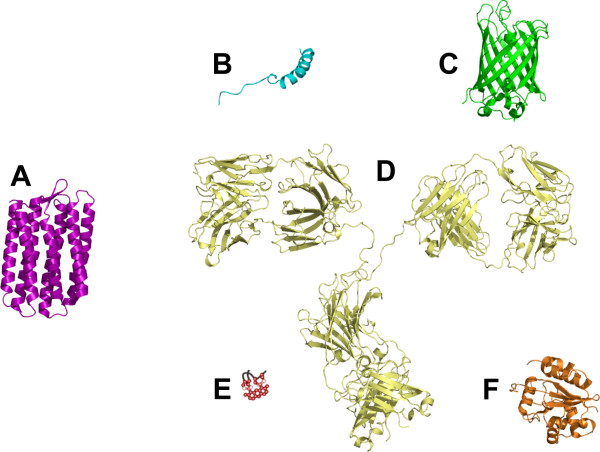
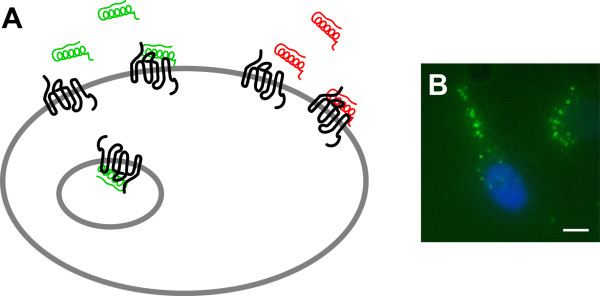
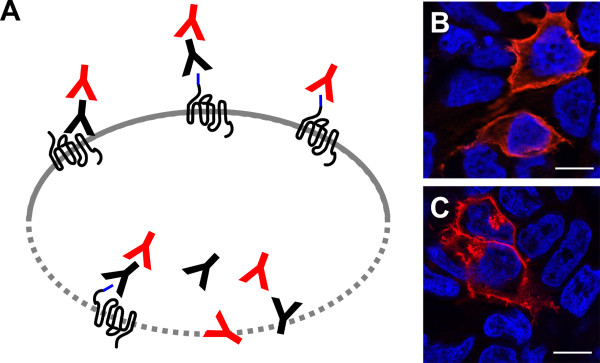
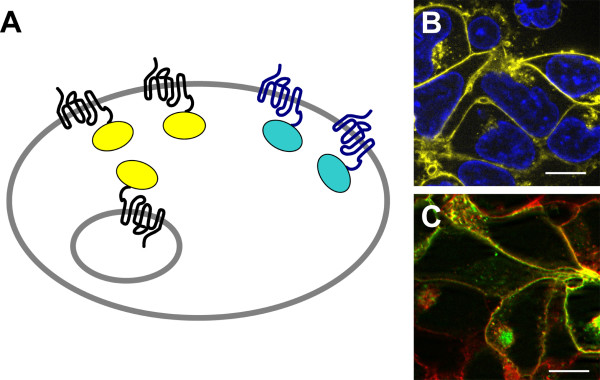
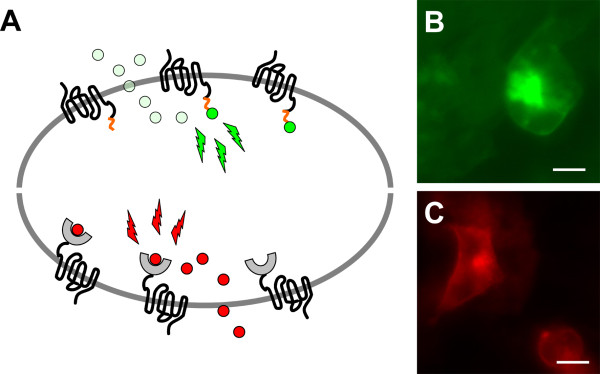
The investigation of biological systems highly depends on the possibilities that allow scientists to visualize and quantify biomolecules and their related activities in real-time and non-invasively. G-protein coupled receptors represent a family of very dynamic and highly regulated transmembrane proteins that are involved in various important physiological processes. Since their localization is not confined to the cell surface they have been a very attractive "moving target" and the understanding of their intracellular pathways as well as the identified protein-protein-interactions has had implications for therapeutic interventions. Recent and ongoing advances in both the establishment of a variety of labeling methods and the improvement of measuring and analyzing instrumentation, have made fluorescence techniques to an indispensable tool for GPCR imaging. The illumination of their complex life cycle, which includes receptor biosynthesis, membrane targeting, ligand binding, signaling, internalization, recycling and degradation, will provide new insights into the relationship between spatial receptor distribution and function. This review covers the existing technologies to track GPCRs in living cells. Fluorescent ligands, antibodies, auto-fluorescent proteins as well as the evolving technologies for chemical labeling with peptide- and protein-tags are described and their major applications concerning the GPCR life cycle are presented.
生物系统的研究在很大程度上取决于使科学家能够实时、非侵入性地可视化和定量生物分子及其相关活性的可能性。G 蛋白偶联受体是一类非常动态和高度调节的跨膜蛋白,它们参与各种重要的生理过程。由于它们的定位不限于细胞表面,因此它们一直是一个非常有吸引力的“移动目标”,对它们的细胞内途径以及已确定的蛋白-蛋白相互作用的了解对治疗干预具有重要意义。在建立各种标记方法和改进测量和分析仪器方面的最新进展和持续进展,使得荧光技术成为 GPCR 成像不可或缺的工具。对其复杂生命周期的研究,包括受体生物合成、膜靶向、配体结合、信号转导、内化、回收和降解,将为空间受体分布与功能之间的关系提供新的见解。这篇综述涵盖了在活细胞中追踪 GPCR 的现有技术。描述了荧光配体、抗体、自体荧光蛋白以及用于肽和蛋白标记的化学标记的新兴技术,并介绍了它们在 GPCR 生命周期方面的主要应用。