Hauptman-Woodward Medical Research Institute and Department of Structural Biology, State University of New York at Buffalo, Buffalo, New York 14203-1102, USA.
ACS Chem Biol. 2009 Oct 16;4(10):811-27. doi: 10.1021/cb900156h.
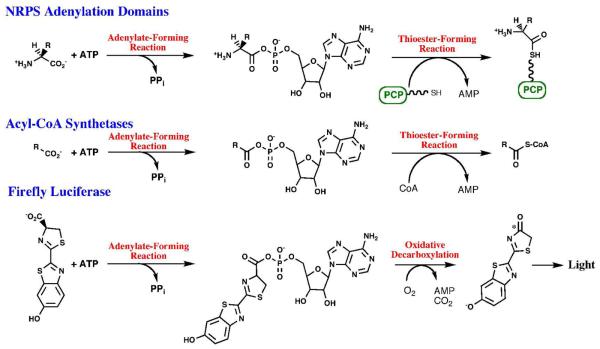
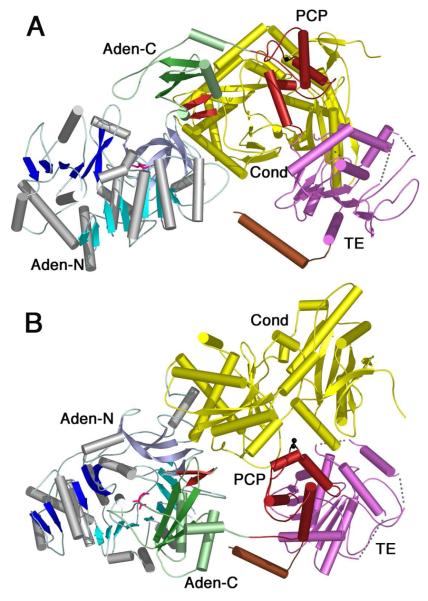
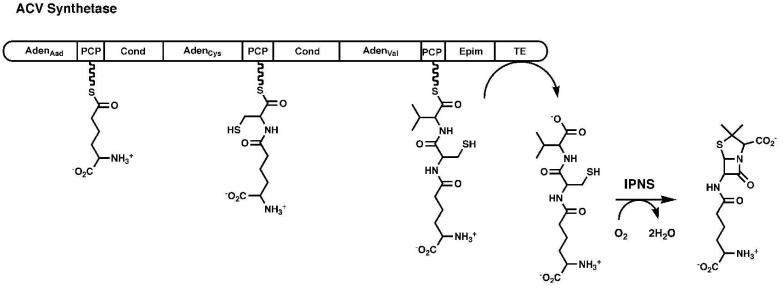
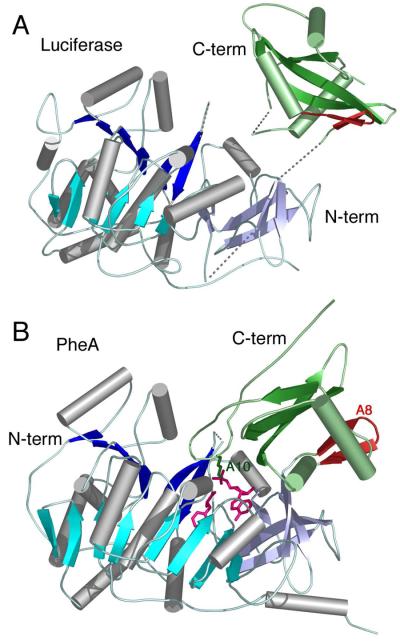
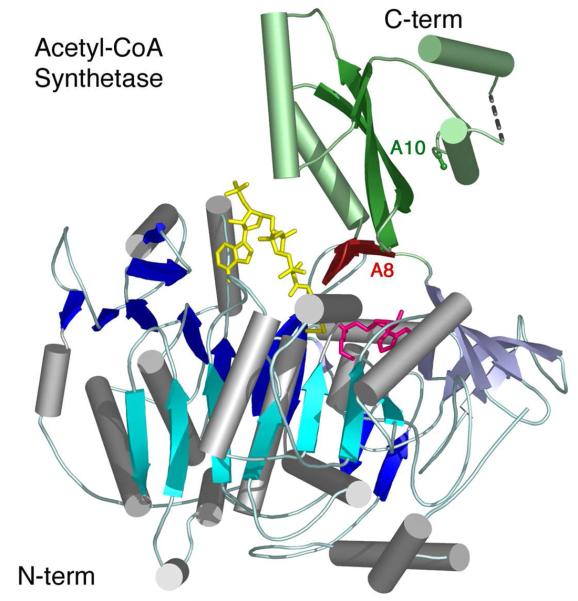
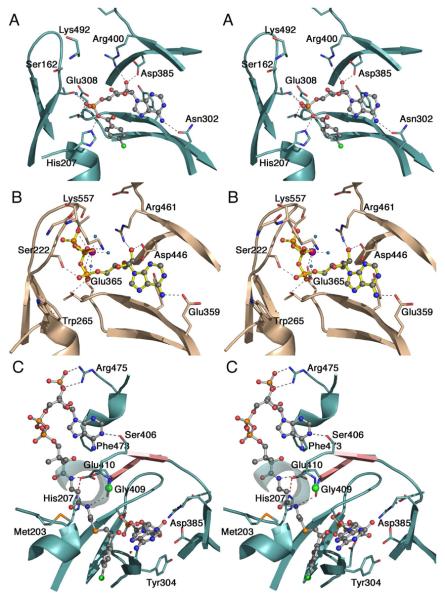
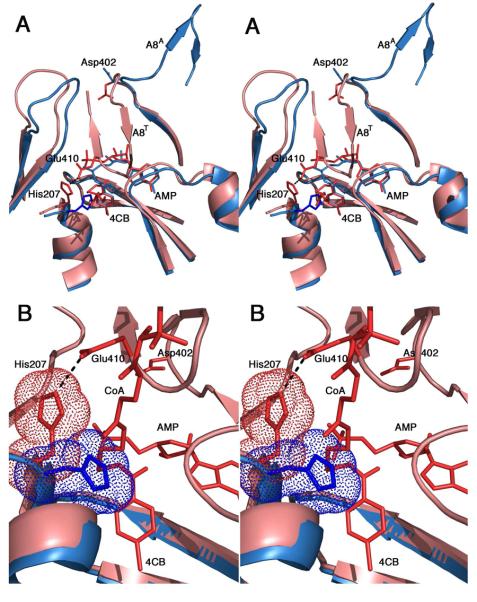
The ANL superfamily of adenylating enzymes contains acyl- and aryl-CoA synthetases, firefly luciferase, and the adenylation domains of the modular non-ribosomal peptide synthetases (NRPSs). Members of this family catalyze two partial reactions: the initial adenylation of a carboxylate to form an acyl-AMP intermediate, followed by a second partial reaction, most commonly the formation of a thioester. Recent biochemical and structural evidence has been presented that supports the use by this enzyme family of a remarkable catalytic strategy for the two catalytic steps. The enzymes use a 140 degrees domain rotation to present opposing faces of the dynamic C-terminal domain to the active site for the different partial reactions. Support for this domain alternation strategy is presented along with an explanation of the advantage of this catalytic strategy for the reaction catalyzed by the ANL enzymes. Finally, the ramifications of this domain rotation in the catalytic cycle of the modular NRPS enzymes are discussed.
腺嘌呤核苷酸转移酶超家族包含酰基和芳基 CoA 合成酶、萤火虫荧光素酶以及模块化非核糖体肽合酶(NRPS)的腺嘌呤转移酶结构域。该家族的成员催化两个部分反应:羧酸的初始腺苷酸化形成酰基-AMP 中间体,然后是第二个部分反应,通常是形成硫酯。最近的生化和结构证据表明,该酶家族使用了一种非凡的催化策略来进行这两个催化步骤。这些酶通过 140 度的结构域旋转,将动态 C 末端结构域的相对面呈现给活性位点,以进行不同的部分反应。本文介绍了这种结构域交替策略的支持证据,并解释了该催化策略对 ANL 酶催化反应的优势。最后,讨论了这种结构域旋转在模块化 NRPS 酶催化循环中的影响。