Wawer Maria J, Makumbi Frederick, Kigozi Godfrey, Serwadda David, Watya Stephen, Nalugoda Fred, Buwembo Dennis, Ssempijja Victor, Kiwanuka Noah, Moulton Lawrence H, Sewankambo Nelson K, Reynolds Steven J, Quinn Thomas C, Opendi Pius, Iga Boaz, Ridzon Renee, Laeyendecker Oliver, Gray Ronald H
Department of Population, Family and Reproductive Health, Johns Hopkins University, Bloomberg School of Public Health, Baltimore, MD 21205, USA.
Lancet. 2009 Jul 18;374(9685):229-37. doi: 10.1016/S0140-6736(09)60998-3.
Observational studies have reported an association between male circumcision and reduced risk of HIV infection in female partners. We assessed whether circumcision in HIV-infected men would reduce transmission of the virus to female sexual partners.
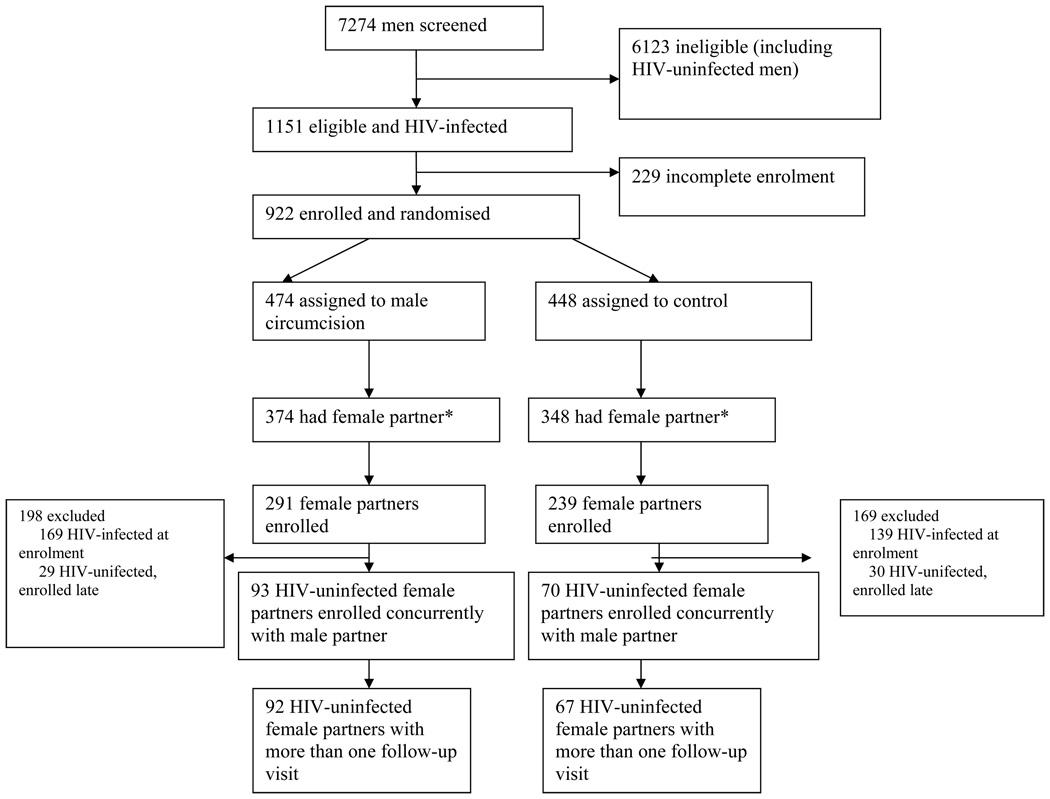
922 uncircumcised, HIV-infected, asymptomatic men aged 15-49 years with CD4-cell counts 350 cells per microL or more were enrolled in this unblinded, randomised controlled trial in Rakai District, Uganda. Men were randomly assigned by computer-generated randomisation sequence to receive immediate circumcision (intervention; n=474) or circumcision delayed for 24 months (control; n=448). HIV-uninfected female partners of the randomised men were concurrently enrolled (intervention, n=93; control, n=70) and followed up at 6, 12, and 24 months, to assess HIV acquisition by male treatment assignment (primary outcome). A modified intention-to-treat (ITT) analysis, which included all concurrently enrolled couples in which the female partner had at least one follow-up visit over 24 months, assessed female HIV acquisition by use of survival analysis and Cox proportional hazards modelling. This trial is registered with ClinicalTrials.gov, number NCT00124878.
The trial was stopped early because of futility. 92 couples in the intervention group and 67 couples in the control group were included in the modified ITT analysis. 17 (18%) women in the intervention group and eight (12%) women in the control group acquired HIV during follow-up (p=0.36). Cumulative probabilities of female HIV infection at 24 months were 21.7% (95% CI 12.7-33.4) in the intervention group and 13.4% (6.7-25.8) in the control group (adjusted hazard ratio 1.49, 95% CI 0.62-3.57; p=0.368).
Circumcision of HIV-infected men did not reduce HIV transmission to female partners over 24 months; longer-term effects could not be assessed. Condom use after male circumcision is essential for HIV prevention.
Bill & Melinda Gates Foundation with additional laboratory and training support from the National Institutes of Health and the Fogarty International Center.
观察性研究报告称,男性包皮环切术与降低女性性伴侣感染艾滋病毒的风险之间存在关联。我们评估了对感染艾滋病毒的男性进行包皮环切术是否会减少病毒向女性性伴侣的传播。
在乌干达拉凯区进行的这项非盲随机对照试验中,招募了922名年龄在15 - 49岁、未行包皮环切术、感染艾滋病毒且无症状、CD4细胞计数每微升350个细胞或更多的男性。通过计算机生成的随机序列将男性随机分配,以接受即刻包皮环切术(干预组;n = 474)或延迟24个月进行包皮环切术(对照组;n = 448)。随机分组男性的未感染艾滋病毒的女性性伴侣同时入组(干预组,n = 93;对照组,n = 70),并在6个月、12个月和24个月时进行随访,以根据男性治疗分配情况评估女性感染艾滋病毒情况(主要结局)。一种改良的意向性分析(ITT),包括所有同时入组且女性伴侣在24个月内至少有一次随访的夫妇,使用生存分析和Cox比例风险模型评估女性感染艾滋病毒情况。该试验已在ClinicalTrials.gov注册,编号为NCT00124878。
由于无效,试验提前终止。干预组92对夫妇和对照组67对夫妇纳入改良ITT分析。干预组17名(18%)女性和对照组8名(12%)女性在随访期间感染艾滋病毒(p = 0.36)。干预组24个月时女性感染艾滋病毒的累积概率为21.7%(95%CI 12.7 - 33.4),对照组为13.4%(6.7 - 25.8)(校正风险比1.49,95%CI 0.62 - 3.57;p = 0.368)。
对感染艾滋病毒的男性进行包皮环切术在24个月内并未减少向女性伴侣传播艾滋病毒;无法评估长期影响。男性包皮环切术后使用避孕套对于预防艾滋病毒至关重要。
比尔及梅琳达·盖茨基金会,美国国立卫生研究院和福格蒂国际中心提供额外的实验室和培训支持。