Lang Julie E, Magbanua Mark Jesus M, Scott Janet H, Makrigiorgos G Mike, Wang Gang, Federman Scot, Esserman Laura J, Park John W, Haqq Christopher M
Department of Surgery, UCSF Comprehensive Cancer Center, 1500 Divisadero Street, San Francisco, CA 94143, USA.
BMC Genomics. 2009 Jul 20;10:326. doi: 10.1186/1471-2164-10-326.
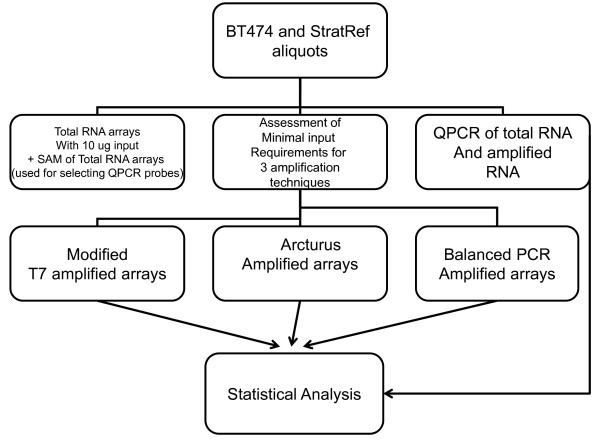
Gene expression profiling of small numbers of cells requires high-fidelity amplification of sub-nanogram amounts of RNA. Several methods for RNA amplification are available; however, there has been little consideration of the accuracy of these methods when working with very low-input quantities of RNA as is often required with rare clinical samples. Starting with 250 picograms-3.3 nanograms of total RNA, we compared two linear amplification methods 1) modified T7 and 2) Arcturus RiboAmp HS and a logarithmic amplification, 3) Balanced PCR. Microarray data from each amplification method were validated against quantitative real-time PCR (QPCR) for 37 genes.
For high intensity spots, mean Pearson correlations were quite acceptable for both total RNA and low-input quantities amplified with each of the 3 methods. Microarray filtering and data processing has an important effect on the correlation coefficient results generated by each method. Arrays derived from total RNA had higher Pearson's correlations than did arrays derived from amplified RNA when considering the entire unprocessed dataset, however, when considering a gene set of high signal intensity, the amplified arrays had superior correlation coefficients than did the total RNA arrays.
Gene expression arrays can be obtained with sub-nanogram input of total RNA. High intensity spots showed better correlation on array-array analysis than did unfiltered data, however, QPCR validated the accuracy of gene expression array profiling from low-input quantities of RNA with all 3 amplification techniques. RNA amplification and expression analysis at the sub-nanogram input level is both feasible and accurate if data processing is used to focus attention to high intensity genes for microarrays or if QPCR is used as a gold standard for validation.
对少量细胞进行基因表达谱分析需要对亚纳克量的RNA进行高保真扩增。有几种RNA扩增方法可供使用;然而,在处理极低输入量的RNA时(这在罕见临床样本中经常需要),很少有人考虑这些方法的准确性。从250皮克至3.3纳克的总RNA开始,我们比较了两种线性扩增方法:1)改良T7法和2)Arcturus RiboAmp HS法,以及一种对数扩增方法3)平衡PCR法。针对37个基因,将每种扩增方法得到的微阵列数据与定量实时PCR(QPCR)进行验证。
对于高强度斑点,三种方法对总RNA和低输入量RNA扩增得到的平均皮尔逊相关性都相当不错。微阵列过滤和数据处理对每种方法产生的相关系数结果有重要影响。在考虑整个未处理数据集时,来自总RNA的阵列比来自扩增RNA的阵列具有更高的皮尔逊相关性,然而,在考虑高信号强度的基因集时,扩增后的阵列比总RNA阵列具有更好的相关系数。
使用亚纳克量的总RNA输入可获得基因表达阵列。高强度斑点在阵列间分析中显示出比未过滤数据更好的相关性,然而,QPCR验证了使用所有三种扩增技术从低输入量RNA进行基因表达阵列分析的准确性。如果使用数据处理来关注微阵列的高强度基因,或者如果使用QPCR作为验证的金标准,那么在亚纳克输入水平进行RNA扩增和表达分析是可行且准确的。