Bouyou-Akotet Marielle K, Dzeing-Ella Arnaud, Kendjo Eric, Etoughe Diane, Ngoungou Edgard B, Planche Timothy, Koko Jean, Kombila Maryvonne
Department of Parasitology, Mycology and Tropical Medicine, Faculty of Medicine, Université des Sciences de la Santé (USS), Libreville-Gabon, Malaria Clinical Research Unit, Centre Hospitalier de Libreville, Gabon.
Malar J. 2009 Jul 20;8:166. doi: 10.1186/1475-2875-8-166.
Improving the understanding of childhood malarial anaemia may help in the design of appropriate management strategies.
A prospective observational study over a two-year period to assess the burden of anaemia and its relationship to Plasmodium falciparum infection and age was conducted in 8,195 febrile Gabonese children.
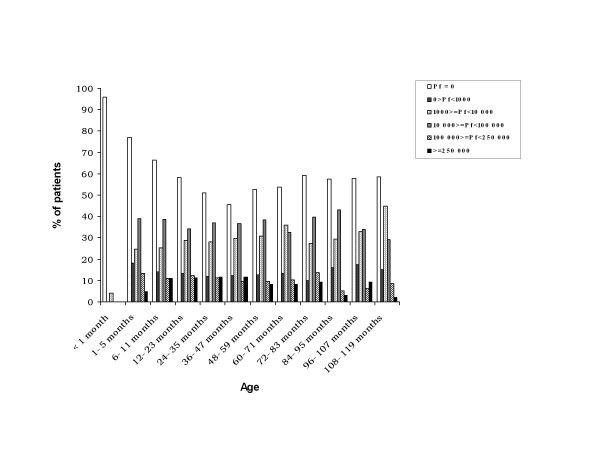
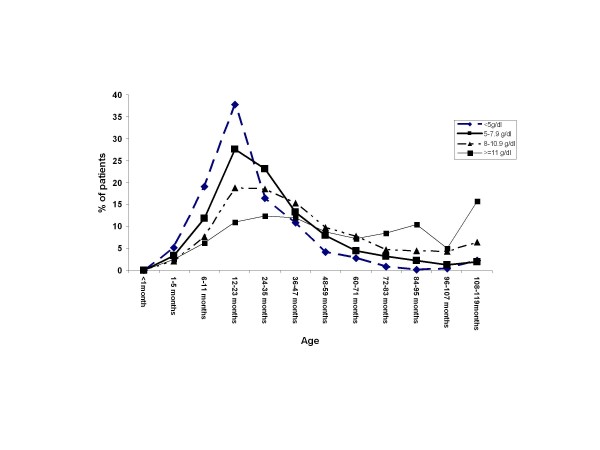
The proportion of children with anaemia was 83.6% (n = 6830), higher in children between the ages of six and 23 months. Those under three years old were more likely to develop moderate to severe anaemia (68%). The prevalence of malaria was 42.7% and P. falciparum infection was more frequent in children aged 36-47 months (54.5%). The proportion of anaemic children increased with parasite density (p < 0.01). Most of infected children were moderately to severely anaemic (69.5%, p < 0.01). Infants aged from one to 11 months had a higher risk of developing severe malarial anaemia. In children over six years of age, anaemia occurrence was high (>60%), but was unrelated to P. falciparum parasitaemia.
Malaria is one of the main risk factors for childhood anaemia which represents a public health problem in Gabon. The risk of severe malarial anaemia increases up the age of three years. Efforts to improve strategies for controlling anaemia and malaria are needed.
增进对儿童疟疾性贫血的了解可能有助于制定适当的管理策略。
对8195名发热的加蓬儿童进行了为期两年的前瞻性观察研究,以评估贫血负担及其与恶性疟原虫感染和年龄的关系。
贫血儿童的比例为83.6%(n = 6830),在6至23个月大的儿童中更高。三岁以下儿童更易发展为中度至重度贫血(68%)。疟疾患病率为42.7%,恶性疟原虫感染在36 - 47个月大的儿童中更为常见(54.5%)。贫血儿童的比例随寄生虫密度增加而升高(p < 0.01)。大多数感染儿童为中度至重度贫血(69.5%,p < 0.01)。1至11个月大的婴儿发生严重疟疾性贫血的风险更高。在六岁以上儿童中,贫血发生率很高(>60%),但与恶性疟原虫血症无关。
疟疾是儿童贫血的主要危险因素之一,贫血在加蓬是一个公共卫生问题。严重疟疾性贫血的风险在三岁前会增加。需要努力改进控制贫血和疟疾的策略。