Immunosciences Lab., Inc., Los Angeles, CA 90035, USA.
Evid Based Complement Alternat Med. 2011;2011:927294. doi: 10.1093/ecam/nep062. Epub 2011 Jun 16.
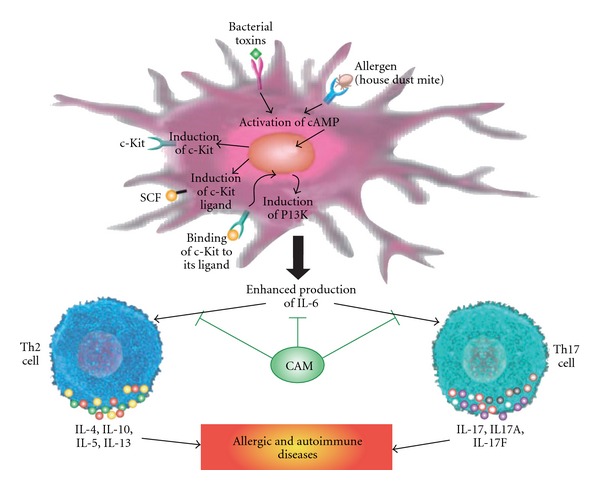
CD4(+) effector cells, based on cytokine production, nuclear receptors and signaling pathways, have been categorized into four subsets. T-helper-1 cells produce IFN-γ, TNF-β, lymphotoxin and IL-10; T-helper-2 cells produce IL-4, IL-5, IL-10, IL-13, IL-21 and IL-31; T-helper-3, or regulatory T-cells, produce IL-10, TGF-β and IL-35; and the recently discovered T-helper-17 cell produces IL-17, IL-17A, IL-17F, IL-21, IL-26 and CCL20. By producing IL-17 and other signaling molecules, Th17 contributes to the pathogenesis of multiple autoimmune diseases including allergic inflammation, rheumatoid arthritis, autoimmune gastritis, inflammatory bowel disease, psoriasis and multiple sclerosis. In this article, we review the differential regulation of inflammation in different tissues with a major emphasis on enhancement of neuroinflammation by local production of IL-17 in the brain. By understanding the role of pathogenic factors in the induction of autoimmune diseases by Th17 cells, CAM practitioners will be able to design CAM therapies targeting Th17 and associated cytokine activities and signaling pathways to repair the intestinal and blood-brain barriers for their patients with autoimmunities, in particular, those with neuroinflammation and neurodegeneration.
CD4(+)效应细胞根据细胞因子产生、核受体和信号通路被分为四个亚群。辅助性 T 细胞 1 产生 IFN-γ、TNF-β、淋巴毒素和 IL-10;辅助性 T 细胞 2 产生 IL-4、IL-5、IL-10、IL-13、IL-21 和 IL-31;辅助性 T 细胞 3,或调节性 T 细胞,产生 IL-10、TGF-β 和 IL-35;最近发现的辅助性 T 细胞 17 产生 IL-17、IL-17A、IL-17F、IL-21、IL-26 和 CCL20。通过产生 IL-17 和其他信号分子,Th17 有助于多种自身免疫性疾病的发病机制,包括过敏炎症、类风湿关节炎、自身免疫性胃炎、炎症性肠病、银屑病和多发性硬化症。在本文中,我们综述了不同组织中炎症的差异调节,重点强调了大脑中局部产生的 IL-17 增强神经炎症的作用。通过了解致病性因素在 Th17 细胞诱导自身免疫性疾病中的作用,补充和替代医学从业者将能够设计针对 Th17 及其相关细胞因子活性和信号通路的 CAM 治疗方法,为自身免疫患者,特别是那些具有神经炎症和神经退行性变的患者,修复肠道和血脑屏障。