Laboratory for Neuronal Circuit Dynamics, RIKEN Brain Science Institute Wako-Shi, Japan.
Front Mol Neurosci. 2009 Jun 22;2:5. doi: 10.3389/neuro.02.005.2009. eCollection 2009.
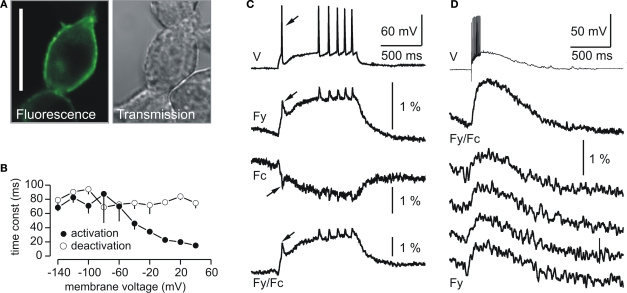
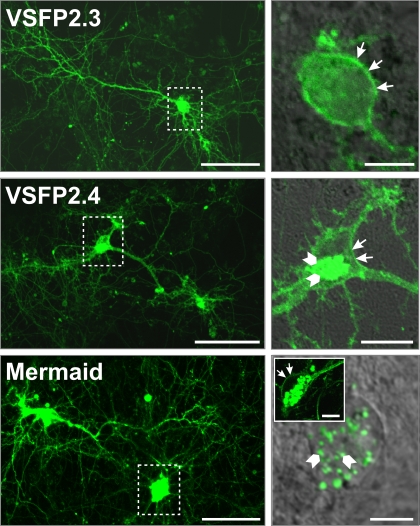
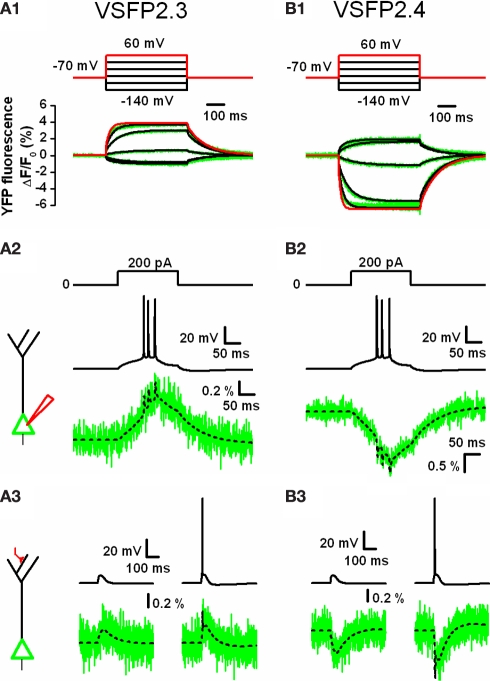
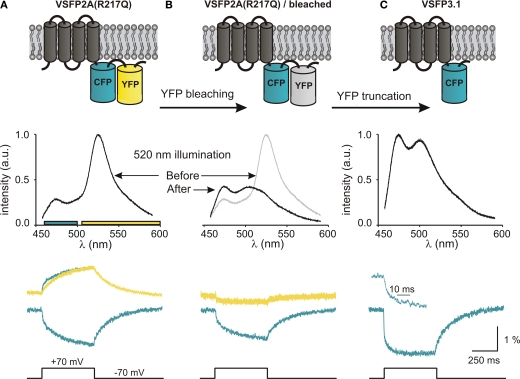
Over the last decade, optical neuroimaging methods have been enriched by engineered biosensors derived from fluorescent protein (FP) reporters fused to protein detectors that convert physiological signals into changes of intrinsic FP fluorescence. These FP-based indicators are genetically encoded, and hence targetable to specific cell populations within networks of heterologous cell types. Among this class of biosensors, the development of optical probes for membrane potential is both highly desirable and challenging. A suitable FP voltage sensor would indeed be a valuable tool for monitoring the activity of thousands of individual neurons simultaneously in a non-invasive manner. Previous prototypic genetically-encoded FP voltage indicators achieved a proof of principle but also highlighted several difficulties such as poor cell surface targeting and slow kinetics. Recently, we developed a new series of FRET-based Voltage-Sensitive Fluorescent Proteins (VSFPs), referred to as VSFP2s, with efficient targeting to the plasma membrane and high responsiveness to membrane potential signaling in excitable cells. In addition to these FRET-based voltage sensors, we also generated a third series of probes consisting of single FPs with response kinetics suitable for the optical imaging of fast neuronal signals. These newly available genetically-encoded reporters for membrane potential will be instrumental for future experimental approaches directed toward the understanding of neuronal network dynamics and information processing in the brain. Here, we review the development and current status of these novel fluorescent probes.
在过去的十年中,光学神经影像学方法通过源自荧光蛋白 (FP) 报告基因的工程生物传感器得到了丰富,这些生物传感器融合了将生理信号转化为内在 FP 荧光变化的蛋白探测器。这些基于 FP 的指示剂是基因编码的,因此可以靶向异源细胞类型网络中的特定细胞群体。在这类生物传感器中,开发用于膜电位的光学探针既非常需要,又极具挑战性。合适的 FP 电压传感器确实是一种非常有价值的工具,可以非侵入性地同时监测数千个单个神经元的活动。以前的原型基因编码 FP 电压指示剂已经证明了这一原理,但也凸显了一些困难,例如细胞表面靶向性差和动力学缓慢。最近,我们开发了一系列新的基于 FRET 的电压敏感荧光蛋白(VSFP),称为 VSFP2,它们可以有效地靶向质膜,并对兴奋细胞中的膜电位信号具有高响应性。除了这些基于 FRET 的电压传感器,我们还生成了第三个探针系列,由具有适合快速神经元信号光学成像的响应动力学的单个 FP 组成。这些新的可用于膜电位的基因编码报告基因将成为未来实验方法的重要工具,这些方法旨在理解大脑中的神经元网络动态和信息处理。在这里,我们回顾了这些新型荧光探针的发展和现状。