Clancy Sinead M, Chen Bihan, Bertaso Federica, Mamet Julien, Jegla Timothy
Department of Cell Biology, Institute for Childhood and Neglected Diseases, The Scripps Research Institute, La Jolla, CA, USA.
PLoS One. 2009 Jul 22;4(7):e6330. doi: 10.1371/journal.pone.0006330.
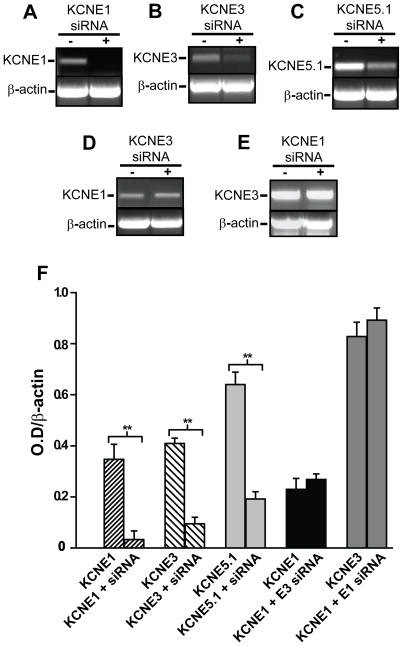
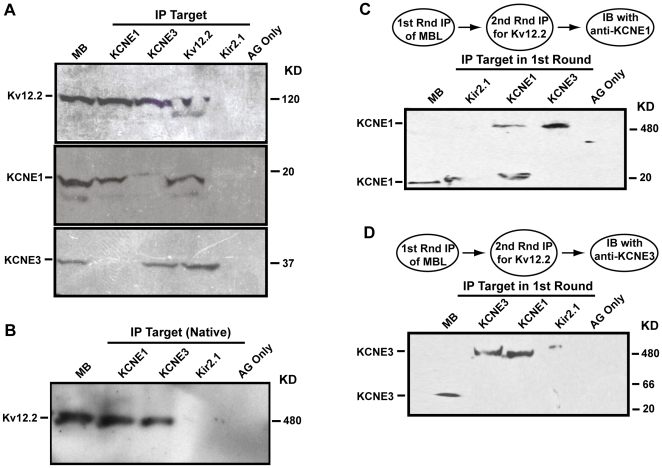
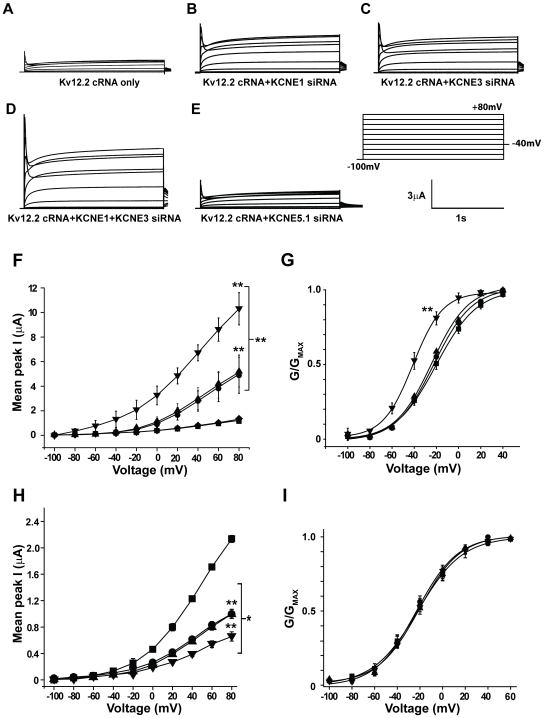
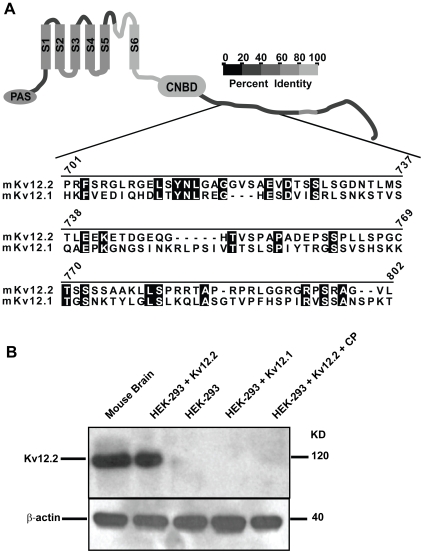
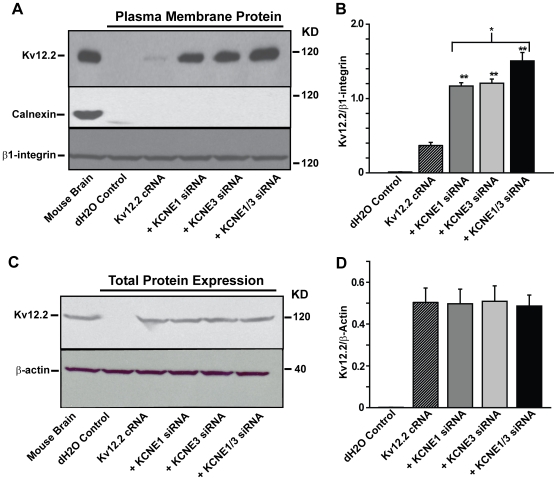
Voltage-gated potassium channels that activate near the neuronal resting membrane potential are important regulators of excitation in the nervous system, but their functional diversity is still not well understood. For instance, Kv12.2 (ELK2, KCNH3) channels are highly expressed in the cerebral cortex and hippocampus, and although they are most likely to contribute to resting potassium conductance, surprisingly little is known about their function or regulation. Here we demonstrate that the auxiliary MinK (KCNE1) and MiRP2 (KCNE3) proteins are important regulators of Kv12.2 channel function. Reduction of endogenous KCNE1 or KCNE3 expression by siRNA silencing, significantly increased macroscopic Kv12.2 currents in Xenopus oocytes by around 4-fold. Interestingly, an almost 9-fold increase in Kv12.2 currents was observed with the dual injection of KCNE1 and KCNE3 siRNA, suggesting an additive effect. Consistent with these findings, over-expression of KCNE1 and/or KCNE3 suppressed Kv12.2 currents. Membrane surface biotinylation assays showed that surface expression of Kv12.2 was significantly increased by KCNE1 and KCNE3 siRNA, whereas total protein expression of Kv12.2 was not affected. KCNE1 and KCNE3 siRNA shifted the voltages for half-maximal activation to more hyperpolarized voltages, indicating that KCNE1 and KCNE3 may also inhibit activation gating of Kv12.2. Native co-immunoprecipitation assays from mouse brain membranes imply that KCNE1 and KCNE3 interact with Kv12.2 simultaneously in vivo, suggesting the existence of novel KCNE1-KCNE3-Kv12.2 channel tripartite complexes. Together these data indicate that KCNE1 and KCNE3 interact directly with Kv12.2 channels to regulate channel membrane trafficking.
在神经元静息膜电位附近激活的电压门控钾通道是神经系统兴奋的重要调节因子,但其功能多样性仍未得到充分了解。例如,Kv12.2(ELK2,KCNH3)通道在大脑皮层和海马体中高度表达,尽管它们很可能对静息钾电导有贡献,但令人惊讶的是,对其功能或调节知之甚少。在这里,我们证明辅助蛋白MinK(KCNE1)和MiRP2(KCNE3)是Kv12.2通道功能的重要调节因子。通过小干扰RNA(siRNA)沉默降低内源性KCNE1或KCNE3的表达,可使非洲爪蟾卵母细胞中的宏观Kv12.2电流显著增加约4倍。有趣的是,同时注射KCNE1和KCNE3的siRNA时,观察到Kv12.2电流增加了近9倍,表明存在累加效应。与这些发现一致,KCNE1和/或KCNE3的过表达抑制了Kv12.2电流。膜表面生物素化分析表明,KCNE1和KCNE3的siRNA显著增加了Kv12.2的表面表达,而Kv12.2的总蛋白表达不受影响。KCNE1和KCNE3的siRNA将半数最大激活电压移向更超极化的电压,表明KCNE1和KCNE3也可能抑制Kv12.2的激活门控。从小鼠脑膜进行的天然免疫共沉淀分析表明,KCNE1和KCNE3在体内与Kv12.2同时相互作用,提示存在新型的KCNE1-KCNE3-Kv12.2通道三方复合物。这些数据共同表明,KCNE1和KCNE3直接与Kv12.2通道相互作用以调节通道膜转运。