Chang Anne-Marie, Reid Kathryn J, Gourineni Ramadevi, Zee Phyllis C
Harvard Medical School, Brigham and Women's Hospital, Department of Medicine, Boston, MA 02115, USA.
J Biol Rhythms. 2009 Aug;24(4):313-21. doi: 10.1177/0748730409339611.
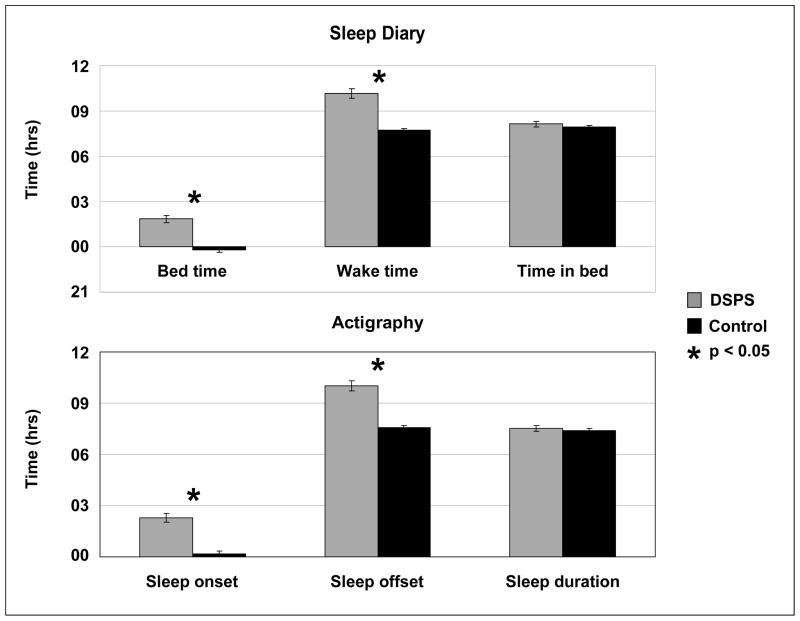
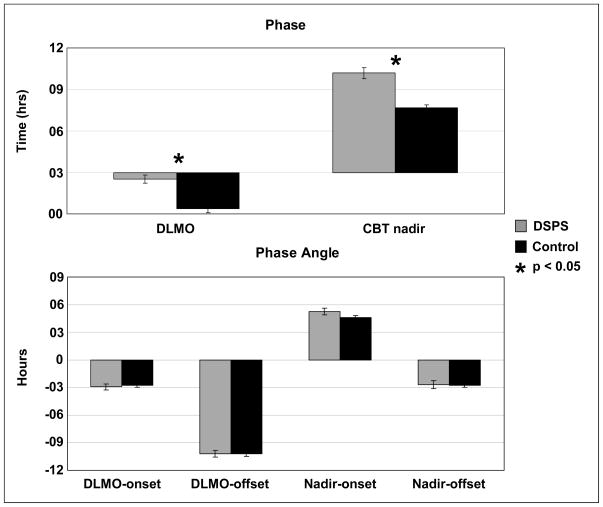
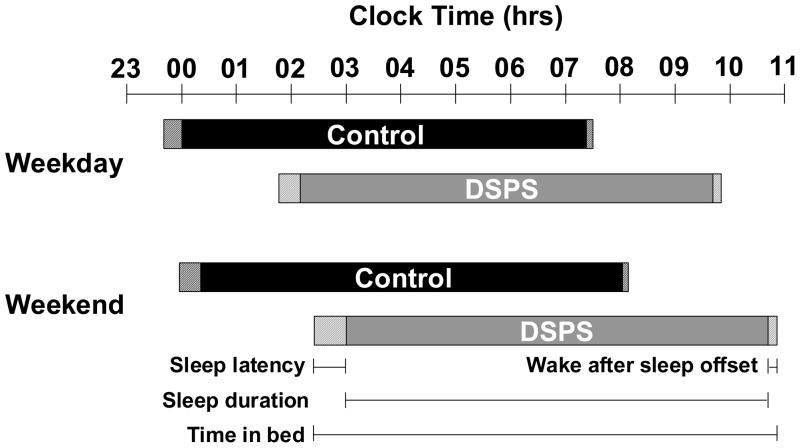
Delayed sleep phase syndrome (DSPS) is a circadian rhythm sleep disorder in which the timing of the sleep episode occurs later than desired and is associated with difficulty falling asleep, problems awakening on time (e.g., to meet work or school obligations), and daytime sleepiness. The phase relationship between the timing of sleep and endogenous circadian rhythms is critical to the initiation and maintenance of sleep, and significant alteration leads to impairment of sleep quality and duration. The aim of this retrospective study was to determine the phase relationship between sleep-wake times and physiological markers of circadian timing in clinic patients with DSPS. Objective and subjective measures of sleep timing and circadian phase markers (core body temperature and melatonin) were measured in patients with DSPS and compared with age-matched controls. As expected, significant delays in the timing of the major sleep episode and circadian phase of body temperature and melatonin rhythms were seen in the DSPS group when allowed to sleep at their own habitual schedules, but the phase relationship between sleep-wake times and circadian phase was similar between the 2 groups. These results suggest that the symptoms of insomnia and excessive daytime sleepiness in DSPS patients living under entrained real-life conditions cannot be explained by an alteration in the phase relationship between sleep-wake patterns and other physiological circadian rhythms.
睡眠时相延迟综合征(DSPS)是一种昼夜节律性睡眠障碍,其睡眠时段比期望的时间晚,与入睡困难、按时醒来(如满足工作或上学需求)的问题以及日间嗜睡有关。睡眠时间与内源性昼夜节律之间的相位关系对于睡眠的起始和维持至关重要,显著改变会导致睡眠质量和时长受损。这项回顾性研究的目的是确定DSPS临床患者的睡眠-觉醒时间与昼夜节律生理标志物之间的相位关系。对DSPS患者的睡眠时间和昼夜节律相位标志物(核心体温和褪黑素)进行了客观和主观测量,并与年龄匹配的对照组进行比较。正如预期的那样,当允许DSPS组患者按照其习惯的时间表睡眠时,主要睡眠时段以及体温和褪黑素节律的昼夜节律相位出现了显著延迟,但两组之间睡眠-觉醒时间与昼夜节律相位之间的相位关系相似。这些结果表明,在现实生活中处于同步状态的DSPS患者出现的失眠和日间过度嗜睡症状,不能用睡眠-觉醒模式与其他生理昼夜节律之间的相位关系改变来解释。